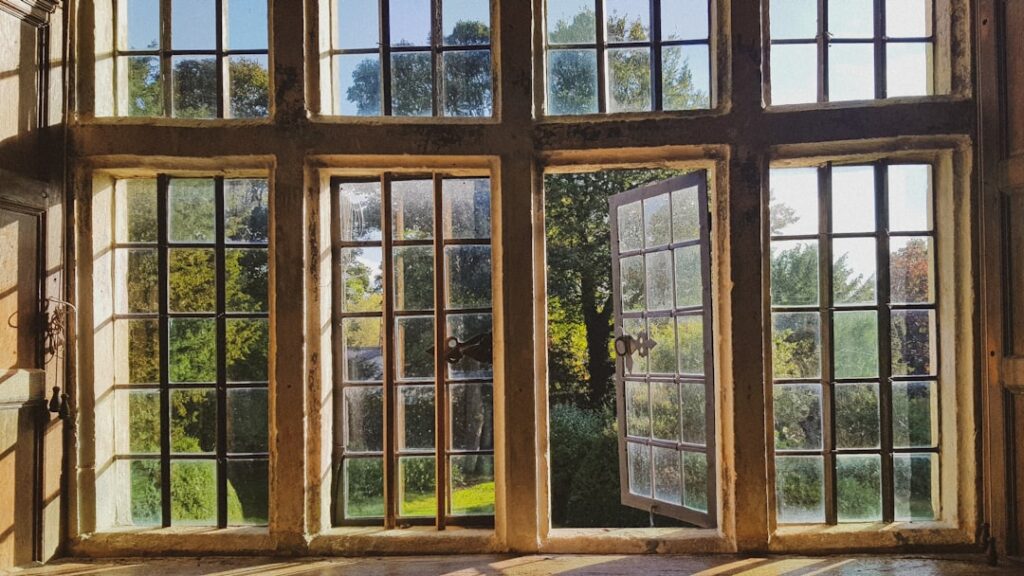
Open both sashes of a French casement and the entire window disappears — no center post, no interruption, just a clean rectangle of air and view. That absent mullion is the defining trick of french casement windows: two crank- or push-out sashes that meet in the middle and seal against each other instead of against a fixed vertical member. The effect is part window, part miniature French door, which is exactly where the name comes from. Specifying french casement windows involves some particulars regular casements skip — astragal seals, sash-sequencing hardware, width limits — and this guide covers the style, the specs, and the honest tradeoffs.
How the No-Post Design Actually Works
A standard pair of casements shares a structural mullion between them; each sash locks into that post. A French casement deletes the post and gives one sash (the “active” or primary) an astragal — a weatherstripped vertical leg attached to its meeting edge. Close the secondary sash first, then the primary, and the astragal laps over the joint, compressing gaskets between the two sashes to seal the meeting line. Multi-point locks on each sash pull everything tight to the frame at top and bottom, and the astragal handles the middle. Done well, the assembly tests nearly as airtight as a single casement; done cheaply, the meeting line is the leak. This is why French casements reward buying from manufacturers with mature hardware rather than the budget aisle.
Operation comes in two flavors: dual cranks (one operator per sash, the American norm) and push-out (lever-latched sashes you simply swing open by hand, the European tradition, usually paired with friction hinges that hold any position). Push-out feels wonderful and looks period-correct; cranks win over kitchen sinks and anywhere a screen must sit inside.
Why People Choose Them
- Unbroken view and airflow: a 48-inch French casement opens essentially 100 percent of its frame area — no other operable window type matches that clear-opening fraction
- Egress performance: the full-width clear opening makes French casements a favored solution for bedroom egress in small openings; a unit as narrow as about 36 inches wide can meet the 5.7-square-foot requirement that would fail as a single casement or double-hung
- Ventilation control: open the leeward sash to draw air, both to scoop it; the paired sashes act like little wind rudders
- Style: cottage, farmhouse, French provincial, and Tudor elevations all predate the picture window; French casements restore the proportions those facades were drawn around
Sizes and Practical Limits
Physics sets the envelope. Each sash hangs from side hinges and meets its partner with no post to stiffen the span, so manufacturers cap widths conservatively. Typical catalog ranges: overall widths from 32 to about 72 inches (16-to-36-inch individual sashes), heights from 24 to 72 inches, with custom sizing in 1/8-inch increments from the wood and fiberglass makers. Past roughly 6 feet wide or 6 feet tall, you are into paired French units or a French casement flanked by fixed panels. Sash weight is the quiet constraint — a 30-by-60 triple-pane sash carries serious glass, and friction hinges or heavy-duty operators become mandatory. When a dealer steers you from triple-pane on a big French unit, that is why.
- Common overall widths: 32-72 inches; heights 24-72 inches
- Clear opening: nearly the full frame width — the egress superpower
- Weight-driven upgrades: reinforced hinges above ~28-inch sashes, especially triple-pane
Materials, Glass, and Grille Choices
Frame options track regular casements — vinyl (limited availability in true French configuration), fiberglass, composite, clad wood, and all-wood for restoration work — but the market skews premium: clad wood and fiberglass dominate because the style itself is a premium choice. Glass packages are the standard menu: double-pane low-E argon at U-0.27 to 0.30, triple-pane at U-0.18 to 0.22 where weight allows. Grilles deserve real thought here, since the style is the point. Simulated divided lites (SDL) with bars adhered to both glass faces read correctly in a way grilles-between-glass never quite do; a classic French pattern runs two-wide by three-high lites per sash. Budget $50 to $200 per sash for SDL and consider it money well spent on a street-facing elevation.
What They Cost
Expect a premium of roughly 30 to 60 percent over an equivalent pair of standard casements, driven by the astragal engineering and doubled hardware. Real numbers per opening, installed: vinyl and entry-level composite French casements where available run $900 to $1,400; fiberglass and mid-tier clad wood, $1,300 to $2,200; premium clad-wood lines with SDL grilles and custom sizing, $2,000 to $3,500-plus. Marvin, Andersen (in its wood lines), Pella, Kolbe, and Sierra Pacific all catalog true French casements; among vinyl makers the configuration is scarcer, so widen the search to regional fiberglass brands before settling. Installation itself prices like any casement — $150 to $400 labor per insert opening, more for full-frame — because the unit arrives as one factory-assembled frame.
Weather Performance and the Honest Tradeoffs
Order of operations matters daily: the secondary sash must close first so the astragal laps correctly, and family members will get this wrong for the first month. Air and water ratings on quality units land close to single casements — look for the same AL 0.1-to-0.2 cfm/ft² and DP/PG ratings appropriate to your wind zone — but bargain French casements miss those numbers at the meeting stile, so demand the tested ratings sheet, not brochure adjectives. Other tradeoffs to weigh: two sashes mean two sets of hardware to maintain; screens complicate push-out versions (they mount inside, hinged or magnetic); and open sashes project into whatever is outside, so avoid the style over walkways, decks with traffic, or tight side yards — the same rule as any outswing window, doubled.
Where They Fit Best in a Real House
Three placements earn the premium most often on my jobs. Over kitchen sinks, where the crank versions open fully without a center post blocking the pass-through view, and where handing hardly matters since both sashes operate. Small bedrooms in older homes, where egress compliance in a 36-to-40-inch opening would otherwise force an ugly oversized single casement. And street-facing elevations of cottage and farmhouse designs, where a pair of two-by-three-lite French casements does more for curb appeal per dollar than nearly any facade spend. Conversely, skip the style on large modern openings (a single big casement or fixed-plus-awning combination is cleaner and cheaper) and on rental properties, where the sequencing hardware will be abused.
Maintenance Particulars of the Two-Sash Design
Owning a French casement adds one component to the usual care list: the astragal gasket along the meeting edge, which does the sealing work a mullion would otherwise do. Inspect it each fall — run a dollar bill between closed sashes at three heights and feel for drag; sections that pull free without resistance mean compressed gasket, replaceable in most lines as a slide-in strip for $15 to $30. Beyond that, the routine mirrors any casement doubled: silicone-spray the hinges and operators of both sashes annually, snug the multi-point lock keepers if either sash starts needing a shove, and wash grit off the weatherstrip so the compression faces stay smooth. Teach everyone the closing order (secondary first, primary over it) and put a small label inside the jamb for guests; half the astragal damage dealers see comes from someone muscling the sashes shut in the wrong sequence.
Buying Checklist
- Confirm true French casement (no fixed mullion) on the quote — some dealers loosely use the term for mulled pairs
- Get tested AL and DP ratings for the exact configuration and size, not the line generally
- Choose crank vs. push-out deliberately; verify screen solution in person
- Check egress math on bedroom units — clear width, clear height, square footage with both sashes open
- Specify SDL grilles for visible elevations; view a corner sample first
- Verify hinge duty rating against your sash size and glass package
- Ask hardware warranty terms — astragal gaskets and operators are the wear items
A French casement is one of the few window choices that changes how a room feels every single day it is open. Pay for good hardware, respect the width limits, and teach the household which sash closes first, and the post-free view earns its premium for decades.