The wide, wire-brushed European oak floors filling design magazines usually cost $12 to $20 per square foot in real hardwood, which puts them out of reach for most renovations. That is exactly the gap French oak LVP fills, recreating the long planks, soft matte finish, and layered graining of genuine French oak in a waterproof luxury vinyl plank that installs over almost anything and costs a fraction as much. The look has exploded in popularity because it reads as high-end and old-world while shrugging off spills, pets, and kids in a way solid oak never could. Choosing a good one, though, means looking past the pretty photo to the core, the wear layer, and the plank size.
Here is what separates convincing French oak LVP from a cheap imitation, and how to buy the right one for your home.
- What Makes It French Oak
- Understanding the Core: SPC vs WPC
- Wear Layer: The Number That Matters Most
- Plank Size and the French Oak Look
- What French Oak LVP Costs
- Installation and Care
- French Oak LVP vs. Real Hardwood and Laminate
- Common Installation Mistakes to Avoid
- Matching French Oak LVP to Your Decor
- Common Installation Mistakes to Avoid
- Final Thoughts
What Makes It French Oak
French oak is prized for its tight grain, subtle character, and the way it takes a muted, driftwood-style finish. Luxury vinyl plank mimics this with a high-resolution printed image layer and, on better products, an embossed-in-register texture that aligns the surface grain with the printed grain so it feels like real wood underhand.
The signature French oak look leans on a few cues: long, wide planks; a matte or low-sheen finish; wire-brushed texture; and multi-tonal coloring in warm honey, greige, and pale blond. The best LVP lines vary the plank images across the box so you do not see the same pattern repeat every few rows, which is the giveaway of a budget product.
Understanding the Core: SPC vs WPC
The core is the heart of any LVP, and French oak styles come in both main types.
SPC (stone plastic composite)
SPC cores blend limestone and PVC into a dense, rigid plank that is extremely dimensionally stable and dent-resistant. It feels firmer underfoot and handles heavy furniture and temperature swings well, making it my default for sunrooms and rentals. Planks are typically thinner, around 4 to 6 millimeters.
WPC (wood plastic composite)
WPC cores use a foamed composite that feels warmer and softer underfoot, with a bit more give and sound absorption. It runs thicker, often 5 to 8 millimeters, and suits living areas and bedrooms where comfort matters.
For French oak looks in busy households, I usually recommend SPC for its toughness, reserving WPC for spaces where underfoot comfort trumps maximum dent resistance.
Wear Layer: The Number That Matters Most
The wear layer is the clear top coating that resists scratches and traffic, measured in mils. It is the single best predictor of how long the floor lasts.
- 6 mil: Light residential use only, such as a guest bedroom.
- 12 mil: Solid for most homes and normal family traffic.
- 20 mil: Heavy residential and light commercial, ideal for pets, kids, and busy entries.
- 28 mil and up: Commercial-grade durability.
For a main-floor French oak LVP that has to look good for years, spring for a 20-mil wear layer. The upcharge over 12 mil is small and the scratch resistance is noticeably better.
Plank Size and the French Oak Look
Wide, long planks are essential to the European oak aesthetic. Standard LVP often measures 6 inches by 48 inches, but French oak styles shine in wider and longer formats, commonly 7 to 9 inches wide and 48 to 60 inches long. The extra width reduces the number of seams and reads as more authentic and more expensive.
Beveled or micro-beveled edges add to the effect by defining each plank the way a real wood floor shows its boards. In a large open room, wide long planks make the space feel more expansive, while narrow planks can look busy.
What French Oak LVP Costs
Pricing spans a wide range based on core, wear layer, and brand.
- Budget LVP: $2 to $3 per square foot, thinner wear layers and more repetition.
- Mid-grade: $3 to $5 per square foot, 12 to 20 mil, convincing French oak visuals.
- Premium lines: $5 to $8 per square foot, thick wear layers, attached pad, and realistic embossing.
Professional installation adds $1.50 to $4 per square foot. Even at the premium end, French oak LVP lands well below the installed cost of real French oak hardwood, which is much of its appeal.
Installation and Care
Most French oak LVP uses a click-lock floating installation that a confident DIYer can handle. Let the planks acclimate in the room for 48 hours, start from the longest wall, stagger end joints at least 6 inches, and leave a 1/4-inch expansion gap around the perimeter. A flat, clean, dry subfloor is essential; rigid SPC bridges minor imperfections better than thinner glue-down vinyl, but low spots over 3/16 inch still need leveling.
Care is simple: sweep or vacuum on the hard-floor setting, damp-mop with a pH-neutral cleaner, and skip steam mops and abrasive pads. Felt pads under furniture and mats at entries protect the wear layer and keep the matte finish looking new for years.
French Oak LVP vs. Real Hardwood and Laminate
Shoppers usually weigh French oak LVP against two alternatives, and the trade-offs are clear once you line them up. Genuine French oak hardwood delivers unmatched authenticity and can be refinished several times, but it costs $12 to $20 per square foot installed, scratches and dents, and cannot go in bathrooms, basements, or over radiant slabs without risk of warping. Laminate mimics wood cheaply at $1 to $3 per square foot and resists scratching well, but its fiberboard core swells permanently if water sits on a seam, ruling it out for wet areas. French oak LVP splits the difference: it is fully waterproof, dent-resistant with a rigid SPC core, and installs anywhere in the home, though it cannot be sanded and refinished the way solid wood can. For kitchens, baths, basements, and homes with kids and pets, the waterproof durability of LVP wins; for a formal main floor where you want a lifetime heirloom surface and refinishing potential, real oak still holds an edge.
Common Installation Mistakes to Avoid
Most LVP failures trace back to a handful of avoidable errors. Skipping acclimation is the biggest, since planks installed straight off a cold truck can contract and open gaps at the seams a week later. An uneven subfloor is the next culprit; anything worse than 3/16 inch over 10 feet telegraphs through the planks and stresses the locking joints, so grind high spots and fill low ones before you start. Forgetting the 1/4-inch perimeter expansion gap causes the whole floor to buckle in summer heat, and running planks in a repeating stair-step pattern with short end joints looks artificial and weakens the layout. Finally, never install rigid-core LVP over a soft, thick carpet pad or a spongy underlayment, which lets the joints flex and separate. Prep the subfloor flat and dry, acclimate 48 hours, stagger joints randomly by at least 6 to 8 inches, and leave the expansion gap, and the floor will stay tight for decades.
Matching French Oak LVP to Your Decor
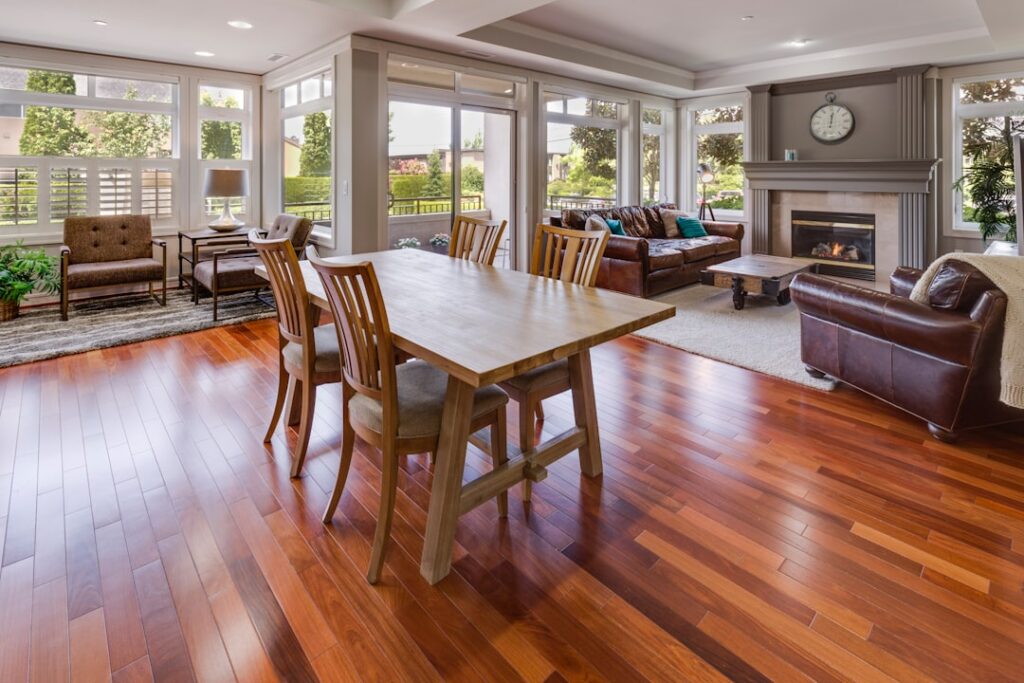
The exact shade you choose sets the room’s entire tone. Pale, whitewashed blond planks brighten small or north-facing rooms and suit coastal, Scandinavian, and modern-farmhouse interiors. Warm honey and caramel tones read traditional and cozy, pairing well with wood cabinetry and warm paint colors. Smoky greige, a gray-beige blend, is the current designer favorite because it stays neutral against nearly any wall color and hides dust and pet hair better than very light or very dark floors. Bring home samples and view them next to your cabinets, trim, and wall colors in both daylight and evening light before committing, since undertones shift dramatically under different lighting. Plan transitions early, too: most makers sell matching quarter-round, T-molding, and stair-nose pieces in coordinating colors for a finished, built-in look.
Common Installation Mistakes to Avoid
Even a forgiving floating floor can go wrong, and a few recurring errors ruin otherwise good installs. Skipping the expansion gap tops the list, because rigid-core planks expand and contract with temperature and a floor butted tight to the wall will buckle or peak at the seams. Failing to flatten the subfloor is next; humps and dips telegraph through the planks and stress the joints, so grind high spots and fill low ones to within 3/16 inch over 10 feet. Installing over an untested, damp concrete slab invites failure even though rigid vinyl tolerates moisture better than wood. Finally, poor plank staggering, lining up end joints or repeating the box pattern, creates an artificial look that undercuts the natural French oak effect. Take your time on prep and layout and the floor will look and perform like professional work.
Final Thoughts
French oak LVP is the rare upgrade that captures a genuinely high-end, old-world hardwood look while beating it on waterproofing, durability, and price. Choose an SPC or WPC core based on how the room is used, insist on at least a 20-mil wear layer for main living areas, and favor wide, long, beveled planks to sell the authentic European oak effect. Get those details right and you get a floor that looks like it belongs in a design magazine yet handles real life, all without the fragility and expense of the solid wood it so convincingly imitates.
Prefer to explore on your own?
See how new flooring looks in your actual room in seconds — free, no signup.
Try the free Floor Studio →