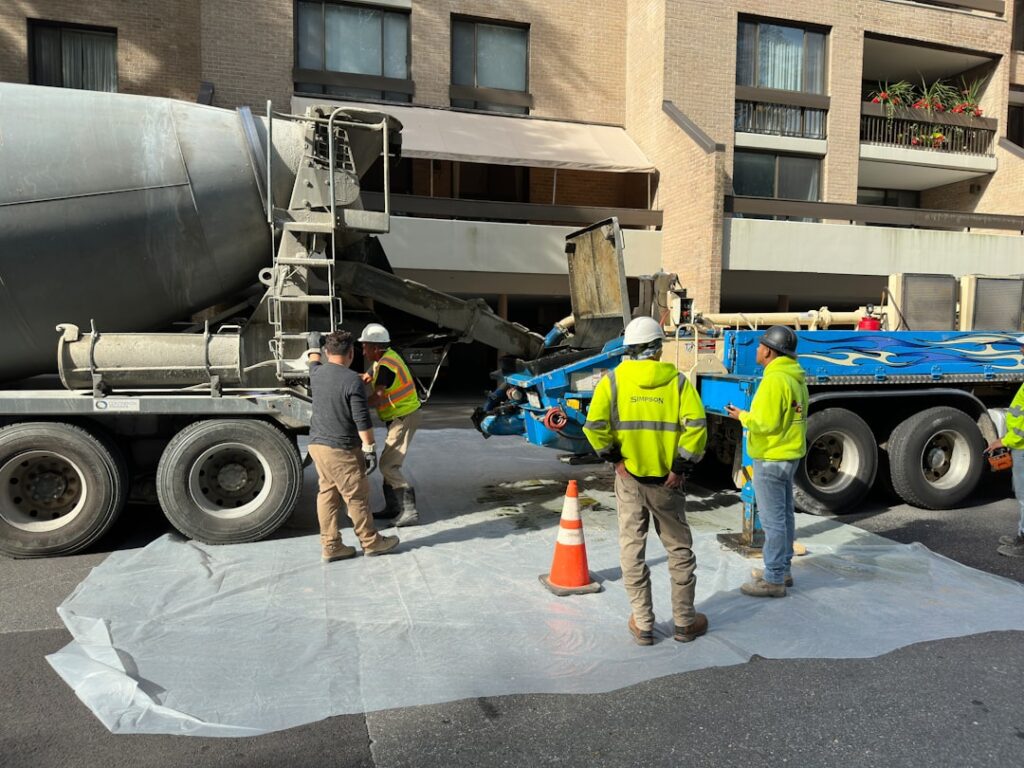
Watch a residential pour in the Midwest and odds are good the mixer backing onto the site isn’t backing at all — it’s driving straight in, nose first, with the chute hanging over the front bumper. The front discharge concrete truck flips the classic mixer layout: the drum unloads toward the cab, the driver places concrete with joystick controls from the seat, and the whole operation runs with one person who never loses sight of the chute. For homeowners scheduling a driveway or slab pour, knowing how these trucks work — and what they need from your site — can save a wasted delivery fee and a torn-up lawn.
How the Design Works
Mechanically, a front discharge mixer carries the same rotating drum as any ready-mix truck — 8 to 15 cubic yards of capacity, spiral fins inside that agitate in one rotation direction and discharge in the other. The differences are packaging. The drum sits with its discharge opening elevated toward the front, above and behind a low, forward-set cab. Concrete exits over the cab onto a long articulated chute mounted at the nose, controlled hydraulically from inside: raise, lower, swing roughly 180 degrees, and extend, all by joystick while the driver watches the pour through the windshield.
The cab itself is the strangest part to the uninitiated — typically a single-seat pod set low and far forward, often with the engine behind or beside it. Drivers sit ahead of the front axle with panoramic glass, seeing exactly where the chute lands. Most front discharge trucks also run more axles than the classic rear-discharge truck: five to seven, including liftable pusher and tag axles, to spread the 66,000-plus-pound loaded weight across bridge-law formulas in the states where these trucks rule.
Who Builds Them
This is a distinctly North American machine. Oshkosh Corporation dominates with the S-Series — the current flagship offers up to a 12-yard drum, a stainless steel or standard chute reaching up to about 19 feet from the bumper, and available all-wheel drive for muddy sites. Terex Advance (the Charger and Commander lines) is the other major player; historic names like Advance and CBMW built the segment’s early trucks from the 1970s onward. New units run $200,000 to $400,000-plus depending on axle count and options, which is one reason ready-mix companies keep them 15 to 25 years and rebuild drums rather than replace trucks.
Geography splits the market sharply. Front discharge trucks are everywhere across the Upper Midwest, Plains, and Mountain West, and comparatively rare on the coasts and in the South, where rear discharge fleets and pump trucks dominate. The pattern tracks fleet tradition, bridge-weight laws that favor multi-axle designs, and the prevalence of open suburban and rural sites where a truck can drive straight onto the pour.
Front vs. Rear Discharge on a Real Job
The advantages show up in site time and labor:
- One-person operation. A rear discharge truck needs the driver out back working the chute, often with a laborer swinging and adding chute sections. A front discharge driver places concrete solo from the seat — on a big flatwork pour, that reallocates a finisher to finishing.
- Driving forward, not backing. The truck noses into the site with full visibility. Backing accidents around mixers are a persistent industry injury source; driving forward with the pour point in view is simply safer, especially on congested residential streets.
- Chute reach and speed. Hydraulic reach around 16 to 19 feet, swung by joystick, lets the driver chase a footing or curb line continuously. Discharge rates are quick, and repositioning takes seconds, not chute-section swaps.
- Placement precision. Watching the chute through the windshield beats mirror-and-spotter guesswork; drivers can feather concrete into forms with surprising finesse.
Rear discharge fights back on cost and simplicity: the trucks are cheaper to buy and maintain, mechanically simpler, shorter-wheelbased for tight urban maneuvering, and every plant and driver in America knows them. Front discharge trucks are longer, heavier, thirstier, and their single-purpose cabs make them useless for anything but concrete. Neither design changes the concrete itself — same mix, same 90-minute placement window from batching, same price per yard in most markets, though some producers add a small surcharge or, conversely, save you the pump-truck fee a rear discharge job might have required.
What It Means for Your Pour
If your ready-mix supplier runs front discharge trucks, plan the site to use them well:
- Give the nose a path. The truck wants to drive toward the pour. A straight approach with about 13 to 14 feet of overhead clearance and 10-plus feet of width lets the chute reach the far side of a typical driveway or garage slab without wheelbarrows.
- Respect the weight. A loaded seven-axle truck can exceed 70,000 pounds. Keep it off septic fields, shallow utilities, new sidewalks, and irrigated lawns after rain — plywood mats help marginal ground, but a stuck mixer is a very expensive tow.
- Measure reach honestly. Roughly 19 feet of chute from the bumper, minus chute drop, means a practical placing radius of 14 to 16 feet from where the front tires can sit. Beyond that, you’re back to a pump ($800 to $1,800 for a residential line pump day) or wheelbarrows and strong friends.
- Order and time it right. The truck’s efficiency doesn’t extend your window — concrete still wants placing within about 90 minutes of batching, faster in summer heat. Have forms, reinforcement, and crew ready before the truck arrives; standby time bills at $2 to $3 per minute after the included unload time.
A Short History and Where It’s Headed
The front discharge concept emerged in the late 1960s and early 1970s from Midwestern builders looking to cut placement labor, with Advance Mixer’s designs defining the layout and Oshkosh eventually consolidating much of the market. The trucks earned their keep during the labor squeezes of subsequent decades — one driver doing the work of a driver plus a chute man scales across a fleet fast. Current development pushes the same direction as the rest of heavy trucking: cleaner diesel and early electric drum drives, more camera coverage around the long chassis, and automated drum and slump management. The machine’s core argument hasn’t changed in fifty years, though: on an open site, the fastest way to move concrete from drum to forms is to drive straight at the forms — and let the driver do the pouring.
Questions People Ask About These Trucks
Does a front discharge truck cost me more per yard? Usually no. Most producers price concrete by mix design and delivery zone regardless of which truck brings it. Where the design saves real money is on placement: if the truck’s reach eliminates a pump rental or two laborers’ worth of wheelbarrow time, that’s $500 to $1,800 kept in your pocket on a typical flatwork job. Ask the dispatcher which trucks serve your area when you order — if reach matters to your site plan, some plants will note a front discharge request, though few guarantee it.
Why is the cab so strange looking? Everything serves the sightline. The driver sits ahead of the front axle, low, behind a huge windshield, because the entire premise is placing concrete visually from the seat. Single-seat pods are common since there’s no second crew member to carry; the engine moves midship or rear to make room.
How much does a loaded truck weigh, and will it crack my driveway? Loaded weights run 60,000 to 76,000 pounds depending on axle configuration and load size. A standard 4-inch residential driveway is designed for cars, and any fully loaded mixer — front or rear discharge — can crack it. Good drivers know this and will refuse to leave the street without a signed damage waiver. Plan pours so the truck stays on the road or on well-compacted gravel, and use the chute’s reach instead of the truck’s wheels to cover distance.
Are they harder to drive? Different rather than harder: drivers describe a learning curve for the forward seating position and the multi-axle length, offset by never having to back blind. Fleets report fewer backing incidents, which is exactly the point of the design.