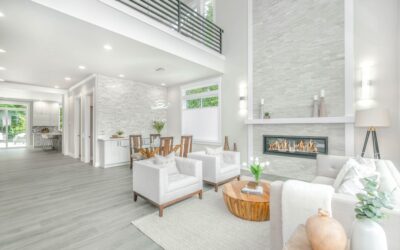
The single most common room in America right now might be this one: brown wood-tone flooring the homeowner isn’t replacing, and a fresh coat of gray paint on the walls. When the gray walls brown floors combination works, it looks expensive — cool sophistication upstairs, warm grounding underfoot. When it fails, the floor turns orange, the walls turn blue, and the whole room feels like two houses arguing. After repainting dozens of these rooms, I can tell you the difference is never the specific colors people pick. It’s whether the gray’s undertone was chosen to cooperate with the brown’s undertone. Here’s the full playbook.
- Why This Combo Works at All
- Step One: Read Your Brown Floor's Undertone
- Matching Gray to Each Brown: The Matrix
- Value Contrast: The Second Lever
- When Gray Walls and Brown Floors Clash — and the Fixes
- Completing the Room: Trim, Furniture, and Accents
- Does the Combo Still Look Current?
- Testing Before You Paint the Whole House
Why This Combo Works at All
Gray and brown are natural partners because they’re temperature complements without being color-wheel opposites. Brown is essentially darkened orange — a warm color. Gray, depending on its build, can lean cool enough to balance that warmth or warm enough to blend with it. Either strategy works; what doesn’t work is ignoring the relationship entirely. Stone and driftwood sit next to earth in nature constantly, which is why the pairing reads as organic when the undertones are handled. The brown floor supplies the warmth and weight; the gray wall supplies calm and light. Neither can do the other’s job.
Step One: Read Your Brown Floor’s Undertone
Every brown floor leans somewhere, and that lean dictates your gray. In daylight, look at your floor next to white paper and sort it into one of these bins:
Red-brown: cherry, Brazilian cherry, red oak with Gunstock or Sedona-type stains, many 2000s-era builder floors. The strongest personality and the hardest to pair.
Orange-brown / golden: honey oak, natural red oak with oil-poly ambering, hickory, golden teak LVP. Extremely common in 1990s–2010s homes.
Yellow-brown: natural maple, ash, blonde oak, pine.
Neutral chocolate-brown: walnut, espresso-stained oak, dark chocolate LVP. The easiest brown to pair with gray.
Matching Gray to Each Brown: The Matrix
| Floor Undertone | Gray Strategy | Specific Paints That Work | Grays to Avoid |
|---|---|---|---|
| Red-brown | Greige or taupe-gray; a touch of green undertone tames red | SW Agreeable Gray 7029, SW Worldly Gray 7043, BM Revere Pewter HC-172 | Blue-grays (make floor scream red), purple-grays (amplify pink) |
| Orange/golden brown | Warm gray with green-beige base to neutralize orange | BM Revere Pewter, SW Anew Gray 7030, BM Edgecomb Gray HC-173 | Icy silver-grays; stark cool gray turns honey oak neon-orange |
| Yellow-brown | Slightly cool or balanced gray adds welcome contrast | SW Repose Gray 7015, BM Gray Owl OC-52, SW Light French Gray 0055 | Yellow-beige greiges (blend into mud with the floor) |
| Neutral chocolate | Widest latitude — warm or cool both work; pick by light | SW Mindful Gray 7016, BM Stonington Gray HC-170, SW Repose Gray | Grays darker than mid-tone in small rooms (cave effect) |
The pattern worth memorizing: the warmer and louder the brown, the warmer your gray must be. Cool grays only earn their keep over calm, neutral browns or in rooms flooded with warm southern light that tempers them.
Value Contrast: The Second Lever
Undertone gets the room right; value contrast makes it interesting. Value is lightness versus darkness, and I aim for a clear gap between wall and floor. Over dark chocolate floors, light grays with an LRV of 55 to 70 make the room feel tall and the floor look intentional — this is the highest-success combination in the whole gray-brown universe. Over mid-brown floors, you can go lighter or moodier; a deep gray like SW Dorian Gray 7017 above a medium oak floor gives a den that cocooned, tailored feel. What I avoid is a mid-gray wall over a mid-brown floor of similar darkness — with no value break at the baseboard, rooms feel shorter and furniture placement gets visually muddy.
When Gray Walls and Brown Floors Clash — and the Fixes
The classic failure is the “orange floor problem”: homeowner paints a fashionable cool gray like BM Stonington over golden oak floors, and the floors — which looked fine for twenty years — suddenly glow like a basketball. Cool gray exaggerates orange by contrast. Fixes, in order of cost: swap the wall to a green-beige warm gray (Revere Pewter is the veteran fix, roughly $60 to $75 a gallon and a weekend); add a large rug that breaks up the orange field; re-lamp the room at 2700K so the light stops emphasizing blue in the paint; and only as a last resort, refinish or replace the floor.
The second failure is the mud room — not the entry, the effect: a heavily beige greige over yellow-brown floors where wall and floor melt into one continuous tan-gray smear. The fix is contrast, not temperature: keep warmth but choose a gray with more actual gray in it, or drop two shades darker on the walls and let crisp white trim carve the line between surfaces.
Third, the blue-flash problem: some grays (notably SW Passive or Gray Screen) throw visible blue in north light, and against brown floors that blue reads intentional-nautical at best, accidental at worst. If your room faces north and your floor is brown, start your search in the warm gray family and save yourself the sample rounds.
Completing the Room: Trim, Furniture, and Accents
Trim is the referee between gray walls and brown floors — always crisp but matched in temperature: SW Alabaster or BM White Dove beside warm grays, SW Pure White 7005 beside cooler grays. Baseboards especially matter here because they’re the literal handshake line between the two colors; a generous 5.25-inch painted base makes the transition look architectural.
For furniture, resist the urge to match the floor’s brown. Repeat it once at most — a leather chair, a walnut console — then build in cream, white, navy, olive, or black. A cognac leather sofa on a chocolate floor against greige walls is a bulletproof living room. Rugs should be lighter than the floor and patterned enough to link wall and floor tones; a cream-and-gray Moroccan-style rug is the workhorse choice. Metals: black and brass thrive in gray-brown rooms; chrome fights the brown, so I keep it out of these schemes. Accent colors that elevate the pairing rather than compete: muted navy, sage, terracotta, and mustard — each appears in nature alongside stone-gray and earth-brown, which is exactly why they feel right indoors.
Does the Combo Still Look Current?
A fair question, since gray had a decade of overexposure. The honest read from someone watching what buyers respond to: gray walls brown floors remains one of the most resale-friendly pairings in American housing precisely because both halves are neutral — what dates a room is cold blue-gray paint over orange floors, not the combination itself. The current version of this scheme leans warm: greige rather than steel on the walls, and it’s freshened with the accents of the moment — sage, brass, cream textiles — rather than the chevron pillows of 2015. If your gray walls feel tired, the fix is rarely repainting to beige; it’s usually warming the gray one step and updating the accessories. I’ve watched identical living rooms with gray walls and brown floors appraise as “dated” or “move-in-ready designer” based entirely on whether the gray had warmth and the styling had this decade’s accents. The bones of the pairing are timeless; only the undertones go in and out of style.
Testing Before You Paint the Whole House
Sample discipline saves this combo. Paint two coats of each candidate on poster board and set the board vertically against the wall so its bottom edge touches the actual floor — undertone conflicts announce themselves right at that junction. Check morning, noon, and under evening lamps. Then do the one step everyone skips: look at the boards from across the room, not up close. Undertone clash is a distance phenomenon; a pairing that looks fine at arm’s length can vibrate from fifteen feet away. If a gray survives the junction test and the distance test through a full day of light, buy the gallons with confidence.
Gray walls and brown floors are not a gamble — they’re a formula. Diagnose the brown honestly, choose a gray whose undertone either soothes it (warm, green-beige grays over red and orange browns) or contrasts it cleanly (balanced grays over neutral chocolates), keep two full steps of value between wall and floor, and referee the meeting point with proper white trim. Follow that sequence and the combination that fills half the failed-paint photos on the internet becomes one of the most reliable, resale-friendly rooms you can build.
Prefer to explore on your own?
See how new flooring looks in your actual room in seconds — free, no signup.
Try the free Floor Studio →