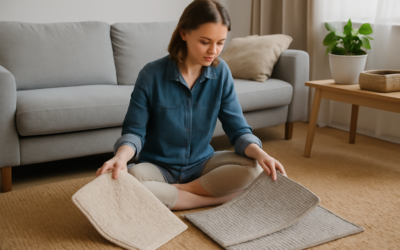
Walk into a busy office lobby, a hotel corridor, or a well-run rental unit and you will often be standing on hard carpet without realizing it. The phrase throws people off, because carpet is supposed to be soft, yet hard carpet is exactly what a lot of homeowners actually want once they think it through. It describes a very dense, low-pile, tightly constructed carpet engineered to resist crushing, matting, and wear. Instead of sinking into a plush shag, your foot meets a firm, almost floor-like surface that shrugs off years of heavy traffic.
This guide breaks down what hard carpet really is, the main constructions you will shop, realistic pricing, and the rooms where it earns its keep. If you have young kids, pets, a home office, or a basement gym, this is the carpet category worth understanding before you buy.
What Homeowners Mean by Hard Carpet
There is no official industry product literally stamped “hard carpet.” The term is shorthand that shoppers and installers use for two overlapping ideas. The first is dense, low-pile carpet with a short face height, usually 1/8 to 1/4 inch, packed with tightly spaced yarns so the surface feels firm underfoot. The second is any carpet marketed as extremely durable and stain-resistant, the kind that stays looking new in high-traffic zones.
Put simply, hard carpet trades cushiony softness for toughness. It resists the two things that make carpet look old fast: matting, where fibers lie down and stop bouncing back, and traffic lanes, those visible paths worn into hallways and in front of couches. A high-density loop with a low pile height gives fibers almost nowhere to flatten, so the floor keeps its texture for a decade or more.
The Main Types of Hard-Wearing Carpet
Not every dense carpet is built the same way. These are the constructions you will run into when you shop for a hard, durable floor.
- Level loop pile: Yarn is looped and left uncut at a uniform, short height. This is the workhorse of commercial spaces and the closest thing to true hard carpet. It cleans easily and hides seams well.
- Berber: A looped style, often flecked with color, that reads as casual and holds up to abuse. Choose a tight, small-loop Berber rather than a chunky one, since big loops can snag on pet claws.
- Cut-and-loop (patterned): Combines cut and looped yarns to form sculpted patterns. The pattern itself disguises footprints and vacuum marks, which is why it wears gracefully.
- Carpet tiles: Modular squares, typically 18 or 24 inches, with a stiff backing. They install flat and firm, and you can swap a single stained tile instead of replacing the room.
Fiber matters as much as construction. Solution-dyed nylon is the gold standard for durability and stain resistance, since color runs all the way through the fiber. Triexta (branded as SmartStrand) resists crushing and cleans up well with pets. Polyester is softer and cheaper but tends to mat faster, so it is the least “hard” of the common options.
Hard Carpet vs. Plush Carpet
The difference comes down to how the carpet is built and how it behaves over time. Plush and frieze carpets use taller, cut yarns for a luxurious, cushiony feel, and they photograph beautifully in a bedroom. The catch is that tall cut pile crushes under furniture legs and shows every footprint in a hallway.
Hard carpet flips those priorities. You give up the barefoot plushness and gain a surface that stays uniform, vacuums clean in half the passes, and survives rolling office chairs. Density is the number to watch. Face weight tells you how much fiber is present, and a tighter gauge, the spacing between yarn rows, keeps that fiber standing up. A carpet at 40 ounces of face weight in a dense low loop will outlast a 55-ounce plush in a busy room.
Where Hard Carpet Works Best
Match the floor to the traffic. Hard, low-pile carpet shines anywhere feet, wheels, and paws move constantly.
- Stairs and hallways: These wear out first in any home, so a tight loop pays off immediately.
- Home offices: A firm, flat surface lets a desk chair roll without a plastic mat, and it resists the wear ring chairs carve into plush pile.
- Basements and rec rooms: Carpet tiles with moisture-resistant backing handle occasional damp and can be replaced square by square.
- Rentals and vacation homes: Landlords lean on level-loop nylon because it looks presentable between tenants for years.
Where would you skip it? Primary bedrooms and formal living rooms, where you actually want to sink your toes in, are better served by a softer plush or a mid-height twist.
What Hard Carpet Costs
Pricing spans a wide range depending on fiber and density. Budget level-loop polyester runs about $1.50 to $3 per square foot for materials. A quality solution-dyed nylon level loop lands around $3 to $6 per square foot, and premium patterned or triexta options reach $6 to $9. Commercial carpet tiles typically cost $2 to $5 per square foot.
Installation adds roughly $1 to $2 per square foot for stretch-in carpet, though carpet tiles and glue-down commercial goods can be a DIY project if you are comfortable with a chalk line and a utility knife. Do not forget the pad. Ironically, hard carpet wants a thin, firm pad, about 3/8 inch at 8-pound density, not a thick cushiony one. A too-soft pad flexes under the backing and shortens the carpet’s life, so this is a place where more is not better.
For a 12-by-15-foot room of 180 square feet, expect a realistic installed range of $600 to $1,600 depending on the fiber you choose. Get at least three quotes, and confirm whether furniture moving and old-carpet removal are included.
Care and Maintenance
Hard carpet is low-maintenance by design, but a simple routine keeps it looking new. Vacuum high-traffic lanes twice a week and the rest weekly, using a machine with adjustable height so the beater bar does not fight a low loop. Blot spills immediately with a white cloth and water before reaching for cleaners, since solution-dyed nylon releases most fresh stains with plain water.
Schedule a professional hot-water extraction once a year, or every six months in a pet household. Walk-off mats at every entry trap the grit that actually grinds carpet fibers down. Because the pile is short and dense, dirt sits on top rather than burrowing deep, which is a big part of why these floors clean up so fast.
Is Hard Carpet Right for You?
Choose hard carpet when durability, easy cleaning, and a tidy long-term appearance outrank barefoot softness. It is the smart pick for stairs, offices, basements, hallways, and any space that sees constant traffic from kids, pets, or chairs on wheels. A dense solution-dyed nylon level loop over a firm pad will look sharp long after a plush carpet would have matted into worn lanes.
If your priority is a cozy bedroom you can sink into, blend your approach: run soft plush where you relax and true hard carpet where life gets rough on the floor. Match the construction to the room, buy the best fiber your budget allows, and pair it with the correct thin, firm pad. Do that, and you get a floor that stays quiet, comfortable enough, and remarkably good-looking for ten to fifteen years.