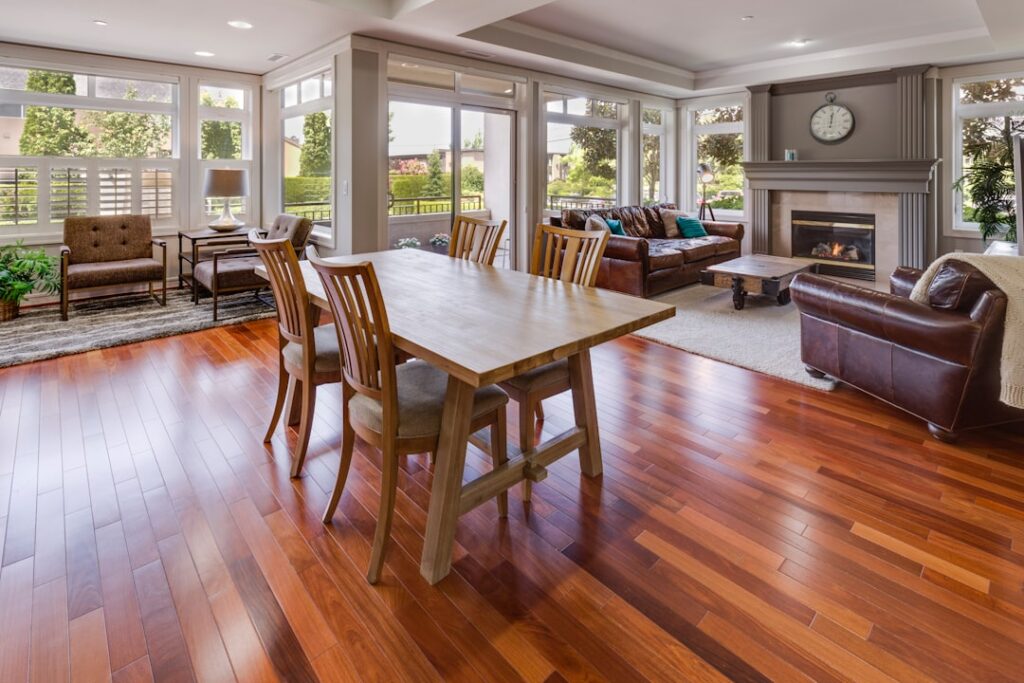
Shoppers often type “hard wood laminate flooring” into a search bar because they’re trying to figure out which one to buy, and the two get blurred together on store displays. Hard wood laminate flooring really refers to two different products: solid or engineered hardwood, and laminate that’s printed to look like wood. They can be hard to tell apart from six feet away, but they’re built differently, cost differently, and perform differently. Choosing wrong costs you money either up front or down the road.
I’ve installed both in hundreds of homes, and neither one is universally “better.” The right pick depends on your budget, your household, and how long you plan to stay. Let’s put them side by side.
What Each Floor Actually Is
Start with what you’re really buying, because the construction drives every other difference.
Hardwood
Real wood, cut from a tree. Solid hardwood is a single piece of oak, maple, hickory, or walnut, three-quarters of an inch thick. Engineered hardwood has a real wood veneer bonded over a plywood core, which makes it more stable and a bit cheaper. Either way, the surface you walk on is genuine timber.
Laminate
A photographic image of wood printed on paper, sealed under a clear melamine wear layer, and fused to a high-density fiberboard (HDF) core. It’s not wood, it’s a picture of wood over compressed wood fiber. Modern laminate looks remarkably convincing, with embossed textures that follow the grain, but scratch through the top layer and there’s no real wood underneath.
Cost: Up Front and Over Time
Price is usually the first thing that separates these two, and the gap is significant.
- Laminate material: $1 to $5 per square foot.
- Laminate installed: $3 to $8 per square foot.
- Engineered hardwood installed: $6 to $14 per square foot.
- Solid hardwood installed: $8 to $16 per square foot, more for exotic species.
For a 300-square-foot room, laminate might run $900 to $2,400 installed, while solid hardwood could hit $2,400 to $4,800. Laminate clearly wins on upfront cost. But hardwood can be refinished and lasts generations, so the cost-per-year over a 30-year horizon often narrows more than the sticker price suggests.
Durability and Daily Wear
This one surprises people. On pure surface hardness, laminate often outperforms hardwood. Its melamine wear layer resists scratches and dents better than a natural wood surface, which is why laminate holds up well in homes with big dogs and rambunctious kids.
Hardwood scratches and dents more easily, especially softer species like pine or even walnut. The crucial difference is repairability. When laminate gets damaged, you replace the plank, and if that product’s been discontinued, you may not find a match. When hardwood gets scratched or dented, you sand and refinish it and it looks new again. So laminate resists damage better, but hardwood recovers from it better.
Water Resistance
Neither is truly waterproof, but they fail differently. Traditional laminate’s HDF core swells and the edges chip if water sits on a seam, though newer water-resistant laminates hold up to spills for several hours. Standing water is still the enemy.
Solid hardwood cups, crowns, and stains when it gets wet, and it does not recover well from a flood. Engineered hardwood tolerates humidity better than solid because of its plywood core, but it’s still real wood on top. For bathrooms, laundry rooms, and basements, honestly, I’d steer you toward waterproof luxury vinyl over either of these. For kitchens, water-resistant laminate has a slight edge over solid hardwood.
Refinishing and Longevity
Here’s where hardwood pulls decisively ahead, and it’s the biggest reason people still pay the premium.
- Solid hardwood: Can be sanded and refinished 5 to 10 times over its life. A well-maintained floor lasts 50 to 100 years and can change color with each refinish.
- Engineered hardwood: Can be refinished 1 to 3 times depending on veneer thickness. Lifespan of 20 to 40 years.
- Laminate: Cannot be refinished at all. The wear layer is a fixed thickness. When it wears out or gets damaged, you replace the floor. Expect 10 to 25 years.
If you want a floor that outlives you and can be renewed instead of replaced, hardwood is the only choice here. Laminate is a replace-it product, not a refinish-it product.
Resale Value and Buyer Appeal
Real estate agents will tell you real hardwood moves houses. Buyers recognize it as a premium feature, and listings often mention “hardwood floors” as a selling point. It can nudge up your sale price and shorten time on market.
Laminate is seen as a practical, budget-friendly finish. It won’t hurt a sale, but it rarely adds to the appraised value the way hardwood does. If you’re renovating to sell, or you’re in a higher-end neighborhood where buyers expect wood, hardwood is the safer investment. If you’re staying put and just want a good-looking, durable floor, laminate’s value proposition is hard to argue with.
Installation and Feel
Most laminate uses a click-lock floating system that a confident DIYer can install over a weekend, no nails or glue. It feels slightly hollow and firm underfoot, and it can sound a little clacky without a good underlayment. Hardwood is typically nailed or glued down (engineered can float), usually a job for a pro, and it feels solid, warm, and quiet underfoot in a way laminate can’t quite match.
Sound and warmth matter more than people expect. Barefoot in the morning, a real wood floor simply feels better. That tactile difference is part of what you’re paying for with hardwood.
Maintenance and Cleaning
Day-to-day care differs enough between these floors to factor into your decision. Laminate is genuinely low-maintenance, sweep or vacuum regularly and damp-mop with a well-wrung microfiber, but you must avoid excess water, since moisture is its weakness. Never wet-mop or steam-clean laminate; standing water at the seams is what swells the core. A slightly damp mop and quick drying is the rule.
Hardwood needs a gentler, more attentive routine. Use a hardwood-specific cleaner rather than all-purpose products, avoid water and harsh chemicals that can dull or damage the finish, and wipe spills promptly. Felt pads under furniture legs and a no-shoes policy go a long way toward preserving both floors, but hardwood in particular rewards that care with a surface that can be renewed decades later. Neither floor likes grit, which acts like sandpaper underfoot, so a good entry mat protects both.
Appearance and Design Options
Both floors offer huge style ranges today, but they get there differently. Hardwood gives you authentic, unrepeatable grain and the ability to choose any stain color during a site finish, plus species-specific character from the pale uniformity of maple to the dramatic streaking of hickory. Every board is one of a kind, and the way real wood catches light has a depth that printing can’t fully match.
Laminate counters with variety and consistency. Because the surface is a printed image, manufacturers offer looks that would be rare or expensive in real wood, weathered gray barnwood, exotic species, wide rustic planks, at a fraction of the cost, and every box matches perfectly. The tradeoff is that a repeating print pattern can show up across a large floor if you look closely, whereas real wood never repeats.
Which Should You Choose?
Go with laminate if you’re budget-conscious, have pets and kids hard on floors, want a DIY-friendly install, or you’re flipping or renting a property. Go with hardwood if you want a floor that lasts generations, can be refinished, adds resale value, and gives you that authentic underfoot feel, and your budget can absorb the premium. Both are excellent floors when matched to the right situation, the mistake is buying one while expecting the other’s strengths.
Prefer to explore on your own?
See how new flooring looks in your actual room in seconds — free, no signup.
Try the free Floor Studio →