Heated flooring — also called radiant floor heating — is one of the most comfortable and efficient ways to warm a room. Instead of blowing hot air through vents, radiant heat warms the floor surface itself, which then radiates heat upward evenly throughout the space. The result is consistent, silent warmth with no drafts, no dust circulation, and warm floors underfoot.
- What Is Radiant Floor Heating?
- Types of Heated Flooring Systems
- Electric vs Hydronic: Comparison Table
- Best Flooring for Heated Floors
- Worst Flooring for Heated Floors
- Cost to Install Heated Flooring
- Running Costs
- Pros and Cons of Heated Flooring
- Retrofit vs New Construction
- Thermostats and Controls
- Is Heated Flooring Worth It?
- Frequently Asked Questions
This guide covers the types of radiant heating systems, which flooring materials work best (and worst) with heated floors, installation costs, running costs, and whether radiant heat is right for your home.
What Is Radiant Floor Heating?
Radiant floor heating works by installing a heat source beneath the flooring surface. The heat conducts through the floor material and radiates into the room. Because heat rises, starting from the floor creates the most comfortable temperature gradient — warm at foot level, slightly cooler at head level.
There are two primary types of radiant floor heating systems: electric and hydronic.
Types of Heated Flooring Systems
Electric Radiant Heat (Electric Mat Systems)
Electric systems use thin heating cables woven into a mesh mat or embedded in a flexible membrane. The mat rolls out over the subfloor, and the flooring is installed on top. A thermostat controls the temperature.
Best for: Single rooms, bathrooms, kitchens, retrofits
- Thickness: Adds only 1/8″ to 1/4″ to floor height
- Installation: Simpler — mats roll out and connect to a thermostat
- Cost to install: $8 – $15 per square foot
- Running cost: Higher electricity rates; best as supplemental heat
- Response time: Heats up in 30-60 minutes
- Best flooring: Tile, stone
Hydronic Radiant Heat (Hot Water Systems)
Hydronic systems circulate warm water through a network of PEX tubing embedded in the subfloor or within a thin concrete slab. A boiler or heat pump heats the water. This is the most energy-efficient option for whole-house heating.
Best for: Whole-house heating, new construction, large areas
- Thickness: Requires 1/2″ to 1-1/2″ of added floor height (gypcrete or subfloor panels)
- Installation: Complex — requires a boiler, manifold, and extensive plumbing
- Cost to install: $12 – $25 per square foot (whole-house systems)
- Running cost: Lower than electric; efficient for whole-house use
- Response time: Slower to heat up (1-3 hours)
- Best flooring: Tile, stone, engineered wood, LVP
Electric vs Hydronic: Comparison Table
| Factor | Electric | Hydronic |
|---|---|---|
| Installation cost | $8 – $15/sq ft | $12 – $25/sq ft |
| Operating cost | Higher (electricity) | Lower (gas/heat pump) |
| Best application | Individual rooms | Whole-house heating |
| Retrofit friendly | Yes — thin mats | Difficult — requires floor buildup |
| Maintenance | Virtually none | Annual boiler maintenance |
| Lifespan | 25+ years | 30-50+ years |
| Heat-up time | 30-60 minutes | 1-3 hours |
| Zoning | Easy per-room control | Manifold zoning available |
Best Flooring for Heated Floors
Not all flooring materials conduct heat equally well. The ideal flooring for radiant heat is thin, dense, and conducts heat efficiently from the heating element to the room. Here are the best options, ranked.
1. Tile and Stone (Best Choice)
Ceramic and porcelain tile and natural stone are the gold standard for heated floors. Their dense composition conducts heat efficiently, and they retain warmth even after the system cycles off. Tile and stone also withstand the temperature fluctuations without expanding, contracting, or degrading.
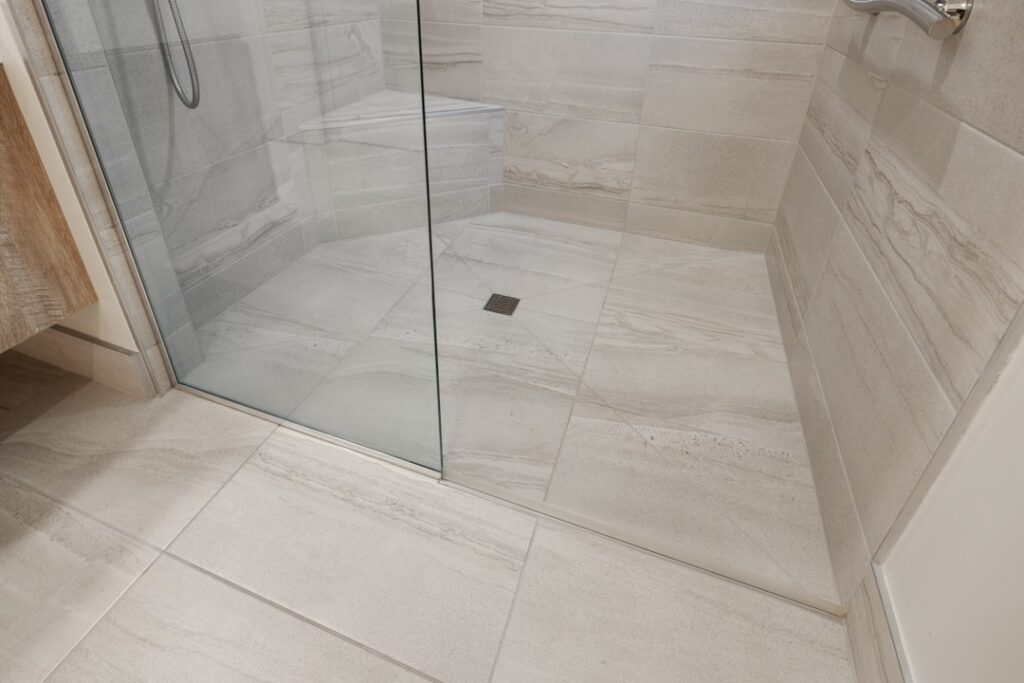
Heated tile floors in bathrooms are perhaps the most popular application of radiant heat — transforming cold bathroom tile into a luxuriously warm surface.
Compatibility: Excellent — no temperature limits, maximum heat transfer.
2. Luxury Vinyl Plank (LVP)
LVP flooring is compatible with radiant heat, provided the floor temperature does not exceed 80-85 degrees Fahrenheit (check the manufacturer’s specifications). LVP is thinner than wood, so heat transfer is good. Its waterproof nature makes it an attractive option for heated bathroom and kitchen floors.
Compatibility: Good — respect the temperature limit of 80-85 degrees F.
3. Engineered Hardwood
Engineered hardwood handles radiant heat well because its layered construction resists expansion and contraction. The cross-ply layers stabilize the wood against the temperature and humidity changes that radiant heat introduces. Choose thinner profiles (5/8″ or less) and avoid species with high expansion rates.
Compatibility: Good — engineered construction handles heat well; keep surface temps under 80-85 degrees F.
4. Laminate
Most quality laminate flooring is rated for radiant heat. Its thin profile allows decent heat transfer. However, laminate is sensitive to moisture and temperature extremes, so a gradual heat-up period is important. Always verify the manufacturer’s approval for radiant heat use.
Compatibility: Moderate — check manufacturer approval; respect temperature limits.
Worst Flooring for Heated Floors
Carpet
Carpet acts as an insulator, trapping heat below the surface rather than transferring it to the room. Thick carpet with heavy padding can reduce the heating system’s efficiency by 25-50%. If you must use carpet over radiant heat, choose thin, low-pile carpet with a thin pad and keep the total R-value (thermal resistance) below 2.5.
Solid Hardwood
Solid hardwood is problematic with radiant heat. The temperature fluctuations cause the wood to expand and contract, leading to gaps, cupping, and cracking over time. The thicker the plank, the worse the problem. Engineered hardwood is always the better choice over radiant heat.
Thick Natural Stone
While thin stone tiles conduct heat well, very thick stone slabs (1″+ like certain marble or granite) take a long time to heat through and can make the system sluggish. Standard 3/8″ to 1/2″ stone tiles are fine.
Cost to Install Heated Flooring
| Project Type | Cost Range | Notes |
|---|---|---|
| Electric mat, bathroom (50 sq ft) | $400 – $750 | Materials only; DIY possible |
| Electric mat, bathroom (installed) | $700 – $1,500 | Including electrician for thermostat |
| Electric mat, kitchen (150 sq ft) | $1,200 – $2,500 | Installed with thermostat |
| Hydronic, single room (200 sq ft) | $3,000 – $6,000 | If boiler exists |
| Hydronic, whole house (1,500 sq ft) | $18,000 – $40,000 | Including boiler and manifold |
These costs are for the heating system only — flooring material and installation are additional.
Running Costs
The operating cost of heated flooring depends on the system type, energy source, floor area, and local utility rates.
- Electric systems: An electric mat in a 50 sq ft bathroom costs approximately $0.25-$0.50 per day to run for several hours. A 150 sq ft kitchen may cost $0.75-$1.50 per day. Used as supplemental heat in specific rooms, electric radiant is affordable.
- Hydronic systems: A whole-house hydronic system using a gas boiler costs roughly 25-40% less to operate than a forced-air furnace. The savings come from lower heat loss (no duct losses) and lower water temperatures needed (100-120 degrees F vs 130-180 degrees F for radiators).
Programmable thermostats dramatically improve efficiency by heating floors only when needed — warm in the morning, off during the day, warm again in the evening.
Pros and Cons of Heated Flooring
Advantages
- Consistent, even warmth — no cold spots or hot blasts
- Silent operation — no fans, no blowing air, no duct noise
- Improved air quality — no dust circulation from ductwork
- Energy efficient — especially hydronic systems for whole-house use
- Invisible — no radiators, no vents, no baseboard heaters taking up wall space
- Luxury feel — warm floors underfoot are a significant comfort upgrade
- Increased home value — radiant heat is a desirable feature for buyers
Disadvantages
- High upfront cost — especially hydronic systems
- Slow response time — takes 30 minutes to 3 hours to heat up
- Retrofit challenges — adding to existing floors means raising floor height
- Repair difficulty — if a heating element fails under tile, repair requires removing the floor
- Floor material limitations — not all flooring types are compatible
- Not for cooling — radiant floors heat only; you still need AC for summer
Retrofit vs New Construction
New Construction
New construction is the ideal time to install radiant floor heating. The system can be designed into the floor assembly from the start, with no floor height compromises. Hydronic tubing can be embedded in a poured slab, and the boiler and manifold are part of the original mechanical plan. This is the most cost-effective approach.
Retrofit
Adding heated flooring to an existing home is more challenging but absolutely possible. Electric mat systems are the best retrofit option because they add minimal height (1/8″ to 1/4″) and can be installed during a floor replacement project.
The ideal retrofit scenario is when you are already replacing the flooring. The old floor is removed, the electric mat is installed on top of the subfloor, and the new flooring goes over it. The only added task is running a dedicated electrical circuit and installing a thermostat.
Hydronic retrofits are more invasive, requiring either routing tubing in the subfloor from below (staple-up method) or adding a new floor layer on top to embed the tubing.
Thermostats and Controls
A proper thermostat is essential for comfort and efficiency. Modern radiant floor thermostats include:
- Floor sensor — measures actual floor temperature (essential for floor temperature limits)
- Ambient sensor — measures room air temperature
- Dual-sensor mode — controls room temperature while preventing the floor from exceeding a maximum temperature (important for LVP and wood)
- Programmable schedules — heat the floor before you wake up, turn it off when you leave
- Smart/WiFi control — adjust from your phone, integrate with home automation
A programmable thermostat that pre-heats the floor before you need it compensates for the slow response time of radiant heat. Set it to start warming 30-60 minutes before your alarm, and you step onto a warm floor every morning.
Is Heated Flooring Worth It?
For bathrooms, the answer is almost always yes. A heated bathroom floor is a relatively affordable luxury ($400-$1,500 for an electric system) that transforms the daily experience of the room. The cost is modest, the comfort is significant, and it adds resale appeal.
For whole-house heating via a hydronic system, the calculation is more complex. The upfront cost is substantial ($18,000-$40,000+), but the long-term energy savings, comfort, and home value increase can justify the investment, especially in new construction where the cost premium over conventional HVAC is lower.
For individual rooms beyond the bathroom — kitchens, entryways, basement family rooms — electric mat systems offer a good balance of cost and comfort.
Frequently Asked Questions
Can you put heated flooring under LVP?
Yes, most LVP products are compatible with radiant heat. The key requirement is keeping the floor surface temperature below 80-85 degrees Fahrenheit. Use a thermostat with a floor sensor to ensure the temperature stays within the manufacturer’s specifications. Check our LVP flooring guide for compatible products.
How long does heated flooring last?
Electric mat systems last 25+ years with no maintenance. Hydronic systems can last 30-50+ years, though the boiler may need replacement at 15-20 years. Both types have no moving parts in the floor itself, making them very reliable.
Does heated flooring increase home value?
Yes. Radiant floor heating is consistently listed as a desirable feature by home buyers. It does not have a specific ROI percentage, but it can differentiate your home and appeal to buyers who value comfort and energy efficiency.
Can you install heated flooring yourself?
Electric mat installation is DIY-friendly — rolling out the mat and embedding it in thinset is straightforward. However, the electrical connection to the thermostat and circuit breaker must be done by a licensed electrician in most jurisdictions. Hydronic systems require professional installation.
Is heated flooring safe?
Yes. Modern radiant floor heating systems are UL-listed and include ground fault protection. The floor temperature is controlled by a thermostat, typically reaching 80-85 degrees Fahrenheit — warm and comfortable but not hot enough to burn. The systems have been in use for decades with excellent safety records.
Does heated flooring dry out hardwood?
Radiant heat can reduce humidity near the floor, which can cause solid hardwood to shrink and develop gaps. This is why engineered hardwood is recommended over solid hardwood for heated floors. A whole-house humidifier can also help maintain proper moisture levels.
Prefer to explore on your own?
See how new flooring looks in your actual room in seconds — free, no signup.
Try the free Floor Studio →