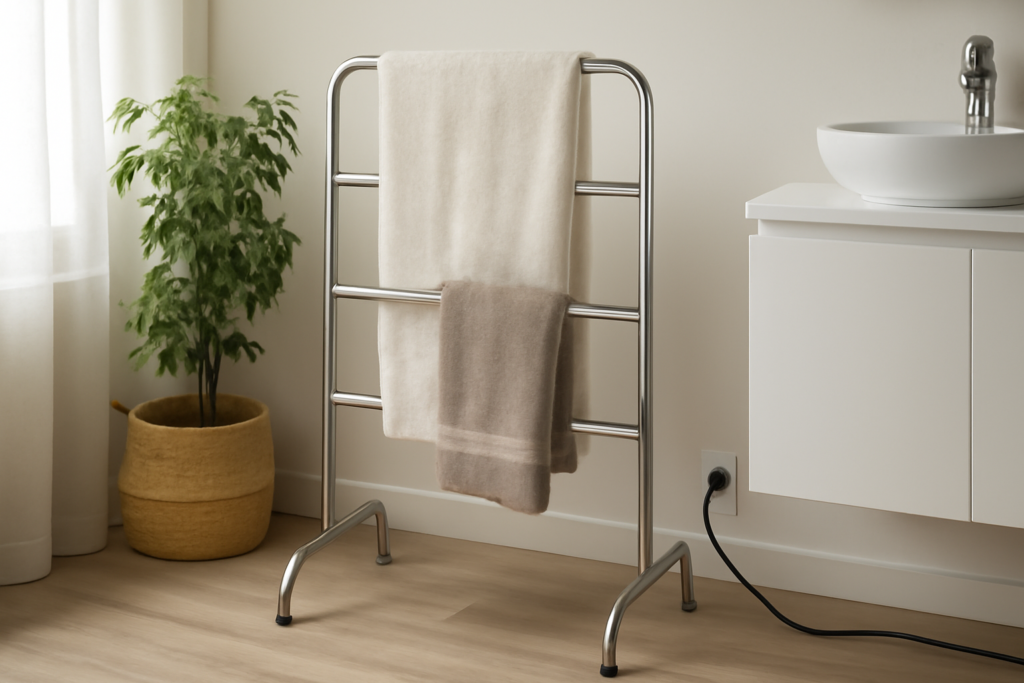
Stepping out of the shower to wrap yourself in a warm, dry towel is a small luxury that feels far more expensive than it is. A heated towel rack freestanding model delivers exactly that with none of the wiring headaches of a built-in unit — you simply plug it into a nearby outlet and set it on the floor. Unlike hardwired towel warmers that require an electrician to run a dedicated circuit into the wall, a freestanding unit is fully portable, renter-friendly, and installed in seconds. Beyond warmth, these racks dry towels between uses, which cuts down on the musty, mildewy smell that damp towels develop in humid bathrooms. Here is what to know before you buy.
How Freestanding Towel Warmers Work
A freestanding towel warmer is essentially a set of heated bars on a self-supporting frame with a power cord. Electricity warms the bars — either through electric heating elements in dry models or a sealed fluid heated by an element in fluid-filled versions — and that gentle heat transfers to any towel draped over them. Because it stands on the floor rather than mounting to the wall, you can place it wherever there is an outlet and move it as needed. Most units reach a comfortable warmth in 15 to 30 minutes.
Bars, Size, and Capacity
The number of bars determines how many towels you can warm and dry at once. Consider your household when choosing:
- Compact 4 to 6 bar units suit a single user, a guest bath, or tight spaces, holding one or two towels.
- Larger 8 to 12 bar racks handle multiple bath towels for a family or a busy household.
- Tall tower or ladder designs maximize capacity on a small floor footprint.
Measure your bathroom before buying — a freestanding rack needs clear floor space where it will not block traffic or the shower door, and it should sit away from water sources.
Wattage and Running Cost
Towel warmers are surprisingly economical to run. Most freestanding models draw a modest amount of power, often in the range of 100 to 200 watts, similar to a few light bulbs. That means leaving one on for a couple of hours a day costs only pennies. Higher-wattage units warm faster and put out more heat, useful if you also want the rack to take the chill off a small bathroom. Check the wattage on the spec sheet and match it to how quickly you want warm towels versus how much energy you want to use.
Timers and Controls
A built-in timer is one of the most useful features to look for. Rather than remembering to switch the rack on and off, a timer lets you program it to warm your towels before your morning shower and shut off automatically afterward. Options range from simple manual on/off switches to programmable digital timers and even models with adjustable temperature settings. A timer also saves energy and adds a layer of safety by preventing the unit from running unattended all day.
Safety Considerations
Because a freestanding towel warmer combines electricity and a wet environment, safety features matter. Look for these:
- Plug into a GFCI-protected outlet — bathroom outlets are typically GFCI, which cuts power instantly if it detects a fault near water.
- Overheat protection that shuts the unit down if it gets too hot.
- A stable, tip-resistant base so the rack cannot easily topple, especially around children or pets.
- A cord routed safely away from walkways and standing water — never run it under a rug or across a wet floor.
- Cool-touch or low-surface-temperature bars on many models, warm enough to dry towels but not to burn skin.
Never leave a plug-in unit running unattended for extended periods unless it has an automatic timer or shutoff.
Dry vs Fluid-Filled Models
Freestanding towel warmers come in two heating designs, and the difference affects both warmth and cost. Dry element models heat the bars directly with an internal electric element; they warm up fast, often within 10 to 15 minutes, and cost less. Fluid-filled (or oil-filled) models heat a sealed liquid inside the bars, which takes a bit longer to reach temperature but holds and radiates heat more evenly and stays warm longer after cycling. If you want quick warmth and lower upfront cost, dry is fine. If you value steady, gentle, even heat and do not mind a slightly longer warm-up, a fluid-filled unit is worth the small premium.
Materials and Finishes
Most freestanding towel warmers are built from stainless steel or chrome-plated steel, both of which resist the humidity of a bathroom well and clean up easily. Finish options let you match your fixtures:
- Polished chrome — bright, classic, and the most common look.
- Brushed nickel and stainless — a softer, fingerprint-resistant satin finish.
- Matte black — a modern statement that coordinates with contemporary hardware.
- Brushed brass and bronze — warm metal tones for a boutique feel.
Choose a finish that echoes your faucet and towel bar for a coordinated bathroom, and confirm the frame feels solid rather than flimsy, since a sturdy base is both a quality and a safety indicator.
Beyond Towels: Other Uses
A freestanding warmer earns its footprint by doing more than heating bath towels. It is excellent for drying hand-washed delicates, swimsuits, and gym gear that you do not want to put in the dryer. In a mudroom or entryway it can dry wet gloves, hats, and small items after a snowy day. Some people keep one in a guest room to offer warm towels, or in a home gym to dry sweat towels between sessions. Because it is portable, you can move it wherever the need is greatest through the seasons — a flexibility a hardwired unit simply cannot match.
Freestanding vs Hardwired
The main alternative is a wall-mounted, hardwired towel warmer. Understanding the trade-offs helps you choose. Hardwired units look sleeker with no visible cord, free up floor space, and can be integrated into the room’s design, but they require an electrician, a permanent location, and a bigger upfront cost. A heated towel rack freestanding model wins on flexibility: no installation, no wiring, no permits, and the freedom to take it with you when you move or reposition it whenever you like. For renters, quick upgrades, and anyone who does not want to open up a wall, freestanding is the clear practical choice — warm towels without the commitment. Choose a model with a timer, an adjustable temperature, and a stable base, plug it into a GFCI outlet, and you can enjoy the small daily luxury of a warm, dry towel in any bathroom, starting the very same afternoon it arrives.