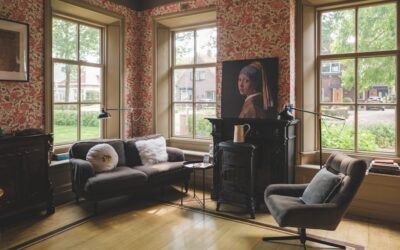
One of the most common mistakes I see in otherwise beautiful rooms is artwork hung too high, floating awkwardly near the ceiling. Knowing exactly how high to hang art on wall space transforms a room instantly, and the rule is simpler than most people think. Get the center height right and even a modest print looks intentional and well placed. Below I share the gallery standard the pros use, plus the adjustments for furniture, gallery walls, and tall ceilings.
The 57 to 60 Inch Gallery Standard
The single most useful guideline is this: hang your art so its center sits about 57 to 60 inches from the floor. Museums and galleries use this range because 57 to 60 inches approximates average eye level, so the piece meets your gaze naturally as you stand in front of it. When in doubt, aim for the center of the artwork at 57 inches and you will rarely go wrong.
The key word is center, not top or bottom. Measure to the vertical midpoint of the frame, then work out where the hanging hardware needs to land so that midpoint hits your target height. This is where most hanging errors happen, so slow down and do the math.
How to Calculate the Hook Position
The hook never sits at the center of the frame, so a quick calculation keeps you accurate. Here is the formula I use on every job:
- Decide your center height, say 58 inches.
- Measure the frame height and divide by two to find its midpoint.
- Add the midpoint to 58 inches to find where the top of the frame will be.
- Measure the drop from the top of the frame to the taut hanging wire or D-ring.
- Subtract that drop from the top-of-frame number. That result is where your hook goes.
For example, a 24-inch-tall frame has a 12-inch midpoint, so the top sits at 70 inches. If the wire pulls up to 3 inches below the top when taut, your hook lands at 67 inches. Mark it, and the center will rest right at 58.
Hanging Art Above Furniture
When art sits above a sofa, console, or headboard, the furniture changes the rules slightly. You still keep the piece at a comfortable viewing height, but you also want it to relate visually to what is below it. Leave roughly 6 to 12 inches of gap between the top of the furniture and the bottom of the frame.
- Above a sofa: the art should span about two-thirds of the sofa width and hang 6 to 10 inches above the back cushions.
- Above a console table: keep an 8 to 12 inch gap so the two pieces read as a group.
- Above a headboard: leave clearance so the frame does not knock against it, usually 6 to 9 inches.
The goal is for the art and furniture to feel connected as one composition rather than two floating objects.
Gallery Walls and Groupings
When you hang several pieces together, treat the entire arrangement as a single unit. Find the visual center of the whole grouping and place that center at the same 57 to 60 inch mark. Lay the pieces out on the floor first and shuffle them until the spacing pleases you.
Keep consistent spacing between frames, generally 2 to 3 inches for smaller works and up to 4 to 5 inches for larger ones. Tight, even gaps make the cluster look curated rather than scattered. A trick I rely on: cut paper templates the size of each frame, tape them to the wall, and step back to judge the layout before a single nail goes in.
Adjusting for Ceiling Height
The 57 to 60 inch rule assumes standard 8-foot ceilings. With taller ceilings, resist the urge to raise everything to fill the wall. Eye level does not change just because the room is taller, so the center-height target stays roughly the same. Instead, choose larger pieces or stack art vertically to occupy the extra height while keeping individual centers near eye level. Over a tall stairwell or in a double-height foyer, you can go higher, but for everyday rooms, hold the line at eye level.
Hardware You Will Need
The right hardware keeps art level and on the wall. Match it to the weight of the piece.
- D-rings: attach two to the back of the frame for a stable, level hang on heavier pieces. They resist tilting better than a single wire.
- Picture wire: fine for lighter frames, but it lets the piece drift sideways, so check the level often.
- Picture hooks: rated by weight, from 10 pounds up to 100 pounds. Read the rating and respect it.
- Wall anchors: required when there is no stud behind your mark. Toggle and molly anchors carry far more than a bare nail in drywall.
For anything heavy or valuable, find a stud with a stud finder and drive your fastener into solid wood whenever the layout allows.
Measuring and Marking Like a Pro
Accuracy at the wall is what separates a clean hang from a crooked one. Use a tape measure, a pencil, and a level every time. Mark your hook height lightly, confirm it with the level if you are setting two hooks, and press the fastener in only after you have double-checked the number. A small bubble level or a laser line keeps multi-piece arrangements aligned across the wall.
If you want zero guesswork, painter’s tape laid on the wall lets you mark and erase positions without leaving holes. Once everything looks right, hang the art, step back to the far side of the room, and make any final nudge. Hung at eye level with even spacing and the right hardware, your art will look like it was placed by a designer rather than guessed at, and the whole room will feel more finished for it.
A few finishing habits keep your work looking sharp over time. Add small adhesive bumpers to the bottom corners of each frame so it sits flush, stays level, and does not scuff the wall. In high-traffic hallways or homes with kids, consider security hardware or a second hook to stop frames from drifting crooked every time someone walks past. And when you rearrange a room, recheck those center heights, because a piece that looked right above one sofa can sit too high or too low above a different one. With the eye-level rule as your anchor, you can confidently hang anything from a single print to a full gallery wall.