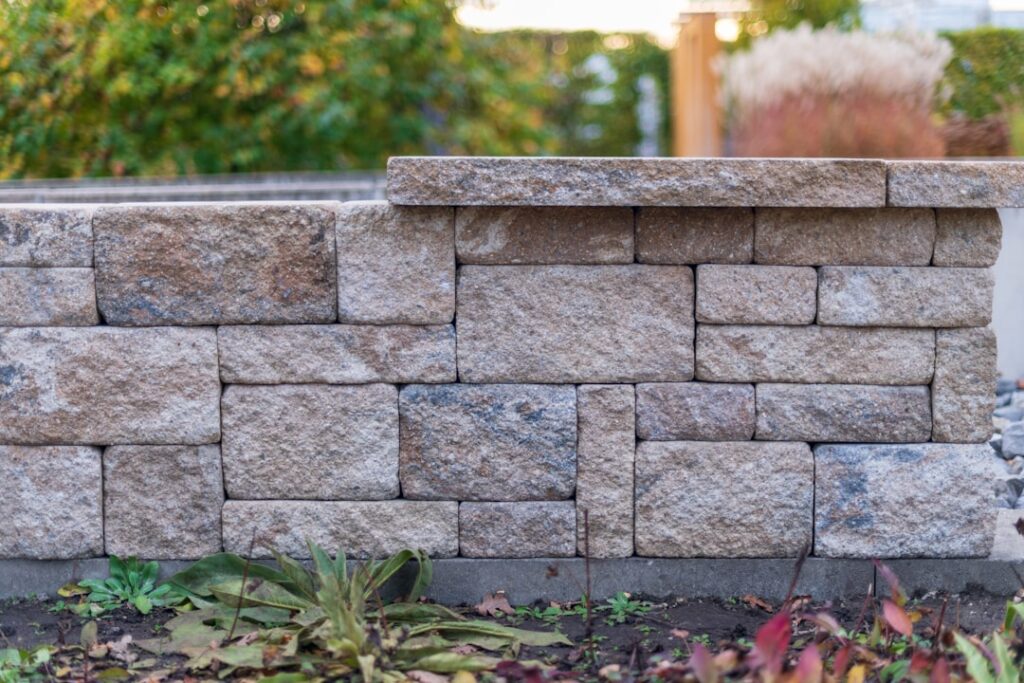
A three-foot wall sits right at the sweet spot where a weekend project can turn into an engineered structure. How much does a 3 foot retaining wall cost comes down to material choice and length, but for most homeowners the answer falls between $40 and $90 per linear foot installed, so a 30-foot run typically costs $1,200 to $2,700. Push into stone or poured concrete and that same wall can double. The reason for the wide range is that a retaining wall is holding back tons of soil, and the drainage, base, and footing you don’t see matter as much as the blocks you do. Here’s how the numbers actually work.
Average Cost by the Foot
Retaining walls are almost always priced per linear foot or per square face foot. At three feet tall, a 30-foot wall covers about 90 square face feet. Interlocking concrete block, the most common residential choice, runs $40 to $70 per linear foot installed. Natural stone climbs to $60 to $120, poured concrete lands around $55 to $90, and timber sits at the low end near $25 to $45.
To convert, take your total wall length in feet and multiply. A 40-foot block wall at $55 per linear foot comes to roughly $2,200. If a contractor quotes by square face foot instead, expect $15 to $40 per square foot depending on material, which lands in the same neighborhood once you multiply by the wall’s height.
Why Three Feet Is a Pricing Threshold
Height changes everything with retaining walls. In most jurisdictions, a wall up to four feet tall, measured from the bottom of the footing to the top of the wall, can be built without an engineer’s stamp or a permit. A three-foot wall usually stays under that line, which keeps costs down.
Cross the four-foot mark, or build a tiered series of walls, and many building departments require an engineered design, a permit, and inspections, which can add $500 to $2,000 in soft costs before a single block is laid. Building at three feet deliberately keeps you inside the DIY-friendly, permit-free zone in many areas, though you should always confirm local rules.
Material Costs Compared
Interlocking segmental blocks such as Allan Block or Versa-Lok are the workhorse of residential walls. Blocks cost roughly $3 to $8 each, and their built-in lip makes them self-aligning, which speeds installation. Natural stone, whether dry-stacked or mortared, looks the best and lasts the longest but demands skilled labor, driving the price toward the top of the range.
Poured concrete gives you the strongest wall and can be faced with veneer, but you’re paying for formwork and a concrete pour. Pressure-treated timber is the cheapest option upfront at $25 to $45 per linear foot, but it typically lasts only 15 to 20 years before rot sets in, versus 50-plus years for block and stone, so it’s rarely the best value.
The Costs Hidden Below Grade
A retaining wall is only as good as its base and drainage, and this is where a cheap bid gets exposed. Every wall needs a compacted gravel base, typically 6 to 12 inches deep, plus a perforated drain pipe and clean gravel backfill behind the blocks to keep water pressure from pushing the wall over. Skimp here and the wall bulges or fails within a few years.
Budget for gravel, drain pipe, and landscape fabric at roughly $5 to $12 per linear foot in materials alone. Excavation matters too: if the site slopes, has poor access, or hides tree roots and buried utilities, expect an extra $200 to $1,000. Soil that must be hauled away runs $100 to $400 per truckload.
Labor Versus DIY
Labor is usually 50 to 60 percent of a professional retaining wall bill. If you DIY a three-foot block wall, you can cut the cost nearly in half, doing a 30-foot wall for perhaps $700 to $1,300 in materials. The work is physically demanding, though; a three-foot wall involves moving several tons of block, gravel, and soil, and getting the base dead level is the difference between a wall that lasts decades and one that leans in a season.
If you hire out, get itemized bids that specify base depth, drainage detail, and block brand. A suspiciously low quote often means the contractor is planning to skip the gravel base or drain pipe, which are the two things you can least afford to lose.
Extra Costs and Upgrades
Several add-ons can nudge the total up. Capstones to finish the top course run $3 to $10 per linear foot. Reinforcing geogrid, a mesh laid between courses and back into the soil, adds a few dollars per foot but is strongly recommended for any wall holding a slope. Curves, corners, and stairs each raise labor. If the wall needs to tie into a patio, driveway, or existing structure, add for that connection.
Steps built into the wall run $150 to $400 per step, and integrated lighting adds $50 to $150 per fixture installed. None are mandatory, but they’re common enough that you should decide upfront rather than discover them mid-project.
How Wall Length and Soil Change the Price
The single biggest driver of your total is simply how long the wall is, since most costs scale by the linear foot. A 20-foot wall at $55 per foot runs about $1,100, while doubling it to 40 feet doubles the material, base, and drainage to roughly $2,200. Curves and corners raise the per-foot rate because each requires cutting blocks and slows the crew, so a straight run is always the most economical shape.
Soil type matters more than most homeowners expect. Sandy, well-draining soil is straightforward, but heavy clay holds water and swells, putting far more pressure on the wall, which may call for extra geogrid reinforcement and more robust drainage. If the wall is holding back a slope rather than just leveling a small grade change, the engineering load rises and so does the cost. Have someone assess the soil and the slope before you finalize a budget.
Common Mistakes That Cost You Later
The failures that force expensive rebuilds almost always trace to skipped fundamentals. Building on uncompacted soil instead of a compacted gravel base lets the wall settle unevenly within a year or two. Omitting the perforated drain pipe and gravel backfill traps water behind the blocks, and the hydrostatic pressure eventually bows or topples the wall, a repair that costs as much as the original build.
Poor backfill is another silent killer: packing native clay directly behind the blocks instead of clean crushed stone means water has nowhere to go. And ignoring the four-foot permit threshold can mean tearing out an unpermitted wall entirely. Paying a little more upfront for a proper base, drainage, and, where needed, an engineered design is far cheaper than answering how much does a 3 foot retaining wall cost twice because the first one failed.
Setting a Realistic Budget
For a typical suburban project, plan on $1,500 to $3,000 for a professionally installed 30- to 40-foot block retaining wall at three feet tall, with drainage done right. Choose engineered segmental block for the best balance of cost, longevity, and ease. Confirm your local permit threshold before finalizing height, insist on a proper gravel base and drain pipe in every bid, and get three quotes. Answering how much does a 3 foot retaining wall cost accurately is less about the blocks and more about making sure the invisible base and drainage are built to last.
One last budgeting tip: get your quotes in writing with the material, base depth, and drainage spelled out, and don’t automatically take the lowest number. On retaining walls, an unusually cheap bid almost always means the contractor plans to shortcut the gravel base, geogrid, or drain pipe, the exact components that determine whether the wall stands for fifty years or leans in two. Paying an extra few hundred dollars for a properly built wall is far cheaper than the full tear-out and rebuild a failed wall demands, so weigh the whole scope, not just the bottom-line price.