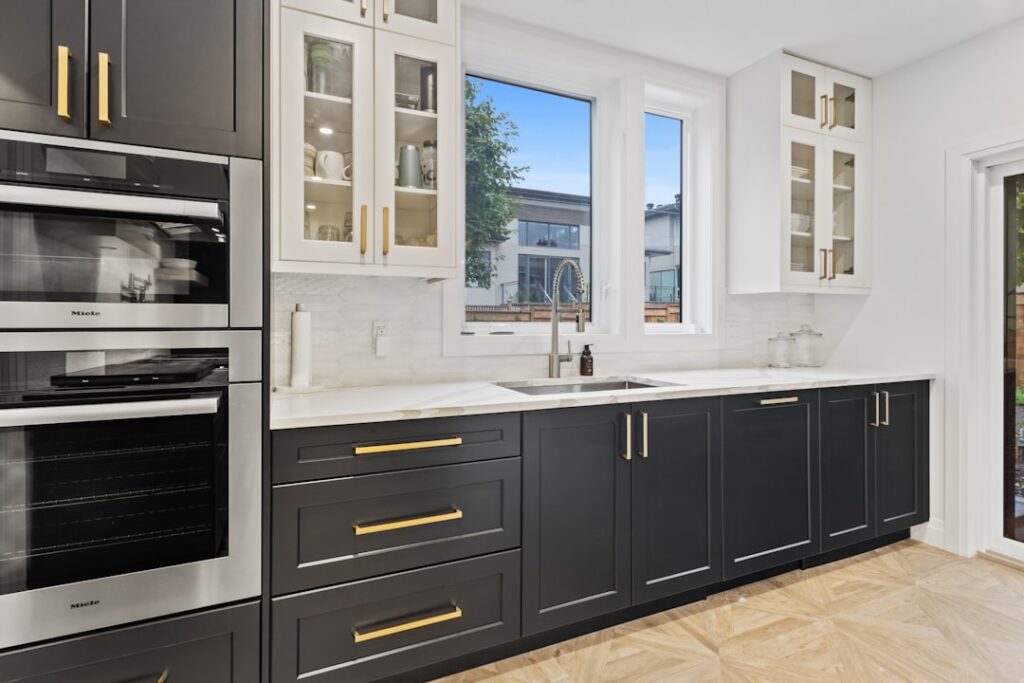
If your cabinet boxes are solid but the doors look dated, refacing gives you a brand-new kitchen for a fraction of a full replacement. So how much does it cost to reface kitchen cabinets? For a typical kitchen, expect to pay between $4,000 and $10,000, with most homeowners landing around $7,000 for a professional job. The final number swings widely based on the material you choose, the size of your kitchen, and whether you hire a pro or tackle it yourself. This guide breaks down every cost factor so you can budget accurately and decide whether refacing beats replacing for your situation.
What Cabinet Refacing Includes
Refacing keeps your existing cabinet boxes in place and replaces or covers everything you see. The doors and drawer fronts get swapped for new ones, and the exposed box faces and sides get covered with a matching veneer or laminate skin.
A complete refacing job typically includes new doors and drawer fronts, new veneer over the face frames and end panels, new hinges and drawer glides, and fresh hardware like knobs and pulls. Because the structural boxes stay, you avoid the demolition, plumbing, and electrical work that a full replacement demands. The result looks like new cabinetry, but the bones of your kitchen never change, which is exactly why it costs so much less than gutting the space.
Average Cost Ranges
Pricing tracks closely with the material and the kitchen size. Here is what to expect for a standard 10 by 12 foot kitchen with roughly 25 to 30 linear feet of cabinets.
- Rigid thermofoil (RTF): $4,000 to $6,000. The budget-friendly option with a durable plastic-laminate door face.
- Wood veneer: $6,000 to $9,000. Real wood veneer over the boxes with solid or veneered doors for an authentic look.
- Laminate and plastic laminate: $5,000 to $8,000. Durable and available in many colors and patterns.
- Solid wood doors: $8,000 to $12,000 or more. Premium hardwood doors deliver the highest-end result.
Per linear foot, refacing generally runs $150 to $350 installed. A large or U-shaped kitchen with 40-plus linear feet can push the total well past $12,000, while a compact galley kitchen might come in under $4,000.
What Drives the Price Up or Down
Several factors move your quote within, or beyond, those ranges. Knowing them helps you control the budget.
Kitchen size and layout
More cabinets mean more doors, more veneer, and more labor. A kitchen with an island, tall pantry cabinets, or lots of glass-front uppers costs more than a simple straight run.
Material and door style
Solid wood costs more than thermofoil or laminate. Intricate door styles like raised-panel or shaker with detailed profiles carry a premium over flat slab doors.
Hardware and extras
Soft-close hinges, full-extension drawer glides, and upgraded knobs and pulls add up. New crown molding, under-cabinet lighting, or added roll-out shelves each raise the total.
Labor and location
Professional labor is 40 to 60 percent of the cost, and rates run higher in major metro areas. A complex job with lots of custom fitting costs more in labor hours.
DIY Refacing Costs
Doing it yourself slashes the price dramatically since labor disappears. A DIY refacing kit with peel-and-stick veneer, new doors, and drawer fronts runs $1,000 to $4,000 in materials for an average kitchen, depending on the door quality you select.
The savings are real, but so are the demands. Applying veneer smoothly without bubbles, cutting precise fits around corners, and hanging doors perfectly level takes patience and decent tool skills. A misaligned door or a bubbled veneer panel undercuts the whole look. Budget a few weekends and expect a learning curve. For handy homeowners, DIY refacing can cut the cost by half or more compared to a pro, but the finished quality depends entirely on your care and precision.
Refacing vs. Replacing vs. Painting
Refacing sits in the middle of three common cabinet upgrade paths, and choosing the right one depends on your budget and the condition of your existing cabinets.
- Painting: The cheapest at $1,000 to $3,500. Refreshes the color but keeps the same doors and shows wear over time. Best when you like your door style and just want a new color.
- Refacing: The middle option at $4,000 to $10,000. New doors and surfaces without the disruption of demolition. Best when the boxes are sound but the look is dated.
- Replacing: The priciest at $12,000 to $30,000-plus. Brand-new boxes and doors, plus the ability to change the layout. Best when the boxes are damaged or you want a different configuration.
Refacing typically saves 30 to 50 percent versus full replacement while delivering a comparable visual result, which is why it appeals to so many remodelers.
When Refacing Is Worth It
Refacing pays off when your cabinet boxes are structurally sound and you are happy with your kitchen’s current layout. If the boxes are made of solid plywood or quality particleboard, are square, and function well, covering them with new faces makes sense.
It is the wrong move if the boxes are water-damaged, sagging, falling apart, or made of low-grade material that will not hold new veneer well. Refacing also can’t change your layout, so if you want to move cabinets, add an island, or reconfigure the space, you need replacement. As a general rule, if you would keep the same footprint and the boxes are in good shape, refacing gives you the biggest visual payoff for the money.
Ways to Save on Refacing
A few strategies trim the cost without cheapening the result. Get at least three quotes, since refacing prices vary widely between contractors for the same work. Choose a mid-range material like laminate or thermofoil rather than solid wood if budget is tight; the durability is excellent and the price is far lower.
- Reface only the visible cabinets and skip interior boxes you never see.
- Reuse hardware if it is still in good shape rather than buying all-new.
- Handle the demo of old doors and hardware yourself before the crew arrives.
- Schedule during a contractor’s slow season, often late winter, for better pricing.
Weigh the material, size, and labor factors against your budget, and refacing kitchen cabinets delivers a fresh, updated kitchen at roughly half the cost of tearing everything out. For most homeowners with solid boxes and a layout they like, it is the smartest value in a kitchen refresh.