Straight answer first: how much is a 10 yard truck of concrete comes down to your local per-yard rate times ten, plus fees — which in 2026 means $1,300 to $2,200 delivered for a full truck of standard 3,000 to 4,000 psi mix in most U.S. markets, with $1,500 to $1,800 the common middle. Anyone pricing a driveway or big slab should understand what sits behind how much is a 10 yard truck of concrete: the per-yard base rate, the add-on fees that plants layer on, and whether you need a pump truck on top. Here is the full picture with worked examples.
Per-Yard Pricing in 2026
Ready-mix is quoted per cubic yard, and the base rate moves with cement prices, diesel, and your distance from the plant:
- National range: $125 to $220 per cubic yard for standard mixes
- Typical middle: $150 to $180 per yard for 3,500 psi
- Strength premiums: figure $5 to $15 per yard per 500 psi step — 3,000 psi at the low end, 4,500 to 5,000 psi (exposed exterior work in freeze climates) at the top
- Common upcharges: fiber reinforcement $8 to $15 per yard, mid-range water reducer or accelerator $5 to $12, air entrainment often included where climate demands it, integral color $25 to $70 per yard
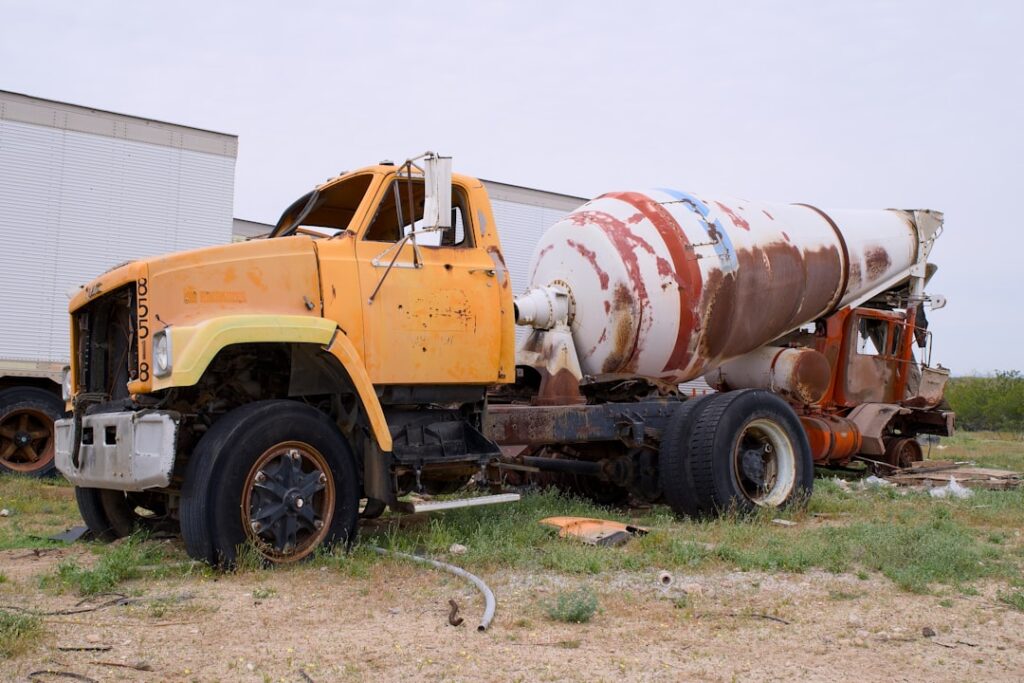
A full standard mixer truck legally hauls 8 to 11 yards depending on the truck and local axle-weight laws; 10 yards is the classic “full load,” and full loads get the best per-yard pricing because the plant’s fixed costs ride on one trip.
The Fee Sheet: What Gets Added to the Ticket
Plants publish a base rate and make their margin on the schedule of fees. The ones that show up on real invoices:
- Delivery/fuel surcharge: $50 to $150 per load, sometimes baked into the yard rate within a radius and charged per mile beyond it ($5 to $10 per mile)
- Short-load fee: the one that stings — orders under a threshold (commonly 8 to 10 yards) pay $40 to $110 per missing yard or a flat $75 to $200. A 4-yard order can carry $250+ in short-load penalty, which is why full-truck jobs are the sweet spot
- Unload time: 4 to 7 minutes per yard free (40 to 60 minutes on a full truck), then $2 to $3 per minute standby. A slow wheelbarrow crew can donate $150 to the plant
- Saturday delivery: $75 to $200; before-6 a.m. pours in hot climates similar
- Environmental/washout fee: $10 to $30
- Winter heated mix or chloride accelerator: $10 to $20 per yard
- Returned-concrete/cancellation fees if you bounce a scheduled load: $150 to $500
What 10 Yards Actually Covers
Volume math so you know whether a full truck is your order. Ten cubic yards = 270 cubic feet, which pours:
- 810 sq ft at 4 inches thick — a 20 x 40-foot driveway with margin
- 540 sq ft at 6 inches — a 24 x 22-foot two-car garage slab at truck-rated thickness
- About 65 linear feet of 16 x 8-inch footing plus a small pad
Work backward from your dimensions: length × width × (thickness in inches ÷ 12) ÷ 27 = yards. A 20 x 30 patio at 4 inches is 20 × 30 × 0.333 ÷ 27 = 7.4 yards — order 8 with a waste factor. Always add 5% to 10% for grade variation and spillage; running two yards short mid-pour means a cold joint plus a short-load fee on the rescue truck, the most expensive concrete you will ever buy.
Worked Totals: Three Real Orders
- Full 10-yard driveway pour, 3,500 psi with fiber, 12 miles from the plant: 10 × $165 = $1,650, fiber $100, delivery $85, washout $20 — $1,855 delivered. Finishing labor (forms, pour, broom finish, cure) hired at $3 to $6 per sq ft would add roughly $2,400 to $4,900 on the 810 sq ft.
- 6-yard garage-addition slab: 6 × $170 = $1,020 plus short-load fee ($75/yard × 4 missing = $300, capped by some plants at $200), delivery $85 — about $1,300 to $1,400. Note how the per-yard effective cost jumped from $185 to $225.
- 3-yard sidewalk-and-stoop order: 3 × $175 = $525, short-load $200, delivery $85 — $810, or $270 per yard. At this scale, compare a U-cart/tow-behind trailer (about $1 per yard-mile plus $120 to $200 rental) or 45 bags of 80 lb mix per yard at $5 to $7 a bag.
When You Need a Pump Truck Too
Mixer chutes reach about 12 to 16 feet off the back of the truck. Backyard slabs behind the house, basement floors, and anything the 70,000 lb truck cannot legally park next to (most residential driveways cannot take a loaded mixer — drivers stay on the street for good reason) need help getting the mud there. Options and prices: a line pump (trailer pump pushing through 2 to 3-inch hose) runs $500 to $900 for a typical residential day including an operator minimum; a boom pump for high or far placement runs $900 to $1,800; and the old-school answer — six guys and wheelbarrows — burns your free unload minutes fast at roughly one yard per 8 to 10 minutes of hard pushing. On any pour over 5 or 6 yards without direct chute access, the line pump pays for itself in standby fees avoided and cold-joint risk eliminated.
Ordering Like You Have Done It Before
The phone call to the dispatcher goes better with this checklist ready:
- Yards needed (with your waste factor already added) and the psi/mix spec — say what it is for and let them recommend the mix and air content
- Slump request (4 to 5 inches typical for flatwork; do not order soup to make finishing easy — added water costs strength, about 5% per extra inch of slump)
- Delivery address, truck access notes, and where the truck will stand
- Date and first-load time; morning slots go first, book 3 to 7 days ahead in season
- Unload method — chute, pump (book the pump separately and tell each company about the other), or barrows — so dispatch schedules realistic truck spacing
- Ask directly: current fuel surcharge, short-load threshold, free unload minutes, and standby rate. Get the quote emailed.
Pour-Day Logistics That Protect Your Money
The truck is on the clock the moment it arrives, so pour day should run like a pit stop. Have forms braced, base compacted and damp, rebar or mesh chaired, and every tool staged — screed board, bull float, mag floats, edgers, groover, and a backup wheelbarrow — before the scheduled window. Crew sizing for a full 10 yards of flatwork: minimum four people (two on the chute and screed, one raking and directing, one floating behind), five or six if any barrowing is involved. Weather rules the schedule: below 40°F you need blankets and possibly heated mix; above 90°F, order a retarder or pour at first light, because a hot, windy afternoon can take a slab from workable to crusted in 45 minutes. Ask dispatch to stage multi-truck orders 45 to 60 minutes apart rather than back-to-back — standby fees on truck two erase any time saved. Two contract details worth confirming in writing: who is liable if the truck must leave the pavement (plants make you sign a damage waiver to cross a sidewalk or driveway), and what happens to returned yardage. And finally, curing is free strength — keep the slab wet or membrane-cured for 7 days and it will reach roughly 70% of design strength; walk on it at 24 to 48 hours, park on it at 7 days minimum, 28 for heavy vehicles.
Bottom-Line Numbers to Remember
A 10-yard truck of concrete costs $1,300 to $2,200 delivered, call it $1,600 in an average market; the concrete itself is $15 to $22 per finished square foot cheaper than most people fear once spread across 800 square feet — material lands around $2 to $2.50 per square foot of 4-inch slab. Fees punish small orders and slow crews, full trucks get the best unit price, and the pump is cheap insurance whenever the chute cannot reach. Price two or three plants (rates spread 15% in the same town), have forms, base, and crew genuinely ready before the truck rolls, and the delivered-concrete line will be the most predictable number on your whole project.