Drywall is the rare building material you cut mostly without a saw — and watching someone saw laboriously through a full sheet is the fastest way to spot a first-timer. Learning how to cut drywall means learning one core move, the score and snap, plus a small family of specialty cuts for boxes, circles, and notches. Master those and every sheet in the house takes seconds to size, with edges clean enough that finishing never has to compensate. This guide covers each technique, the four tools worth owning, and the measuring tricks that make cuts land right the first time.
The Tools: $40 Covers Everything
Four tools handle 99 percent of drywall cutting, and the whole set costs less than one sheet of specialty board:
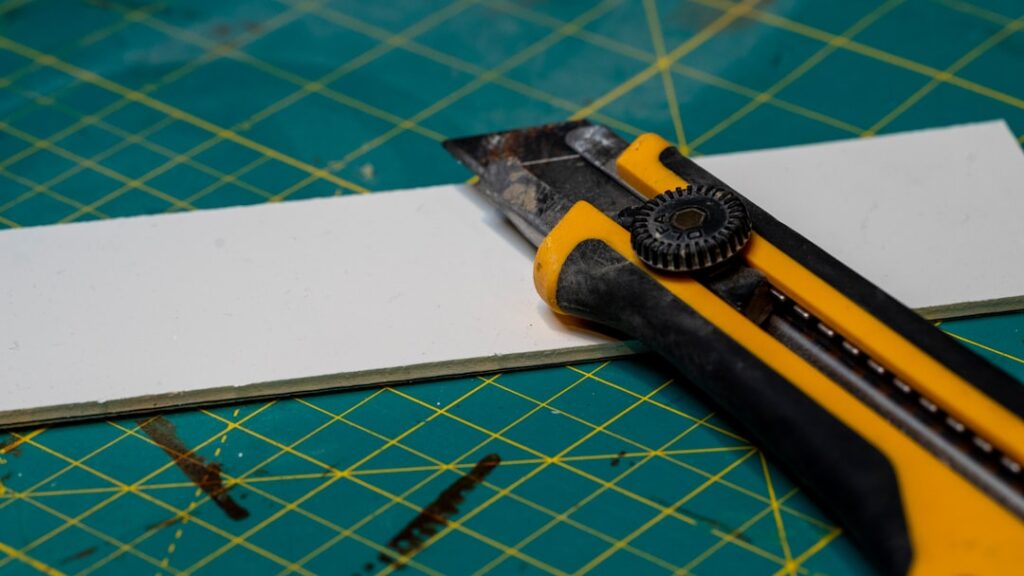
- Utility knife ($8 to $15) — the primary cutter. Buy extra blades and change them often; a dull blade tears paper instead of slicing it, and torn paper edges fuzz up under joint compound.
- 4-foot drywall T-square ($15 to $25) — spans the sheet’s width for dead-straight score lines and doubles as a rip guide.
- Jab saw (keyhole saw, $8 to $12) — a stiff pointed blade you can stab through the board for cutouts and openings.
- Rasp ($6 to $10) — shaves a proud edge flush in two strokes, far faster than recutting.
Worth adding for volume work: a spiral cut-out tool (RotoZip-style, $60 to $100) that traces electrical boxes in seconds, a compass/circle cutter ($12) for recessed lights, and an oscillating multi-tool for cutting openings in board that is already hung.
Score and Snap: The Fundamental Cut
Every straight cut is the same four beats. Mark the length on the sheet’s face, top and bottom. Hold the T-square on the marks and draw the knife down its edge once, with firm pressure — you are cutting the face paper and barely denting the gypsum, not sawing through the core. Snap the sheet away from the scored face with a sharp bump of your knee behind the cut line; the core breaks cleanly along the score. Finally, fold the waste back and slice the back paper along the crease to free it. Total time, under thirty seconds for a full-width cut.
Two details produce the clean edge. Score in one confident pass rather than several tentative ones — repeated strokes wander and chew the paper. And always score the face side, so any raggedness lands on the back where it does not matter. If the edge lands slightly proud during fitting, do not recut; two strokes of the rasp remove 1/16 inch cleanly.
Rips: Long Cuts Down the Sheet
Cuts along the sheet’s length outrun a 4-foot square, and there are two good answers. Snap a chalk line between end marks and freehand the score against it — steadier than it sounds if you watch the line ahead of the blade rather than the blade itself. Or use the tape-measure trick pros use for speed: pinch the tape at the rip width with the knife blade held against the tape’s hook-end mark, then run knife and tape together down the sheet, letting your pinching fingers ride the sheet edge as a fence. Practice it once on scrap and narrow rips take ten seconds. Snap and finish the back paper exactly as with a crosscut.
Cutouts for Electrical Boxes
Box cutouts sink more sheets than any other cut, and precision beats speed: a cutout more than 1/8 inch oversize needs patching before finish. The measuring method: from the edge of the last-hung sheet and from the ceiling or floor reference, measure to both sides and the top and bottom of the box, transfer the rectangle to the sheet, stab the jab saw through and cut on the waste side of the lines. The transfer method for awkward spots: rub the box rim with chalk, lipstick, or a builder’s crayon, position the sheet exactly, press it against the box, and cut the printed outline the paper picks up.
A spiral cut-out tool changes the workflow: hang the sheet with screws kept away from the box, plunge the guide-point bit inside the box outline, ride it out to the box edge, and trace the outside counterclockwise. The bit follows the box like a router bearing, producing a perfect cutout in ten seconds — this is how production hangers do every box in a house.
Circles, L-Cuts, and Notches
Round cuts for recessed lights and vents come three ways: a compass-style circle cutter scores the arc for a snap-out, an adjustable hole saw in a drill bores clean holes up to about 7 inches, and the spiral tool freehands any radius against a traced line. For L-shaped cuts around doors, windows, and outside corners, mix tools: saw the short leg of the L with the jab saw, then score and snap the long leg — snapping both legs of an L tears the inside corner. Notches for outlets at sheet edges work the same way: two saw cuts in, one score across. When an opening must be cut after the board is already hung — a forgotten box, a new penetration — the oscillating multi-tool cuts flush and shallow without punching into wires behind the board.
Measuring Tricks That Prevent Redos
Cut errors are almost always measuring errors. Measure twice, and measure from the same reference the sheet will actually touch — the edge of the previously hung board, not the corner of the room, because rooms are never square. Write measurements on the sheet itself, not your memory. Subtract 1/8 inch from tight dimensions; drywall wants breathing room, and forcing a snug sheet crumbles edges and bows the panel (the rasp fixes proud, nothing fixes shattered). Mark the face, cut the face, and keep the factory tapered edges for field seams — send your cut edges to floors, ceilings, and corners where trim and tape forgive them. These habits feed directly into good hanging; the layout logic behind which edge lands where is covered in our how to hang drywall guide.
Cutting Specialty Boards
Not every panel cuts like standard 1/2-inch. Type X fire-rated board (5/8 inch) has glass fibers in the core, so score deeper and expect a firmer snap — two knife passes help. Moisture-resistant green and purple boards cut normally but dull blades faster; change blades more often. Cement backer board is a different animal entirely — score with a carbide scriber, not your utility knife, or cut with a diamond blade outdoors. And ultralight 1/2-inch panels snap so easily that overenthusiastic knee bumps can break them off-line; let the score do the work. Whatever the board, support the sheet on both sides of the cut across sawhorses or against the stack so the snap breaks at the score rather than somewhere gravity chooses.
Dust, Safety, and Cleanup
Score-and-snap cutting is nearly dustless — one of drywall’s mercies — but saw and spiral-tool work throws fine gypsum dust that lingers for days. Wear an N95 for any powered cutting, and glasses always with the spiral tool, which sprays chips at eye height. Before any plunge cut into hung board, confirm what is behind: wires staple to studs within reach of every box, and pipes run wherever they please. Sweep-cut shallow with the multi-tool rather than stabbing deep with the jab saw in unknown territory. Keep a scrap-cut station on sawhorses near the door, bag offcuts as you go, and the trade’s most satisfying ritual — sheet scored, snapped, hung in under a minute — stays clean from the first board to the last. Cutting is the skill you use most and think about least on a drywall job — get it smooth and the whole project accelerates. For where it fits in the larger sequence, from estimating sheets through taping and paint, see our full drywall installation walkthrough.