
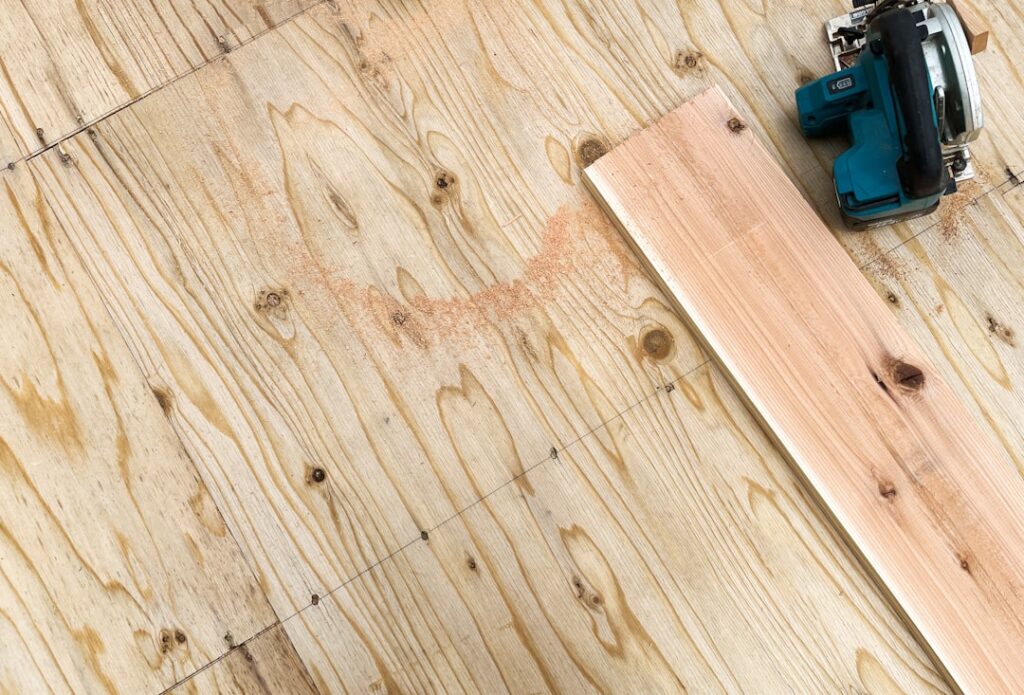
Power saws are the noisiest, dustiest part of a laminate install, and for apartment dwellers, night workers, or anyone cutting inside a finished room, they are often the dealbreaker. The good news: learning how to cut laminate flooring without a saw is entirely practical, because laminate’s brittle fiberboard core actually snaps cleanly once its hard surface is scored or sheared. Two silent, dust-free methods handle the vast majority of cuts in a typical room, a guillotine-style laminate cutter and the score-and-snap knife technique, and this guide covers both step by step, along with honest talk about edge quality and the few cuts where you will still want a powered blade.
Why Laminate Cuts Without a Saw at All
A laminate plank is a sandwich: a hard melamine wear surface over a printed layer, bonded to a high-density fiberboard (HDF) core with a balancing layer beneath. HDF is dense but brittle, it has no grain like real wood, so once the tough top surface is interrupted by a score line or a shearing blade, the core fractures along that line predictably, like snapping drywall or glass after scoring. That is the whole trick. The methods below simply differ in how the surface gets interrupted and how much force the process takes. Plank thickness matters: 7 to 8 mm product scores and snaps easily, 10 mm takes patience, and 12 mm is where knife methods get tiring and a guillotine cutter earns its price.
Method 1: The Guillotine Laminate Cutter (Best All-Around)
A laminate flooring cutter looks like an oversized paper guillotine: a long handle drives a hardened steel blade straight down through the plank in one squeeze. Models from Bullet Tools, Norske, Roberts, and Marshalltown run $60 to $150 for versions handling planks up to 8 to 13 inches wide, and rental counters at big-box stores often carry them for $15 to $25 a day. The workflow is quick:
- Mark the cut line with a speed square across the plank face.
- Set the plank decor-side up (check your model’s manual; most cut cleanest face-up) against the fence, aligning the mark with the blade.
- Pull the handle down smoothly in one continuous stroke. The shear severs the plank instantly, no dust, no noise beyond a thunk.
Expect clean, square crosscuts all day at a pace faster than a miter saw once you find a rhythm. Two honest limitations: the shearing action slightly compresses the cut edge, occasionally leaving a small chip or a rolled edge on brittle high-gloss laminates, so keep sheared ends against walls where baseboard hides them; and most guillotines only crosscut, they cannot rip a plank lengthwise or cut curves.
Method 2: Score and Snap With a Utility Knife
The zero-equipment option needs only a sharp utility knife with fresh blades, a metal straightedge, and something to snap the plank over. It is slower per cut but silent, free, and surprisingly clean:
- Mark the line and clamp a straightedge along it, a level, a framing square, or another plank held very firmly.
- Score the decorative face repeatedly, starting with light passes to establish the track, then five to ten firmer passes. The goal is cutting fully through the hard melamine layer and into the core about 1 to 2 mm. Swap blades often; melamine dulls edges fast.
- Snap upward along the score. Position the score line over a table edge or a scrap plank, hold the supported side down, and pull the overhang up sharply. The plank breaks along the score, with the clean face on the scored side.
- Tidy the underside if needed with a knife pass or a few strokes of 100-grit sandpaper on a block.
This method shines on 7 to 8 mm planks and works for lengthwise rip cuts too, score with the straightedge run along the plank’s length and snap over a table edge. On 10 to 12 mm laminate, scoring takes real arm work and the snap needs more leverage; it remains doable, just budget the effort. Edge honesty: the scored face breaks crisply, but the back edge can splinter slightly, so orient the good face up and the cut end toward the wall.
Handling Notches and Curves Without Power
Doorways, vent registers, and jamb notches are where straight-line methods struggle. For an L-shaped notch, score both lines deeply, then score an X across the waste area and snap the pieces out in stages, finishing corners with knife cuts. Aviation snips can nibble thin laminate along a scored curve, and a coping saw or hacksaw blade in a handle (technically saws, but silent hand tools most homes already own) manages radius cuts around toilet flanges and pipes. Drill-through holes for pipes come from a spade or hole-saw bit in a cordless drill, again quiet and dust-light. Perfection is unnecessary here: every one of these cuts hides under trim, escutcheons, or transition moldings, and a 1/4 inch expansion gap is required anyway.
When a Jigsaw Is Still the Right Call
Fairness requires the caveat: a jigsaw with a fine, down-cutting laminate blade ($8 to $12) remains the best tool for long curved cuts, intricate door-casing scribes, and mid-plank cutouts, and it is cheap to rent or borrow. If your room involves a curved hearth, a bay of angled walls, or column wraps, plan on borrowing one for that hour even if the guillotine and knife handle the other 95 percent of cuts. The point of going saw-free is avoiding dust and noise for the bulk of the job, not proving a point on the one cut that genuinely wants a blade.
Edge Quality: What to Expect and How to Hide Flaws
Set expectations honestly. A sharp miter saw leaves the crispest edge; a guillotine comes close with slight compression; score-and-snap gives a clean face and a slightly rougher back. None of that matters in practice if you follow the installer’s rule: cut ends go toward walls, where baseboard and quarter-round cover them, and factory edges meet factory edges in the field of the floor. Lightly ease any splintered edge with sandpaper so it does not hold up the next plank, check that no debris sits in the click channel, and a snapped cut is functionally identical to a sawn one.
The Bottom Line
For a standard rectangular room, how to cut laminate flooring without a saw comes down to two tools: a $60 to $150 guillotine cutter for fast, silent crosscuts, and a utility knife with a straightedge for rips and the occasional notch, with a borrowed jigsaw on standby for true curves. You give up almost nothing in edge quality once cut ends are tucked under trim, and you gain a dust-free room, quiet evening work hours, and one less power tool to buy. Score firmly, snap confidently, and keep fresh blades in the knife, the laminate does most of the work for you.
Prefer to explore on your own?
See how new flooring looks in your actual room in seconds — free, no signup.
Try the free Floor Studio →

