A permanent marker stain feels like a lost cause, but your clothes are far from ruined even if you have no rubbing alcohol in the house. Learning how to get sharpie out of clothes without rubbing alcohol means reaching for the everyday products already in your kitchen and bathroom, most of which dissolve marker ink just as well as isopropyl. The key is acting fast, working from the back of the stain, and choosing the right solvent for your fabric. Several proven methods below use nothing you would have to buy.
- Why Sharpie Is So Stubborn
- Hand Sanitizer: The Easiest Swap
- Hairspray Still Works on Alcohol-Based Formulas
- White Vinegar and Dish Soap
- Other Household Solvents to Try
- Removing Sharpie From Different Fabrics
- Speed Matters: Fresh vs Dried Stains
- How These Solvents Actually Break the Ink
- Always Test on a Hidden Spot First
- Finishing and What Not to Do
Why Sharpie Is So Stubborn
Sharpie ink is permanent because it uses a dye suspended in a solvent along with a resin that binds it to surfaces. Water alone does nothing, which is why plain laundering never lifts it. To break the stain you need something that redissolves that resin and dye, and plenty of household products do exactly that.
The good news is that alcohol-based rubbing alcohol is just one of many solvents. Hand sanitizer, hairspray, and certain cleaners all contain alcohols or surfactants that attack marker ink effectively. Understanding this lets you improvise with confidence.
Hand Sanitizer: The Easiest Swap
Alcohol-based hand sanitizer is the closest stand-in for rubbing alcohol because it contains the same active ingredient. Most sanitizers run 60 to 70 percent alcohol, plenty to dissolve Sharpie.
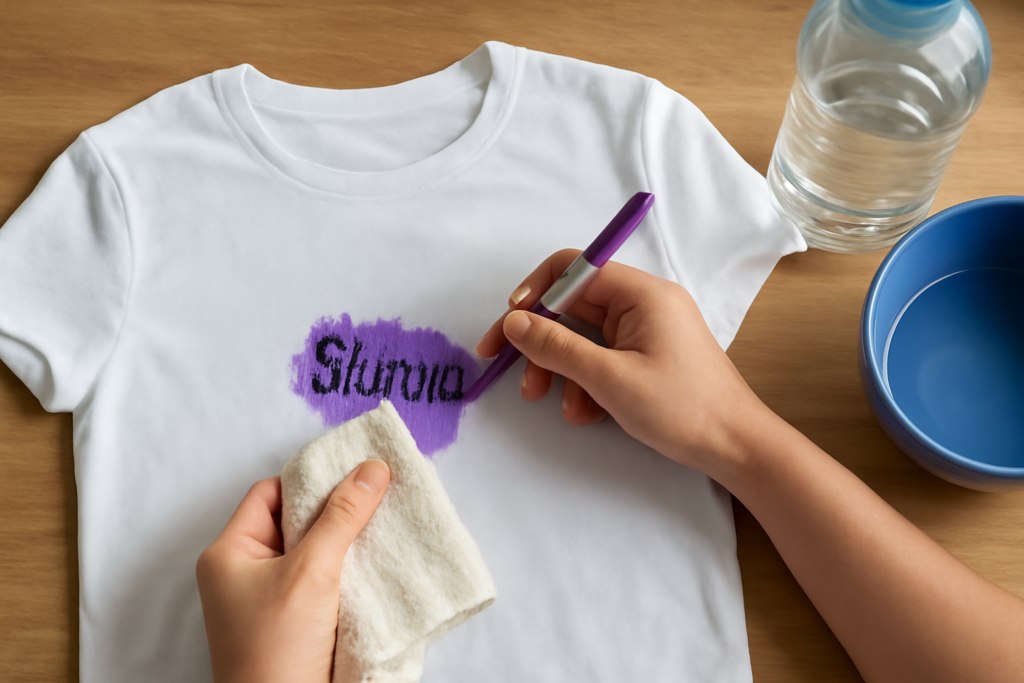
- Place a clean cloth or paper towel behind the stained fabric to catch the ink.
- Squeeze a generous dab of sanitizer directly onto the stain.
- Blot with a second clean cloth, working from the outside of the stain inward.
- Replace the backing cloth as ink transfers to it, so you never push ink back into the fabric.
- Repeat until no more ink lifts, then launder as usual.
Blotting, not rubbing, is what saves the garment. Rubbing spreads the dye and grinds it deeper, while blotting pulls it out into the backing cloth.
Hairspray Still Works on Alcohol-Based Formulas
Hairspray was the classic marker remover for decades because older formulas were loaded with alcohol. Many aerosol hairsprays still contain enough to break down Sharpie, so it is worth trying if you have a bottle.
Spray the stain until saturated, let it sit for a minute, then blot with a clean cloth over a backing towel. Check the label for alcohol in the ingredients; modern low-VOC and alcohol-free hairsprays will not work. If the ink starts to lift onto your blotting cloth, keep going, respraying and blotting until the stain fades.
White Vinegar and Dish Soap
For a gentler, non-alcohol approach that suits delicate fabrics, combine white vinegar with dish soap. The acid in vinegar loosens the ink while the surfactants in dish soap lift it away.
- Mix one tablespoon of white vinegar with one tablespoon of liquid dish soap and two cups of warm water.
- Sponge the solution onto the stain and let it soak for 20 to 30 minutes.
- Blot and reapply, working the mixture in with a soft toothbrush for stubborn spots.
- Rinse and repeat before washing.
This method is slower than alcohol-based options but far kinder to fabrics like silk, wool, and anything you would not risk with a stronger solvent.
Other Household Solvents to Try
Several other common products contain solvents that dissolve permanent marker. Reach for whichever you have on hand and always test first.
- Nail polish remover with acetone: very effective, but harsh, so keep it off acetate, triacetate, and modacrylic fabrics.
- Non-oily hairspray or body spray: works if alcohol-based.
- Milk soak: soak the stained area in milk for several hours; the proteins can loosen fresh ink.
- Whitening toothpaste: its mild abrasives and detergents lift ink from sturdy cotton.
Whatever you choose, place a backing cloth behind the fabric and blot in the same outside-in pattern to keep the stain from spreading.
Removing Sharpie From Different Fabrics
Not every fabric responds the same way, and matching your method to the material prevents trading a stain for permanent damage. Sturdy fabrics tolerate strong solvents, while delicate ones need the gentlest approach.
- Cotton and denim: the most forgiving. Hand sanitizer, hairspray, or even acetone-based remover work well.
- Polyester and blends: respond well to hand sanitizer and dish-soap methods, but test first since some dyes bleed.
- Silk and wool: delicate. Stick to the mild vinegar-and-dish-soap soak and blot gently, never using acetone.
- Leather and suede: require specialized cleaners; household solvents can strip the finish or leave a mark.
The rougher and more durable the fabric, the more aggressive you can be. When in doubt about a garment you care about, start with the gentlest method and escalate only if it does not budge the ink.
Speed Matters: Fresh vs Dried Stains
How quickly you act has a huge effect on your success. A fresh Sharpie mark, still slightly wet, lifts far more easily than one that has dried and set into the fibers over days.
The moment you notice the stain, blot up any excess ink with a dry cloth, then get to treating it. Fresh ink has not yet fully bonded, so the first solvent application often removes most of it. A stain that has been through the wash and dryer is the hardest case, because heat sets the dye, but even old marks usually respond to repeated treatments. Patience and persistence beat a single heavy-handed attempt, so plan on treating a set-in stain two or three times.
How These Solvents Actually Break the Ink
Understanding why these household products work helps you choose the best one for a given stain and improvise when you are out of your first choice. Permanent marker ink is made of colored dye, a resin binder, and a carrier solvent, and the dye stays put because the resin grips the fibers as the carrier evaporates.
To lift the stain, you have to redissolve that resin so the dye lets go. Alcohol-based products like hand sanitizer and many hairsprays do this because alcohol is a solvent chemically similar to the ink’s original carrier, so it loosens the resin on contact. Acetone in nail polish remover works the same way but more aggressively. The vinegar-and-soap method takes a gentler route, using mild acid to weaken the bond while surfactants surround and float away the freed dye. Once you see the stain as a resin problem rather than a color problem, choosing an effective solvent becomes straightforward.
Always Test on a Hidden Spot First
Solvents that dissolve ink can also dissolve dyes and damage some fabrics, so a spot test is not optional. Apply a small amount of your chosen remover to an inside seam, waistband, or hem, then wait a few minutes.
Watch for the garment’s own color transferring onto your cloth or any change in the fabric’s texture. If the material or dye reacts, switch to the gentler vinegar-and-soap method. Delicate and colored fabrics deserve extra caution, since a stronger solvent could trade a marker stain for a bleached patch.
Finishing and What Not to Do
After the stain has lifted as much as it will, launder the garment normally in the warmest water the fabric allows, then air dry. Do not put it in the dryer until you are certain the stain is gone, because dryer heat bakes any remaining ink permanently into the fibers.
If a faint shadow lingers after the first treatment, repeat the process rather than reaching for bleach, which can set some inks and damage the fabric. Patience and repetition beat brute force every time. With a little hand sanitizer or a vinegar soak and the right blotting technique, most Sharpie stains come out completely, no rubbing alcohol required.