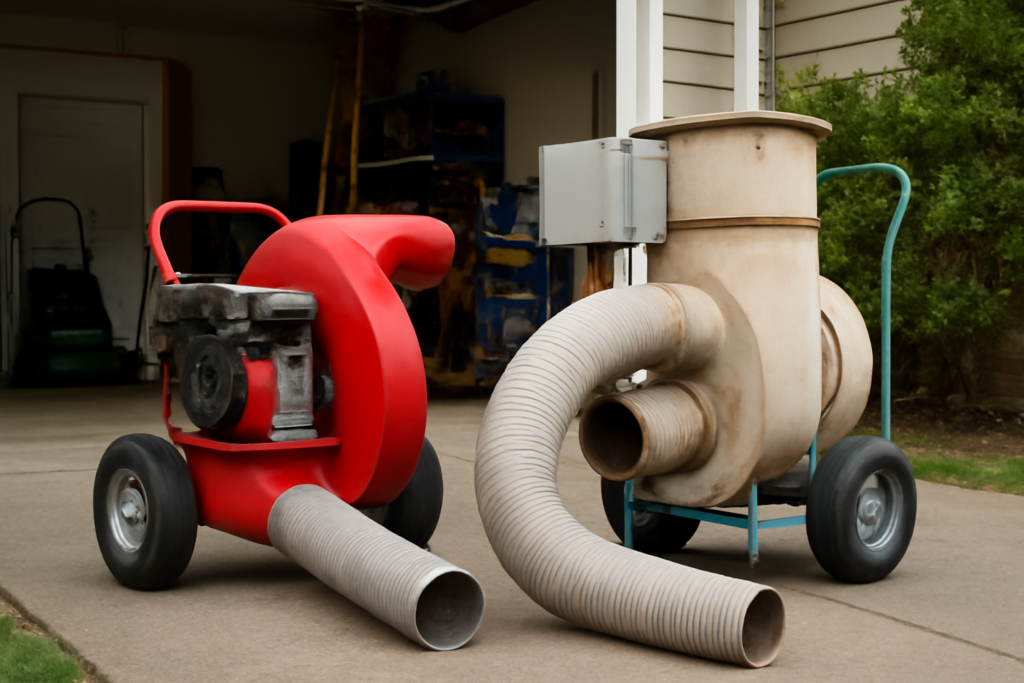
A shop vac tops out around 150 CFM and clogs on the first shovelful of cellulose; a purpose-built insulation vacuum moves 1,200 to 3,700 CFM and will empty a 1,500-square-foot attic in a working day. That gap is why attic remediation crews haul a dedicated machine on a trailer instead of fighting the job with consumer gear. This guide covers the equipment itself — engine types, airflow specs, hoses, bags, rental economics, and how to shop the used market without buying someone else’s worn-out impeller.
How These Machines Are Built
Every insulation vacuum is the same basic architecture: an engine or motor spins a large steel or aluminum impeller inside a housing; suction pulls loose insulation up an intake hose, through the impeller, and out a discharge port into a collection bag or a trailer. Two design details matter more than anything on the spec sheet. First, the impeller must be a material-handling design — insulation, staples, and the occasional mouse skeleton pass directly through the fan, so blades are thick steel, often with replaceable wear plates. Serrated or notched impellers (Meyer, Intec) shred material as it passes, packing 30-50 percent more into each bag. Second, the housing needs an accessible cleanout, because you will eventually feed it a chunk of batt that wads up.
Gas vs. Electric
Gas machines: the production standard
Serious removal rigs run gasoline engines — typically a Briggs Vanguard, Honda GX, or Kohler between 14 and 40 HP. Representative machines: the Intec Cyclone 84140 (14 HP Kohler, about 2,000 CFM), the Meyer 22-HP Hurricane, and the big Cool Machines CM3500 class units in the 35-40 HP range pushing 3,000-3,700 CFM. Advantages are obvious: no power dependency at an occupied or unpowered house, and enough airflow to pull wet, compacted, or rodent-matted cellulose 150-plus feet. The machine stays outside on a trailer or truck bed — never run one in a garage — so exhaust and its 95-105 dB scream stay out of the house. Expect 300-600 pounds and a trailer or liftgate to move it. New prices run $6,000-$16,000 depending on horsepower.
Electric machines: retrofit crews and DIY
Electric units like the Intec Vortex or dual- and triple-motor vacs from Cool Machines use two or three universal motors and deliver roughly 200-400 CFM per motor. They’re 100-200 pounds, roll through a doorway, and can work indoors. The constraint is power: each motor wants its own 15-20 amp circuit, so a triple-motor unit needs three separate circuits and you’ll trip breakers finding out which outlets share one. Suction is adequate for dry blown fiberglass and cellulose over runs of 50-100 feet, marginal for wet or compacted material. New cost: $2,000-$5,500. For a one-house DIY removal, this class — or a rental gas unit — is the sane choice.
Specs That Actually Predict Performance
- CFM: the headline number. 1,000-1,500 CFM handles typical attics with sub-100-foot hose runs; 2,000+ CFM buys speed and tolerance for long runs and damp material. Roughly, a 23 HP machine removes 40-70 bags per hour in dry cellulose versus 15-25 for a dual-motor electric.
- Static pressure/lift: rarely published, but it’s why gas units keep pulling when the hose snakes up two stories. More horsepower equals more lift at the same CFM.
- Hose diameter: 6 inches is the removal standard; 4-inch moves less material and clogs on batting scraps, while 8-inch suits only the biggest machines. Vacuum hose is heavy-wall urethane or PVC at $8-$15 per foot, sold in 25 and 50-foot sections joined with steel couplers. Every coupling and every 90-degree bend costs airflow — plan the shortest, straightest run and expect real-world performance to drop noticeably past 100-150 feet of hose.
- Bag system: collection bags are woven poly, typically 75-95 cubic feet, filling to 40-70 pounds. Figure one bag per 40-60 square feet of attic at 12-inch depth; a 1,500-square-foot attic commonly produces 25-40 bags. Buy bags by the bale ($8-$15 each) and check your landfill’s rules — some require insulation double-bagged.
Rental Costs and the DIY Math
Insulation vacuums rent from specialty equipment houses and some Home Depot Rental locations for $150-$350 per day (electric at the low end, 14-23 HP gas at the high end), with weekly rates around 3-4x the daily. Hose sections and bags are usually add-ons, so a realistic one-day DIY removal budget looks like: $250 machine, $60 hose rental, $120 in bags, $80 landfill fee — call it $500-$600 plus a helper. Contractors charge $1-$2 per square foot for removal, so $1,500-$3,000 for that same attic; the rental saves real money if you can stomach the labor. Reserve ahead in spring and fall, and confirm the rental includes a spare bag clamp and the correct hose couplers — mismatched cam-lock sizes have killed many rental days.
One planning note: removal is a two-person job. One person works the attic feeding the hose; one stays at the machine swapping bags and clearing clogs. Budget a full day for anything over 1,000 square feet, longer if there’s rodent contamination requiring slow, careful work.
HEPA, Dust, and Safety
Standard insulation vacuums are not HEPA machines — the collection bag is the only filter, and fine dust escapes it. That’s acceptable for clean fiberglass and cellulose discharged outdoors. It is not acceptable for material contaminated with vermiculite (possible asbestos — stop and get it tested at a lab for about $50 before touching it) or heavy rodent waste where hantavirus is a concern; those jobs call for negative-air setups, true HEPA-filtered equipment, and often licensed abatement contractors. For ordinary removals, the attic worker needs an N95 minimum (a P100 half-mask is better), goggles, gloves, and a bump cap for truss nails, and the machine operator should stand upwind of the bag discharge. Kill power to the attic circuits before you start — you will vacuum over live cables and junction boxes you can’t yet see.
Workflow Details That Double Your Removal Rate
Machine specs set the ceiling; technique determines what you actually hit. Position the vacuum as close to the attic access as the property allows — every 25 feet of hose you delete is free CFM. Feed the hose mouth along the insulation surface in slow sweeps rather than plunging it in; burying the inlet chokes airflow and triggers clogs, while skimming keeps material entrained in a steady stream. Rake compacted or matted sections loose with a garden rake first, and cut any batting scraps into forearm-size pieces before they reach the hose, because a folded batt is the number-one clog. When a clog does hit, don’t keep revving — kill the throttle, break the hose at the nearest coupler, and clear it there; nine of ten jams sit at a coupler or the first bend. At the discharge end, swap bags at three-quarters full, not stuffed, so the bag throat still cinches cleanly, and stage full bags in a line for one loading pass at the end. Crews that run this rhythm routinely clear 1,000-plus square feet per machine-day; crews that fight clogs all afternoon blame the equipment.
Buying Used Without Getting Burned
Contractors turn over machines constantly, so Facebook Marketplace, auction sites, and insulation supply houses list used vacs at $1,500-$6,000 — often half of new. Inspect in this order:
- Impeller and housing: pull the inspection cover. Look for blade erosion (sandblasted thin edges from years of grit), cracked welds, and wallowed-out shaft bearings — grab the impeller and check for play. A worn impeller is a $400-$900 part.
- Engine hours and history: Honda and Vanguard engines are rebuildable and parts are everywhere; obscure engines are the risk. Cold-start it yourself. Blue smoke or a hunting idle means walk away or discount hard.
- Seals and gaskets: weak suction with a strong engine usually means leaking housing gaskets or a worn hose-inlet collar — cheap fixes, good negotiating levers.
- Run a material test: bring a garbage bag of loose insulation or shredded paper and actually vacuum it. Ten minutes of load testing reveals what an idle rev-up hides.
If you’re only clearing one attic, rent. If you’re a contractor adding removal services, a used 23 HP gas unit around $3,500 pays for itself in three or four jobs. Either way, match the machine to the hose run and the material in front of you — CFM you didn’t bring is the one spec you can’t fake in the field.