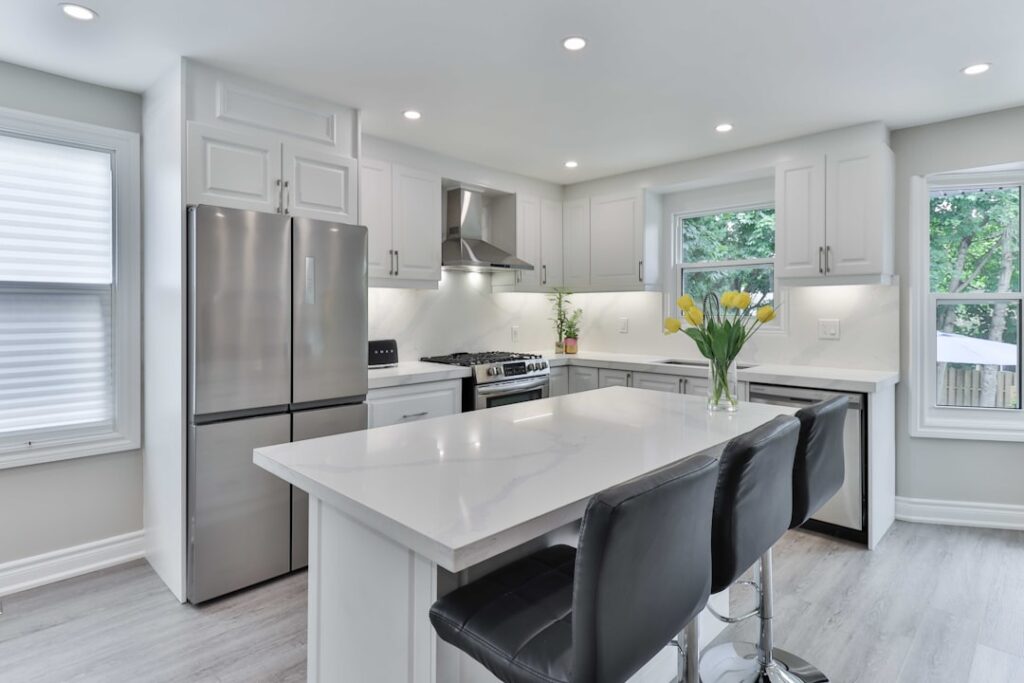
Replacing kitchen counters is one of the highest-impact remodels you can do in under a week, but the budget can balloon fast if you don’t plan ahead. Kitchen counter top replacement typically runs $40 to $150 per square foot installed depending on material, plus $200 to $800 in unexpected costs for plumbing, electrical, and backsplash work most homeowners overlook. After running this project hundreds of times across the country, here’s the playbook that keeps you on schedule and on budget.
- What Drives Kitchen Counter Top Replacement Cost
- Choosing the Right Material
- Templating and Lead Times
- Demo Day: Pulling Off the Old Counters
- Cabinet Prep Before the New Top Lands
- Installation Day Realities
- Backsplash Considerations
- Sink and Faucet Replacement
- Edge Profiles That Affect Cost and Look
What Drives Kitchen Counter Top Replacement Cost
Material is the biggest variable, but it’s not the only one. A typical 30-linear-foot kitchen with about 55 square feet of counter surface costs roughly $2,200 for laminate, $4,500 for butcher block, $5,500 for entry-level quartz, $7,500 for mid-grade granite, and $10,000-plus for premium quartz, marble, or quartzite.
The hidden costs that catch people off guard are the disconnect/reconnect of plumbing ($150 to $300), removing and resetting the cooktop ($75 to $150), the new sink and faucet (because you’ll want to upgrade them at the same time), and the backsplash damage from the old counter coming off (almost always at least partial replacement). Budget another 15 percent over the slab quote for these line items.
Choosing the Right Material
Quartz is the dominant choice for new replacements because it’s non-porous, doesn’t need sealing, and resists most stains. Brands like Caesarstone, Cambria, Silestone, and MSI Q hover between $50 and $100 per square foot installed for popular colors. Premium veined quartz like Cambria Brittanicus or Caesarstone Calacatta Nuvo runs $90 to $130.
Granite still has loyal fans for the unique stone variation. Expect $40 to $90 per square foot installed for tier-1 colors, $80 to $150 for exotics. Granite needs sealing every 12 to 18 months — a $20 bottle of StoneTech Bulletproof Sealer and 30 minutes of work. Quartzite (a natural stone, not engineered) runs $75 to $200 per square foot and offers the durability of granite with the look of marble.
Templating and Lead Times
For stone or quartz, the fabricator templates after your old counters are removed and the cabinets are level. Templating takes about 90 minutes for a typical kitchen. Most fabricators digital-template using LT-2D3D or similar laser systems, which capture the cabinet geometry to within 1/32 of an inch.
From template to install runs 7 to 14 business days depending on the fabricator’s backlog. During peak remodel season (April through October), expect the longer end of that range. Plan a temporary kitchen setup — a card table with a hot plate, a microwave, and a cooler — because you’re without counters for that period.
Demo Day: Pulling Off the Old Counters
Day one is demolition. Disconnect the sink drain and water supplies, cap them, then loosen the sink clips. The countertop itself is held with construction adhesive, screws from underneath, or both. For laminate, cut through silicone caulk at the wall, find screws driven up from inside the cabinet, remove them, and tilt the counter up.
For stone, expect breakage during removal — that’s expected since the slab is going to landfill anyway. Wear safety glasses and heavy gloves. Two people minimum for any 8-foot stone section, three for anything longer. Stone tops can weigh 20 pounds per square foot. A typical L-shaped kitchen counter weighs 600 to 1,200 pounds.
Cabinet Prep Before the New Top Lands
Take advantage of the window with no countertop in place. Tighten loose cabinet boxes, shim any sagging cabinets back to level, and replace damaged plywood tops where the previous counter sat. Verify the upper cabinet face frames are plumb — if they’ve shifted, fix them before the new top arrives so it sits tight against the wall.
Run new electrical for under-cabinet lighting if you’ve wanted it. Pull the cooktop and check that the cabinet cutout will fit your new range or cooktop spec. Many older kitchens had 30-inch slide-in ranges that need a 30-1/8 inch opening — induction cooktops sometimes need 31-inch openings. Better to widen the hole now than after the stone is on.
Installation Day Realities
Installation takes most of a day for a typical kitchen. The crew arrives with the slabs already cut, edged, polished, and labeled. They dry-fit each piece, run beads of structural silicone or polyester glue along the cabinet rails, and lower the slabs into place. Seams between pieces get filled with color-matched epoxy and razored flat.
Plumbing reconnect is rarely included. Schedule a plumber for day two or three after install — sealing silicone needs 24 hours to cure before you stress the joints with sink installation. Garbage disposals, dishwasher air gaps, and water filter taps all add labor. A typical sink reconnect runs $200 to $400 if no parts need replacement.
Backsplash Considerations
Removing old counters almost always damages the existing backsplash, especially if it’s tile that runs to the cabinet underside. Plan to replace the backsplash as part of the project. Subway tile in the 3×6 inch format runs $8 to $15 per square foot installed and is the safest aesthetic bet for resale.
A full-height backsplash slab using the same quartz as your counter is the current premium look. Add about 30 percent to the slab budget for the additional square footage. Slab backsplash eliminates grout cleaning entirely and gives the kitchen a continuous surface that reads as designer-grade.
Sink and Faucet Replacement
Replace the sink during the kitchen counter top replacement, not after. Cutting a sink hole into installed stone is risky and expensive. Single-bowl 30-inch undermount sinks dominate today’s specs — Kraus KWU111-30 or Ruvati RVH7400 in 16-gauge stainless run $250 to $500 and outlast cheap sinks two decades.
For faucets, Moen, Delta, and Kohler dominate replacement parts availability. The Moen Arbor and Delta Trinsic both run $250 to $450 with pull-down sprays and lifetime warranties. Avoid no-name imports — the cartridges fail in 5 years and you can’t find replacements.
Edge Profiles That Affect Cost and Look
Eased (a slight rounded corner) and squared (90-degree) edges are usually included in the base price. Beveled, ogee, full bullnose, and waterfall edges add $5 to $25 per linear foot. Mitered waterfalls down the side of an island add hundreds depending on slab thickness — 3cm material is harder to miter than 2cm.
For a clean modern kitchen, an eased edge in 2cm or 3cm thickness is timeless. For traditional, an ogee edge fits. Avoid bullnose unless you specifically want a 1990s look — it dates the kitchen instantly.
Plan your kitchen counter top replacement with realistic timing, three written quotes from local fabricators, and a 15 percent contingency. Verify the fabricator is certified with your slab brand (Cambria Premier Dealer, Caesarstone Authorized, etc.) for warranty coverage. Done right, your new counters last 30 years and earn back 75 to 90 percent of cost at resale.