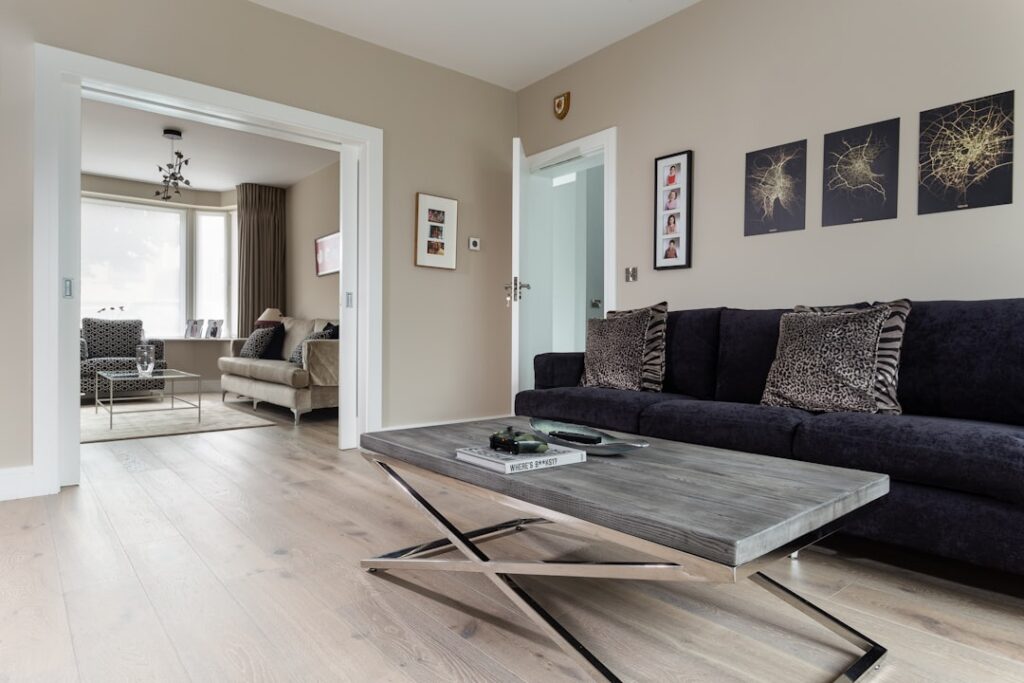
Anyone who has cut laminate flooring with a circular saw knows the downside: screaming noise, a cloud of fine dust, and chipped edges if the blade is wrong. A laminate cutter solves all three at once. This shear-style hand tool slices through planks with a single lever pull, producing clean, dust-free cuts in seconds without electricity. For a typical floating-floor project, it can dramatically speed up installation and keep your workspace clean enough to cut indoors. This guide explains how laminate cutters work, the types available, and when you should reach for a saw instead.
- How a Laminate Cutter Works
- Benefits of Using a Laminate Cutter
- Types of Laminate Cutters
- What a Laminate Cutter Can and Cannot Do
- How to Use a Laminate Cutter
- Laminate Cutter vs. Power Saws
- Will It Cut Vinyl Plank, Too?
- Keeping Your Cutter in Good Shape
- Buying Tips and Pricing
- Estimating How Many Cuts a Floor Needs
- Cutter Blade Care and Replacement
- Is a Laminate Cutter Worth It?
How a Laminate Cutter Works
A laminate cutter is essentially a heavy-duty guillotine. You slide a plank onto the base, line up your mark against the blade or guide, and pull down the long lever. A sharp blade shears straight through the plank in one motion. Because it cuts by slicing rather than grinding, there is no sawdust and almost no noise. The tool relies on leverage, so even thick planks cut with manageable effort.
Benefits of Using a Laminate Cutter
For straight crosscuts, a cutter has real advantages over a power saw:
- Dust-free: No airborne particles, so you can cut in the room you are working in.
- Quiet: No motor noise, which matters in apartments or shared spaces.
- Fast: A single pull versus measuring, clamping, and sawing.
- Clean edges: Sheared cuts avoid the chipping that dull saw blades cause.
- No cords or batteries: Works anywhere, no power source needed.
Types of Laminate Cutters
Not all cutters are built the same. The main categories:
- Manual shear cutters: The standard lever-operated tool for straight crosscuts on laminate and luxury vinyl plank. Affordable and reliable.
- Heavy-duty contractor cutters: Wider beds and longer levers that handle thicker planks and high-volume work.
- Multi-angle cutters: Some models include a guide for angled cuts, useful around doorways and corners.
Cutter capacity matters. Check the maximum plank width and thickness a model handles, since some struggle with wide planks or thick rigid-core flooring.
What a Laminate Cutter Can and Cannot Do
A cutter excels at straight crosscuts across the width of a plank. What it generally cannot do is rip a plank lengthwise, cut curves, or make notches around pipes, door jambs, and irregular obstacles. For those cuts you still need a jigsaw, a multi-tool, or a coping saw. Most installers keep a cutter for the bulk of straight end cuts and a jigsaw for the handful of tricky shapes per room.
How to Use a Laminate Cutter
Using one is straightforward, but a few steps ensure clean results:
- Measure the plank and mark your cut line clearly with a pencil.
- Place the plank on the cutter bed, decorative side up unless the manufacturer advises otherwise, and align the mark with the blade.
- Hold the plank firmly against the fence so it does not shift.
- Pull the lever down in one smooth, firm motion.
- Check the cut edge. It will go against a wall, so a slightly rough edge is fine since trim covers it.
Practice on a scrap piece first to learn how much pressure your specific cutter needs.
Laminate Cutter vs. Power Saws
Each tool has a sweet spot. A laminate cutter wins for clean, fast, dust-free straight crosscuts and indoor work. A miter saw with a fine-tooth blade gives precise angled cuts but throws dust and noise. A jigsaw is essential for curves and notches but is slower and chippier on straight cuts. A table saw handles rip cuts down the length of a plank that a cutter cannot. The ideal kit for a flooring project is a laminate cutter for the bulk of cuts plus a jigsaw for the awkward ones.
Will It Cut Vinyl Plank, Too?
Many homeowners ask whether a laminate cutter handles luxury vinyl plank, and the answer is usually yes for flexible and many rigid-core products, as long as the plank falls within the cutter’s thickness capacity. The shearing action works well on vinyl and often leaves an even cleaner edge than on laminate. Very thick or dense rigid-core SPC planks can strain a lightweight cutter, so check the rated capacity before buying if vinyl is your main material. For engineered hardwood, a cutter is generally not the right tool, since real wood tends to crack rather than shear cleanly, and a miter saw is the better choice there.
Keeping Your Cutter in Good Shape
A laminate cutter needs little maintenance, but a few habits keep it cutting cleanly. Wipe the blade and bed after use to clear dust and debris that can interfere with alignment. Keep the pivot points lightly lubricated so the lever pulls smoothly. Inspect the blade periodically, and if cuts start to chip or require excessive force, the blade may be dull or nicked and need sharpening or replacement. Store the cutter in a dry place so the metal frame and blade do not rust. Treated well, a quality cutter will outlast many flooring projects.
Buying Tips and Pricing
Laminate cutters are reasonably priced for the time they save. General ranges:
- Basic homeowner models: roughly $40 to $90.
- Heavy-duty or wide-capacity cutters: roughly $100 to $250.
- Rental: available at some tool rental shops if you only need it for one job.
When buying, prioritize a sturdy steel frame, a comfortable lever, a measuring guide, and a blade rated for the thickness of flooring you plan to install. A wobbly, undersized cutter will frustrate you on a full-room job.
Estimating How Many Cuts a Floor Needs
Knowing the volume of cuts ahead of time helps you decide whether a cutter is worth it for your specific job. On a typical floating floor, you make at least one cut on the last plank of every row to fit the wall, plus a cut to start the next row with the offcut for a staggered seam pattern. A 12-by-15-foot room with planks around 48 inches long can easily involve 30 to 50 straight crosscuts, and most of those are exactly the kind of clean, square cuts a shear cutter handles best in a single pull. Larger open areas push that count well past a hundred. When you are repeating that many cuts, the time saved over measuring, clamping, and sawing each one adds up fast, and you avoid hauling a saw and vacuum in and out of the room. The handful of notched and angled cuts around door casings, heat registers, and pipes are the exception, and those go to a jigsaw regardless.
Cutter Blade Care and Replacement
The blade does all the work, so its condition determines cut quality. A sharp blade shears cleanly with moderate lever effort; a dull or nicked one tears the wear layer, leaves a ragged edge, or demands so much force that you risk shifting the plank mid-cut. If you notice chipping on the decorative face or a sudden jump in the effort needed, inspect the cutting edge for nicks. Many manufacturers sell replacement blades, and on better cutters the blade is bolted in for easy swapping rather than riveted in place. Wipe the blade and bed clean after each session, because the fine grit shed by laminate and rigid-core vinyl is abrasive and dulls the edge faster than the cutting itself. A light film of machine oil on the blade and pivot keeps everything moving smoothly and prevents surface rust between projects. Replacing a worn blade costs a fraction of a new tool and restores factory-clean cuts.
Is a Laminate Cutter Worth It?
For a laminate or vinyl plank flooring project, a cutter is one of the best tool investments you can make. It keeps the work quiet and clean, speeds up the repetitive straight cuts that make up most of a floor, and produces tidy edges without a dust mask. Pair it with a jigsaw for the handful of shaped cuts, and you have everything you need to install a floating floor like a pro.
Prefer to explore on your own?
See how new flooring looks in your actual room in seconds — free, no signup.
Try the free Floor Studio →