The typical laminate flooring installation price lands between $3 and $8 per square foot installed, combining materials and professional labor. That single range hides a lot of variation, because a builder-grade plank clicked into a square bedroom costs a fraction of a thick, textured board fitted around a curved staircase. Understanding the components lets you predict your own bill instead of flinching at a contractor’s quote.
Homeowners frequently confuse the price of the planks with the price of the finished floor. The laminate flooring installation price includes the underlayment, the transition strips, the labor to acclimate and lay the boards, and the subfloor prep that nobody enjoys paying for but every good floor needs. Break it into parts and the number stops feeling arbitrary.
Average Cost Per Square Foot
Laminate planks themselves run $1 to $5 per square foot. Entry-level 7mm boards with a basic AC3 wear rating sit near $1 to $2, mid-range 8 to 10mm planks with embossed texture and an AC4 rating fall around $2 to $3.50, and premium 12mm boards with painted bevels, water-resistant cores, and AC5 commercial ratings reach $4 to $5. Thickness alone does not equal quality, but a thicker core does feel more solid and quiets the hollow click that cheap laminate makes underfoot.
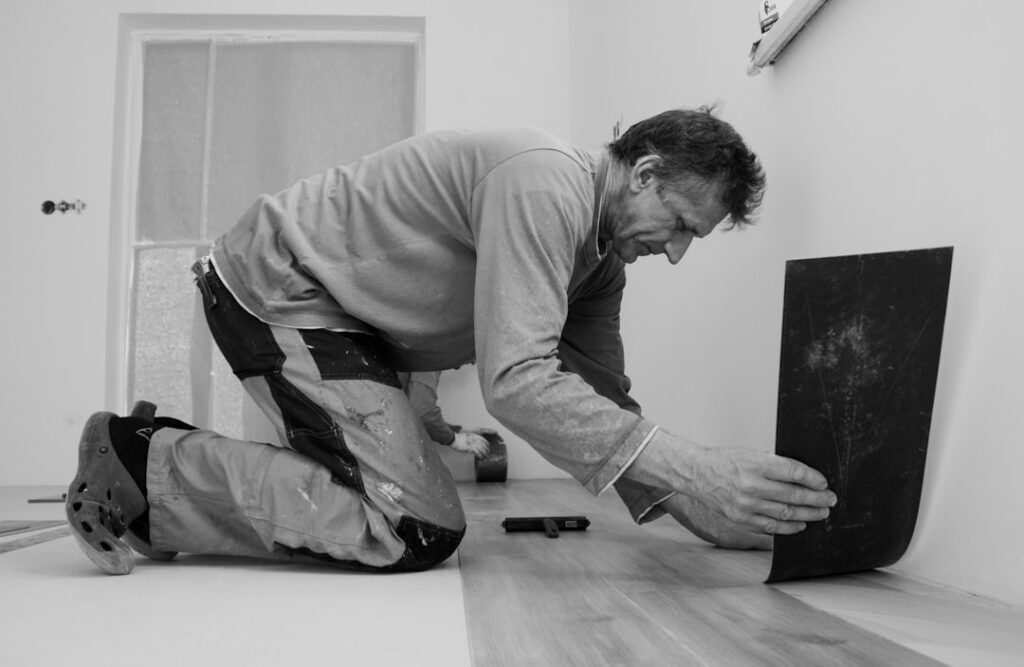
Professional labor adds another $2 to $5 per square foot. Straightforward floating installs in open, rectangular rooms sit at the low end, while rooms with many closets, angled walls, or a herringbone pattern push labor toward the top. Many installers set a minimum job charge of $300 to $500, which makes a single small room disproportionately expensive per square foot compared with doing your whole main level at once.
Adding it together, a realistic all-in figure for a standard install is $3 to $8 per square foot. Budget-minded homeowners pairing $1.50 planks with a $2.50 labor rate land near $4; those choosing a 12mm water-resistant board with intricate cuts can reach $8 or slightly beyond. Get itemized quotes so you can see exactly which line drives your total.
What You Pay For Beyond the Planks
Underlayment is the first hidden line. Basic foam runs about $0.30 per square foot, while premium versions with an attached moisture barrier and sound-deadening felt cost $0.50 to $0.80. Skipping quality underlayment to save a few dollars is a false economy, because it is what stops the floor from echoing and protects the core from subfloor moisture in slab-on-grade homes.
Subfloor preparation is the wildcard that blows budgets. Installers need a surface flat to within about 3/16 inch over ten feet. If your existing floor dips or humps beyond that, expect $1 to $2 per square foot for self-leveling compound or sanding. Old flooring removal and haul-away adds $1 to $3 per square foot, and popcorn-textured or glued vinyl underneath drives that higher still.
Finishing touches round out the invoice. Transition strips at doorways and between flooring types cost $15 to $40 each installed, quarter-round or baseboard trim adds $1 to $3 per linear foot, and door undercutting to clear the new floor height runs $10 to $25 per door. These small items routinely add several hundred dollars that first-time buyers forget to plan for.
Real Room-by-Room Examples
A 120-square-foot bedroom with a simple rectangular layout typically runs $500 to $900 installed. The job is fast, but the installer’s minimum charge means the per-foot cost feels high; bundling it with an adjacent hallway spreads that minimum across more square footage and lowers the effective rate.
A 300-square-foot living room lands around $1,200 to $2,400 depending on plank grade and whether old carpet must be torn out. This is the sweet spot where laminate shines on value, since the open floor lets an installer move quickly and the fixed costs get diluted across a generous area.
A whole main level of roughly 1,000 square feet spanning kitchen, dining, and living spaces generally costs $4,000 to $8,000. At this scale you gain real negotiating leverage on both materials and labor, and paying once for setup, delivery, and cleanup instead of spreading it across several small jobs is where the budget-conscious homeowner wins.
DIY Versus Hiring a Professional
Laminate’s click-lock design is genuinely DIY-friendly, and doing it yourself erases the $2 to $5 labor charge, often halving your total. A confident weekend installer needs only a tapping block, a pull bar, spacers, and a laminate cutter or fine-tooth miter saw. For a square 200-square-foot room, a first-timer should plan on a full weekend and roughly $50 in tools if renting the saw.
The savings are real, but so are the risks. Wrong expansion gaps, an unlevel subfloor left uncorrected, or planks laid straight out of a cold truck without acclimation all cause buckling and gapping that void the warranty. Complex layouts with many transitions, stairs, or a stone-look pattern reward professional precision, and a botched DIY job often costs more to tear out and redo than hiring a pro would have in the first place.
A sensible middle path is to split the work. Many homeowners tear out old carpet, haul it away, and handle their own subfloor cleanup, then pay a pro only for the acclimation-and-lay portion. That single move can trim $1 to $2 per square foot off the labor line without exposing you to the precision risks of the actual plank installation. Ask any installer whether they will quote a labor-only rate on a subfloor you have already prepped; most will, and the savings on a whole main level can run into the hundreds.
Water-Resistant and Premium Upgrade Costs
Standard laminate is only water-resistant at the surface, but newer water-resistant and waterproof laminate lines seal the plank edges and use a treated core to survive spills for up to 24 or 72 hours. These lines add roughly $0.75 to $1.50 per square foot over comparable standard laminate, pushing an installed floor toward the upper half of the $3 to $8 range. For a kitchen, entry, or home with pets, that premium is usually money well spent, since it prevents the seam-swelling that ends a standard floor’s life early.
Thicker 12mm boards with attached underlayment also carry a modest upcharge of $0.50 to $1 per square foot but simplify the install and quiet the floor, sometimes offsetting their cost by eliminating a separate underlayment line. Weigh these upgrades against how long you plan to stay and how hard the room gets used; a rarely walked guest room rarely justifies them, while a busy family kitchen almost always does.
Regional and Seasonal Price Swings
Labor rates track local cost of living. Expect the low end of the labor range in the rural Midwest and South, and the high end or beyond in coastal metros like San Francisco, Boston, or New York, where installers may quote $5 to $7 per square foot for the same work. Getting three written bids in your own zip code is worth more than any national average.
Timing helps too. Flooring contractors are busiest in late spring and early fall, so scheduling in the slower mid-winter or mid-summer windows can shave 10 to 15 percent off labor. Big-box retailers also run laminate promotions around major holidays, and pairing a material sale with a slow-season install date is the simplest way to trim the overall laminate flooring installation price without cutting a single corner on quality.
How to Budget With Confidence
Measure your rooms, add 7 to 10 percent for cutting waste, and multiply by a realistic all-in rate for your area. For most homeowners choosing a solid mid-grade plank, $5 to $6 per square foot installed is a safe planning figure that covers underlayment, standard subfloor prep, and trim. Set aside a further 10 percent contingency for the surprises hidden under old flooring, which reveal themselves only after the tear-out begins.
Insist on itemized written quotes that separate materials, labor, prep, and finishing so you can compare bids fairly and spot padded lines. Ask each installer what happens if the subfloor needs leveling, since a vague answer today becomes an ugly change-order tomorrow. With honest measurements and a clear itemization, the final laminate flooring installation price will match your plan rather than ambush your wallet.
Prefer to explore on your own?
See how new flooring looks in your actual room in seconds — free, no signup.
Try the free Floor Studio →