Finding laminate flooring under 50 cents sq ft is absolutely possible, but it pays to understand exactly what that rock-bottom price gets you before you load up a cart. Ultra-budget laminate exists in a specific corner of the market, closeouts, discontinued styles, builder-grade overstock, and remnants, and it can be a genuine bargain for the right project. It can also be a costly mistake if you put a paper-thin floor in a high-traffic room. This guide explains where to find it, what to inspect, and when sub-50-cent laminate makes sense.
- Where Sub-50-Cent Laminate Comes From
- What the Low Price Really Buys
- The Specifications That Matter
- The Real Trade-Offs
- The Best Uses for Ultra-Budget Laminate
- How to Inspect a Bargain Lot
- The Bottom Line
- Calculating Your True Installed Cost
- Installing Budget Laminate Successfully
- When to Spend a Little More
Where Sub-50-Cent Laminate Comes From
Laminate priced under fifty cents a square foot is rarely current-line product at full retail. It typically surfaces through a handful of channels:
- Closeouts and discontinued styles, where a manufacturer or retailer is clearing inventory to make room for new lines.
- Builder-grade overstock, leftover product from large construction orders.
- Remnants and odd lots, partial pallets or mixed boxes from completed jobs.
- Discount and salvage outlets, stores that specialize in moving surplus building materials.
- Open-box or cosmetically blemished packaging with sound flooring inside.
Because these are one-time deals, quantity and availability are limited. If you find enough for your room plus overage, grab it, it will not be there next week.
What the Low Price Really Buys
At this price point, you are almost always getting thin, basic laminate. Expect planks around 6mm to 7mm thick, the lower end of the spectrum. Thinner planks feel less solid underfoot and can sound hollow without good underlayment. They also tend to carry lower AC ratings, the abrasion-resistance scale, meaning a thinner, less durable wear layer that handles light use far better than heavy traffic.
None of this makes sub-50-cent laminate junk. It makes it appropriate for the right rooms and a poor choice for the wrong ones.
The Specifications That Matter
When shopping ultra-budget laminate, do not just chase the lowest number. Check these specs:
- AC rating: AC1 and AC2 suit light-use spaces like guest bedrooms and closets. For a living room or hallway, you really want AC3 or higher, which is harder to find at this price.
- Thickness: 7mm tolerates a budget room; thinner can feel cheap and telegraph subfloor flaws.
- Wear layer and finish: A thicker top layer resists scratches and scuffs longer.
- Water resistance: Most ultra-cheap laminate is standard (not waterproof), so keep it out of bathrooms and basements.
- Underlayment: Budget laminate rarely has it attached, so factor in $0.20 to $0.50 per square foot for a separate pad.
The Real Trade-Offs
The savings are real, but so are the compromises. Thin, low-AC laminate scratches and wears faster, so it may need replacing sooner in busy areas, which can erase the upfront savings. Limited closeout quantities mean you might not be able to buy more later for repairs, so always purchase extra. And because most ultra-budget laminate lacks waterproofing and attached underlayment, your true installed cost is higher than the headline price once you add a pad and any moisture barrier.
The Best Uses for Ultra-Budget Laminate
Sub-50-cent laminate shines where cost matters more than longevity:
- Rental properties and flips where you need a clean, presentable floor on a tight budget.
- Low-traffic rooms like guest bedrooms, home offices, and closets.
- Temporary or short-term installations.
- Spaces you plan to upgrade later but want to make livable now.
For a main living area, kitchen, or high-traffic hallway in a home you will keep, spending a little more on AC3-plus laminate or LVP is the better long-term value.
How to Inspect a Bargain Lot
Before buying a closeout, open a box and inspect the planks. Confirm the lot number matches across boxes so colors line up. Check that the click-lock edges are intact and undamaged, broken locking profiles ruin a budget deal. Make sure you have enough square footage plus 7 to 10 percent overage for cuts and future repairs, since you cannot reorder.
The Bottom Line
Laminate under fifty cents a square foot is a legitimate way to floor a room cheaply, as long as you match its limitations to the right space. Treat it as light-duty, non-waterproof flooring best suited to rentals, low-traffic rooms, and temporary fixes. Check the AC rating and thickness, budget for separate underlayment, and buy extra. Used wisely, it delivers a fresh floor for a fraction of the usual cost.
Calculating Your True Installed Cost
The headline price is only part of the story, so add up the full cost before celebrating a deal. Start with the laminate itself, then add underlayment at roughly $0.20 to $0.50 per square foot, transition strips and trim, and a moisture barrier if you are going over concrete. If you hire out the labor, installation typically runs $2 to $4 per square foot, which can dwarf the material savings. For a DIY install, factor in a few tools: a laminate cutter or saw, spacers, a tapping block, and a pull bar. Even with these extras, ultra-budget laminate usually comes in well below mid-range flooring, just go in with eyes open about the real number.
Installing Budget Laminate Successfully
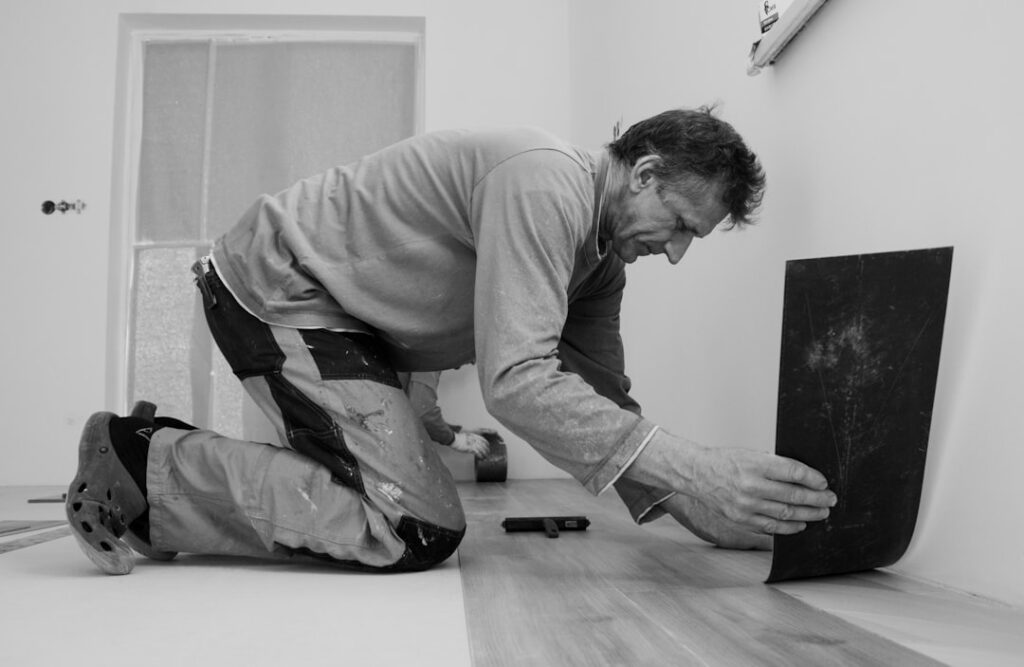
Thin, low-cost laminate is less forgiving of a poor subfloor, so preparation matters more, not less. Make sure the subfloor is clean, dry, and flat within the manufacturer’s tolerance, often about 3/16 inch over 10 feet, because dips and humps telegraph through a thin plank and stress the locking joints. Let the boxes acclimate in the room for at least 48 hours so the planks adjust to indoor conditions. Use a quality underlayment to add cushion and quiet the hollow sound thin laminate can produce, and leave the recommended expansion gap around the perimeter.
When to Spend a Little More
Bargain laminate is a smart tool, but it is not always the right one. If the room sees heavy daily traffic, gets wet, or belongs to a home you plan to keep for years, stepping up to AC3 or AC4 laminate or to waterproof LVP usually pays off, you replace the floor far less often. Reserve the sub-50-cent stuff for low-traffic rooms, rentals between tenants, flips, and temporary fixes. Knowing when a few extra dimes per square foot buys real longevity is the difference between a smart bargain and a false economy.
Prefer to explore on your own?
See how new flooring looks in your actual room in seconds — free, no signup.
Try the free Floor Studio →