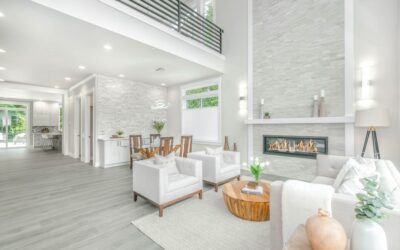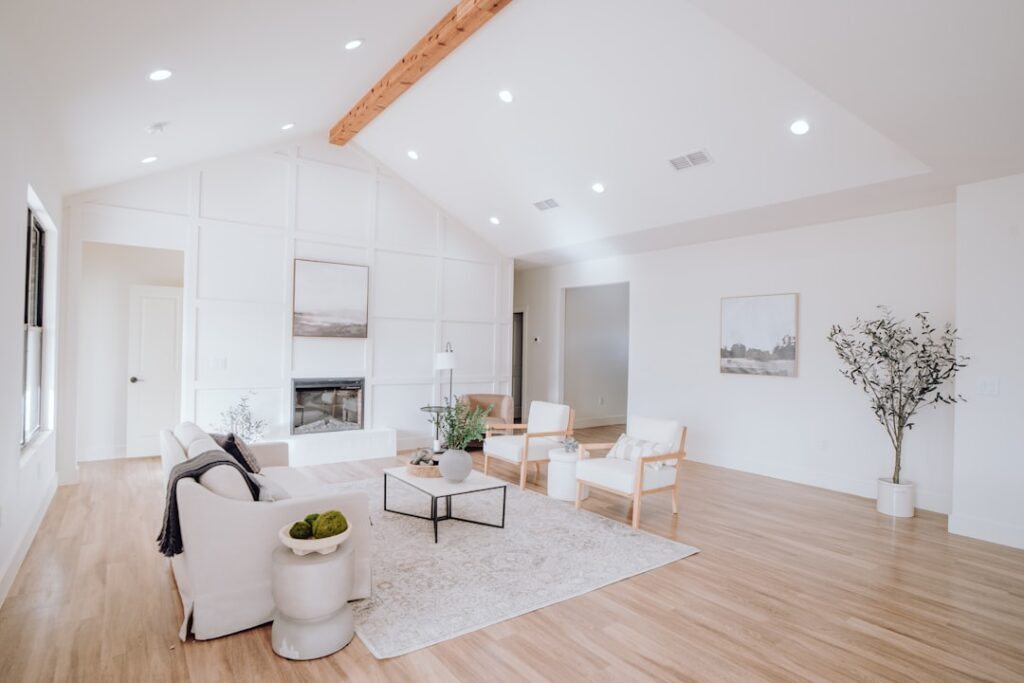
An 18-foot wide, 11-foot tall living room wall reads as 198 square feet of blank canvas — roughly four times the canvas size of a standard 8-foot bedroom wall. The mistake most homeowners make is treating it the same way, hanging a single 24-inch piece of art and a small console table that looks lost from across the room. Smart large living room wall ideas use scale-appropriate elements: 60-inch and wider artwork, full-wall paneling systems, floor-to-ceiling stone veneer, and gallery arrangements that fill 60 to 80 percent of the available wall area. The goal is balance with the room’s furniture footprint, not minimalism or maximalism for its own sake.
Oversized Art That Holds the Room
The rule from interior designers: a feature artwork should occupy 50 to 75 percent of the available wall width above a sofa, and the bottom edge should sit 6 to 12 inches above the sofa back. A 96-inch sofa demands artwork at least 48 inches wide. Single canvases at this scale from Etsy printmakers or Society6 run $200 to $700; museum-quality stretched canvas from Saatchi Art and Minted starts at $600 and ranges up to several thousand.
Custom canvas printers like CanvasOnDemand, Easy Canvas Prints, and Mpix print client photos at sizes up to 54 by 81 inches for $150 to $400. A high-resolution landscape photograph blown up to that scale becomes a gallery-quality focal point at a fraction of original art pricing.
Gallery Walls Done at Scale
A small gallery wall with eight frames doesn’t fill a 16-foot wall. For large spaces, plan a grid or organic cluster of 18 to 30 frames spanning 80 to 90 percent of the wall width. Mix three frame sizes (8×10, 11×14, and 16×20 in equal numbers) and one frame style for visual consistency.
Layout the entire arrangement on the floor first, then trace each frame on craft paper and tape the templates to the wall. Adjust until the spacing reads balanced — 2 to 3 inches between frames is the standard, tighter for a salon-style dense cluster.
Floor-to-Ceiling Paneling Systems
Board-and-batten paneling, vertical reeded panels, and slat-wall systems all scale beautifully to large walls. Reeded wood panels from companies like Naturewall, ASI Building Products, and DecorChunk install in 4-foot panels at $8 to $22 per square foot. The vertical lines visually raise ceiling height and add dimension to flat drywall.
For a more traditional look, install board-and-batten with 1×4 vertical boards spaced 16 inches apart from floor to ceiling. Material costs run $1.50 to $3 per linear foot for primed MDF battens. Paint the entire wall (panels and field) in one color like Benjamin Moore White Dove OC-17 or Sherwin-Williams Alabaster SW 7008 for a clean, contemporary effect.
Stone and Brick Veneer Feature Walls
Manufactured stone veneer from Eldorado Stone, Cultured Stone, or ProVia transforms a large wall into a focal point that feels permanent and high-end. Cost runs $14 to $26 per square foot installed for ledgestone or stacked stone profiles. Brick veneer (real thin brick from Glen-Gery or General Shale, or faux brick panels from Z-Brick) runs $10 to $22 per square foot installed.
Wall preparation matters. Stone veneer requires a moisture barrier (Tyvek HomeWrap or grade D building paper), metal lath, and a scratch coat of mortar before stone installation. Skipping these steps results in moisture problems and stone delamination within five years.
Built-In Cabinetry and Bookcases
A full-wall built-in delivers the highest visual impact and adds storage that drywall art cannot. Custom site-built cabinetry runs $250 to $700 per linear foot. Semi-custom modular systems from Inspired Closets, California Closets, and IKEA PAX with integrated lighting hit $130 to $300 per linear foot.
Plan around a focal point — a fireplace, large TV, or signature artwork — with symmetrical cabinetry flanking it. Add interior lighting (LED strip from Hera, WAC Lighting, or Phantom CCT-S) on display shelves to highlight books, ceramics, and decorative objects after dark.
Color Strategies for Large Walls
Dark, saturated colors on large walls create cocoon-like atmosphere and make oversized rooms feel intimate. Benjamin Moore Hale Navy HC-154, Sherwin-Williams Iron Ore SW 7069, and Farrow & Ball Hague Blue No. 30 all work as full-wall feature colors that anchor large rooms.
For lighter approaches, Behr Swiss Coffee 12 and Sherwin-Williams Agreeable Gray SW 7029 read clean and let architectural detail or artwork carry the visual weight. Test paint in 2-foot square swatches on the actual wall and view at multiple times of day before committing. Wall color reads dramatically different in morning versus evening light.
Lighting That Reveals the Wall
Large walls disappear in flat overhead lighting. Add directional accent lighting that grazes the wall surface. Wall-washer LED downlights spaced every 4 feet across the ceiling, set 12 inches out from the wall, throw even light across the entire surface. Juno Trac-Lites and WAC Lighting MultiTrack systems deliver this look at $80 to $250 per fixture.
For art-focused walls, picture lights mounted directly above artwork (Hyperikon, House of Troy) deliver targeted illumination. Battery-powered options from Mighty Bright avoid the need for wall-fishing electrical to each piece.
Combining Multiple Elements
The most impactful large walls combine two or three of these strategies. A floor-to-ceiling stone veneer fireplace surround flanked by built-in bookcases, with oversized art mounted to a paneled accent above the fireplace, fills the wall completely without feeling cluttered. Layering gives depth that single-element walls cannot match.
Sketch the entire wall to scale before purchasing anything, and budget for both materials and the professional install help that complex feature walls usually require to look finished and intentional. A simple 1/4-inch grid drawing with furniture and art elements scaled in 1-inch-equals-1-foot proportions reveals balance problems before money is spent on full-size pieces that don’t work in the room.