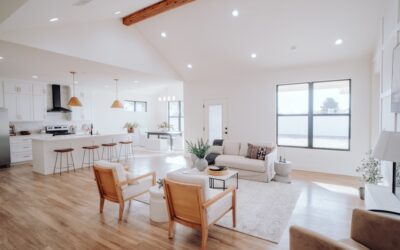
A lounge is the room people actually live in, and the floor under it takes more punishment than any other surface in a residential setting. Think spilled wine at 11pm, a Golden Retriever doing laps, kids building forts, and a fireplace dropping ember sparks three feet from the rug. Picking the right lounge flooring is less about aesthetics and more about matching material durability to the way the room actually gets used. This guide walks through the five options that genuinely work, what each costs installed, and where each one fails.
What Makes a Floor Work in a Lounge
Four traits matter more than any others. First, acoustic warmth: hard floors need an area rug or the room echoes every conversation. Second, scratch resistance rated for dog claws and furniture sliders. Third, underfoot comfort, because people actually sit, lie, and play on lounge floors. And fourth, a finish that cleans quickly when someone tips over a glass of cabernet. Miss any one of these, and the floor either looks terrible within two years or makes the room unpleasant to spend time in.
Climate also plays a role. Lounges with large south-facing windows experience 20 to 30°F temperature swings between summer afternoons and winter mornings. Solid hardwood expansion and contraction becomes visible across 12-foot spans if humidity is not controlled.
Hardwood: The Traditional Gold Standard
Solid or engineered hardwood still sells more lounge remodels than any other material. The visual warmth reads as premium across every design style from traditional to mid-century modern to transitional farmhouse. Wide-plank white oak and hickory are the two species most commonly specified right now, with European-style 7 to 9 inch boards driving $2 to $4 per sq ft above the 3.25 inch strip standard.
Expect $8 to $16 per sq ft installed for quality engineered oak, and $12 to $22 for solid hardwood on plywood subfloor. Maintenance runs low: dust mop weekly, neutral pH cleaner monthly, and recoat the finish every seven to ten years. The refinishing option is the killer feature. A lounge hardwood floor scratched to death by Labradors can be sanded and re-stained in three days for roughly $4 per sq ft, restoring it to factory-new condition.
Luxury Vinyl Plank: The Practical Winner for Most Homes
LVP has quietly taken over the living room floor market in the past five years, and for good reason. A quality rigid-core LVP with a 20 mil wear layer handles kids, pets, and standing water from a toppled dog bowl without flinching. Installed pricing runs $5 to $9 per sq ft, which undercuts engineered hardwood by 30 to 50%.
- Shaw Floorte Pro Paragon HD Plus: $5.29 per sq ft, 20 mil wear layer, waterproof.
- COREtec Plus HD: $6.49 to $7.99 per sq ft, attached cork underlayment, limited lifetime warranty.
- Karndean Korlok Select: $7.99 to $9.49 per sq ft, premium visuals, best in class dimensional stability.
- Mohawk SolidTech Plus: $4.99 to $6.49 per sq ft, budget-friendly waterproof option.
The downside is resale perception. Higher-end buyers in homes above $750,000 still expect hardwood in public rooms. LVP also cannot be refinished, so wear-through at 15 to 20 years means a full replacement.
Carpet: Comfort at a Cost
Wall-to-wall carpet remains the warmest, quietest lounge option. Nothing beats it for acoustics in a room with a television, and nothing feels better on bare feet on a January morning. Expect $4 to $9 per sq ft installed for a quality polyester or nylon carpet with an 8 lb density pad, or $10 to $18 per sq ft for wool Berber.
The problem is stain resistance and longevity. Even solution-dyed nylon carpets show traffic patterns within five to seven years in a primary lounge. Pet accidents can permanently stain the pad if not addressed within an hour. Budget to replace residential lounge carpet every 8 to 12 years regardless of how well you maintain it.
Polished Concrete and Tile: Modern Minimalism
Contemporary lounges increasingly feature polished concrete or large-format porcelain tile. Concrete runs $6 to $14 per sq ft for grind-and-polish on existing slabs, and the thermal mass keeps the room cooler in summer. Radiant hydronic heat under concrete transforms it into the most comfortable lounge floor in winter, though retrofit radiant adds $9 to $15 per sq ft.
Porcelain plank tile at 9×48 inches or larger reads as wood from a distance and handles every possible spill, scratch, and UV exposure. Installed cost lands at $9 to $17 per sq ft. The catch is acoustic coldness. Without heavy area rugs and fabric furniture, these rooms echo and feel uninviting.
Pros and Cons Summary
Each material solves different problems. Hardwood delivers premium resale and refinishability at premium cost. LVP delivers 80% of hardwood’s visual appeal at 60% of the cost, plus waterproofing. Carpet delivers comfort and acoustics at the expense of longevity. Concrete and tile deliver design impact and durability at the expense of warmth.
- Best for pets and kids: LVP with 20+ mil wear layer.
- Best for resale: Wide-plank engineered white oak.
- Best for comfort: Wool Berber over memory foam pad.
- Best for modern design: Polished concrete with radiant heat.
- Best budget pick: Mid-range waterproof laminate at $3.50 per sq ft.
Installation Considerations
Most lounges sit directly over crawl spaces or basement ceilings, so subfloor condition matters. Have your installer check for squeaks, out-of-level spots more than 3/16 inch across 10 feet, and moisture levels before any product arrives onsite. Concrete slabs require calcium chloride testing. Wood subfloors need moisture meter readings below 12%. Skipping these steps voids most material warranties.
Plan the installation around a three-day window where the lounge is out of service. Moving furniture through a popular family room mid-install creates chaos, so stage it properly and order 10% extra material for future repairs.
Bottom Line
The right lounge flooring matches how your family actually uses the room. Pet-heavy households default to LVP. Design-focused remodels still reach for hardwood. Budget builds lean on quality laminate. Whichever direction you go, spec the top two-thirds of the product category rather than bottom-tier, and the floor will deliver 15-plus years of service in a room that earns its keep every single day.
Prefer to explore on your own?
See how new flooring looks in your actual room in seconds — free, no signup.
Try the free Floor Studio →