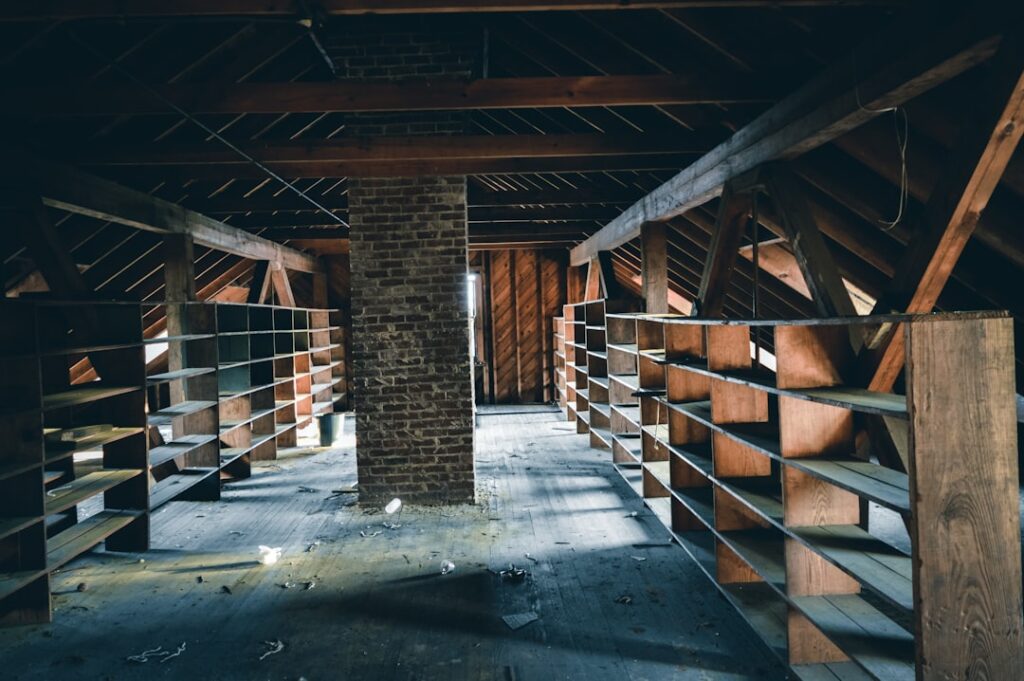
An attic with 36 inches of clearance under the ridge feels useless until you measure what fits horizontally. A 1,200-square-foot house with truss-framed gables typically gives you 200 to 400 square feet of dead space above the joists — enough to clear two entire closets if you plan the build correctly. The right low ceiling attic storage solutions turn that overlooked zone into legitimate square footage without remodeling permits, framing changes, or the $80-per-square-foot cost of finishing a habitable room.
Confirm the Joists Can Carry the Load
Most attics framed before 1995 use 2×6 ceiling joists at 24 inches on center, rated for 10 pounds per square foot dead load and 20 psf live load — fine for sheetrock and insulation, marginal for stacked plastic bins. Trussed roofs (almost universal post-2000) use 2×4 bottom chords engineered only for ceiling weight and may bow or crack under 30-pound boxes. Check joist depth with a tape, span between bearing walls, and any visible truss stamps before adding weight.
If you have a stick-framed attic with 2×8 or 2×10 joists, you can usually store evenly distributed loads up to 30 psf without sistering. Trussed attics need an engineer’s letter ($300 to $600) before you cut, drill, or load above 10 psf. Lowe’s and Home Depot both stock Simpson Strong-Tie L-clip kits ($4 per pair) that let you sister 2×6 lumber to truss bottom chords if your local building department signs off.
Build a Floor System That Clears Insulation
Code-minimum attic insulation under IECC 2021 is R-49 in Climate Zones 4-8, which translates to roughly 16 inches of loose-fill cellulose. Compressing it ruins R-value and triggers ice dams. The fix is an Attic Dek modular floor (Plasticade, $7 per panel covering 16 inches on center) that elevates 14 inches above the joist tops, preserving insulation depth while creating a flat OSB-friendly surface.
For permanent installs, run 2×10 sleepers perpendicular to existing joists, lag-bolt with 5-inch SDS Heavy-Duty screws ($1.20 each), and top with 23/32-inch tongue-and-groove AdvanTech subfloor ($45 per 4×8 sheet). Budget $4 to $6 per square foot in materials. A 200-square-foot platform runs about $1,000 in materials and a weekend of work.
Choose Bins That Fit Under the Slope
Standard 27-gallon totes (HDX Tough Tote at Home Depot, $13) measure 30 inches long, 20 inches wide, and 15 inches tall — too tall for many low-pitch areas. The IRIS USA WeatherTight series ($22) drops the height to 12.5 inches, and IRIS Hi-Top Underbed bins ($18) shrink further to 6 inches, ideal for the lowest section where the rafter meets the top plate.
Label every bin on three sides with a Brother P-touch printer ($35) and matte tape so you can read contents from any direction. Keep heavy items (books, tools, tile samples) within 6 feet of the access opening to limit the distance you crawl with weight. Reserve the deep corners for seasonal lightweight goods like artificial trees and luggage.
Maximize the Pull-Down Stair Zone
The first 4 feet around the attic ladder gets used 90 percent of the time, so build it as a staging zone. Frame a U-shaped landing with a 30-inch-wide aisle and 16-inch-deep shelves on each side, capped at 5 feet tall — anything higher creates a head-strike hazard. Werner aluminum attic ladders ($230 to $400) handle 250 to 375 pounds; if you exceed 200 pounds with cargo, upgrade to the Louisville Elite series ($475) rated for 350 pounds.
Install a hardwired LED puck light at the head of the ladder wired to a motion sensor switch ($25 Leviton DOS01) so both hands stay free. The IRC requires a minimum 22-by-30-inch rough opening and a fire-rated cover if the attic sits above an attached garage.
Use Overhead and Vertical Tricks
Rafter bays are usable real estate. Screw 1×4 cleats horizontally across two rafters and slide a piece of luan or hardboard on top to create a shelf that hugs the slope. The HyLoft 45-by-45-inch ceiling-mount rack ($90) hangs from joists or rafters and holds 250 pounds — perfect for kayaks, ladders, and surplus drywall sheets.
Garage-style track systems (Gladiator GearTrack at $33 per 4-foot section) bolt directly to rafter ties or collar beams and accept hook accessories rated for 50 to 75 pounds each. They keep extension cords, shop vacs, and Christmas wreaths off the floor and free up bin space below.
Plan a Hoist for Heavy or Bulky Items
Lifting a 50-pound bin up a ladder one-handed is how rotator cuffs tear. The Racor PHL-1R Pro HeavyLift attic hoist ($230) bolts to a single joist and lifts 250 pounds via a hand crank — installs in two hours with a drill and a stud finder. For larger budgets, the Versalift 32W electric attic lift ($1,300, 200-pound capacity) runs on a standard 120V outlet and moves a full Rubbermaid Action Packer in under 30 seconds.
Both products require a 22-by-22-inch minimum opening and structural blocking between joists. Confirm headroom clearance above the unit before drilling — a hoist that hits a collar tie at full extension is an expensive paperweight.
Climate-Proof the Whole System
Attic temperatures swing from 20°F in northern winters to 140°F in southern summers. Avoid storing candles, photographs, vinyl records, leather goods, electronics, and adhesives — heat damages them within one season. Use vacuum bags (Ziploc Space Bag 5-pack, $20) for textiles to reduce volume by 75 percent and block moisture.
Install a wireless hygrometer (Govee H5075, $13) and keep readings below 60 percent relative humidity. Add a passive ridge vent or gable-end fan ($120) if humidity stays elevated. Smart low ceiling attic storage solutions combine load-rated framing, slope-aware bins, lighting, and ventilation so the space stays organized and your stored goods survive every season intact.