Walk into most model homes today and the “slate” entryway is not slate at all. It is luxury vinyl plank flooring stone look product, and unless you tap it with a knuckle you would never know. Stone-look LVP has quietly become the go-to for homeowners who want the drama of travertine, marble, or slate without the cracking, cold underfoot feel, or four-figure installation bill. Here is what actually separates a convincing plank from a plastic-looking one, and what you should pay.
Why Stone-Look LVP Beats the Real Thing for Most Homes
Natural stone is porous, heavy, and unforgiving. Drop a cast-iron pan on a marble floor and you get a chip; do it on quality vinyl and you get nothing. Stone-look LVP runs about 4mm to 8mm thick and floats over your subfloor, so it flexes slightly instead of shattering. It is also warm underfoot compared to actual stone, which can sit at 55°F on a winter morning.
The realism comes from two things: the printed film layer and the surface texture. Better products use embossed-in-register (EIR) texturing, meaning the bumps and grout-line valleys you feel line up exactly with the printed image. Run your hand across a Karndean or COREtec stone plank and the veining has real depth. Cheaper goods print a stone photo on a flat, glossy surface, and that gloss is what gives budget vinyl away instantly.
Formats: Planks, Tiles, and Groutable Options
Stone visuals come in three formats. Standard planks (roughly 7 inches by 48 inches) mimic large-format stone with subtle simulated seams. Square or rectangular LVT tiles (12×24 or 18×18) read more like a traditional stone floor. And groutable LVT lets you install real grout between the tiles for a near-indistinguishable slate or travertine look.
- Floating plank: Fastest install, click-lock edges, no grout to maintain.
- Glue-down LVT: Best for large commercial-style spaces and very flat subfloors.
- Groutable tile: Most realistic, but you take on grout sealing and cleaning again.
Wear Layer: The Number That Actually Matters
The single spec that predicts how long your floor lasts is the wear layer, measured in mils (thousandths of an inch). This clear top layer takes the abrasion.
- 6 mil: Light residential, low-traffic bedrooms only.
- 12 mil: Solid choice for most family homes.
- 20 mil and up: Heavy traffic, pets, or light commercial. Often carries a 25-year-plus residential warranty.
For a stone look in a busy kitchen or entryway, do not go below 12 mil, and 20 mil is worth the small upcharge. A thicker wear layer also holds the embossed texture longer, so the floor keeps looking like stone instead of buffing smooth.
SPC vs. WPC Cores
Stone-look LVP almost always uses a rigid core, and you will see two acronyms. SPC (stone-plastic composite) has a dense limestone-and-PVC core that is extremely dent-resistant and dimensionally stable in a hot sunroom or over a slab. WPC (wood-plastic composite) is slightly softer and warmer underfoot with a bit more give. For a stone aesthetic, SPC is usually the better match because it feels appropriately solid and handles temperature swings without gapping. Look for a core at least 4mm thick, ideally with an attached IXPE or cork underlayment pad for sound.
What Stone-Look LVP Costs
Material pricing spans a wide range depending on wear layer and brand:
- Budget (6-8 mil): $1.50 to $2.50 per sq ft.
- Mid-range (12-20 mil, name brand): $3.00 to $5.00 per sq ft.
- Premium (20+ mil, groutable or designer): $5.00 to $8.00 per sq ft.
Professional installation typically adds $2 to $4 per sq ft for a floating floor, more for glue-down or groutable tile because of the added labor. For a 300 sq ft entry and kitchen, budget roughly $1,500 to $3,000 installed with a mid-grade stone product. Compare that to $15 to $30 per sq ft installed for real slate or travertine, and the appeal is obvious.
Installation Notes
Rigid-core stone LVP is forgiving but not magic. Your subfloor must be flat within 3/16 inch over 10 feet; high spots telegraph through and cause clicking or gapping. Let the planks acclimate in the room for 48 hours at normal living temperature. Leave a 1/4-inch expansion gap at every wall, and never run a floating floor more than about 40 feet in one direction without a transition. In bathrooms, use 100% waterproof SPC and silicone the perimeter rather than relying on the click joints alone.
Pro Tip for a Convincing Stone Look
Randomize the planks or tiles from at least three or four boxes as you install. Stone patterns repeat every several planks, and if you lay them straight out of one box you will see the same “chunk” of veining marching across the floor. Mixing boxes breaks up the repeat and sells the natural-stone illusion.
Popular Stone Looks and Where They Fit
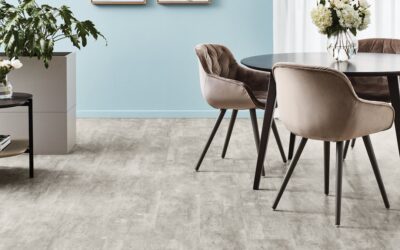
Not every stone visual works in every room, so match the look to the space. Marble-look planks, with their soft gray veining on a white ground, read as bright and upscale and suit bathrooms, powder rooms, and open kitchens. Slate looks, in charcoal and multicolor cleft tones, hide dirt and read as rugged, which makes them a smart pick for mudrooms and entries where boots track in grit. Travertine and limestone looks bring warm beige and cream tones that flatter Tuscan and transitional interiors. Concrete-look planks, technically a stone-adjacent visual, give a modern industrial edge that pairs with quartz counters and matte-black fixtures.
One practical note: darker stone looks show dust and pet hair more than mid-tone travertine or gray slate, so if you have a shedding dog and hate sweeping daily, lean toward a variegated mid-tone that camouflages the day-to-day mess between cleanings.
Maintenance and Repair
Stone-look LVP is close to maintenance-free, which is a major advantage over real stone that needs periodic sealing. Sweep or dry-mop to keep grit off the wear layer, and damp-mop with a pH-neutral cleaner as needed. Skip steam mops, wax, and abrasive scrubbers, which can dull or damage the finish. Put felt pads under furniture legs and use non-staining rugs (avoid rubber-backed mats, which can discolor vinyl over time).
Repairs are where floating click-lock earns its keep. If a plank gets gouged or stained, you can unclick the floor back to the damaged board, swap in a spare from your leftover stock, and reassemble, no wet saw or grout float required. This is exactly why buying 7 to 10% extra material at install time is worth it: a matching replacement plank from the same dye lot is far better than hunting for a discontinued color years later.
Frequently Asked Questions
Does stone-look vinyl plank feel cold like real stone?
No. The PVC core and any attached underlayment insulate far better than actual stone, so the floor sits closer to room temperature. It also pairs well with electric radiant heat rated for vinyl, usually up to about 85°F surface temperature.
Is stone-look LVP truly waterproof?
SPC and WPC rigid-core planks are 100% waterproof at the plank level, meaning standing water will not swell them. Seams and perimeter still need attention in full bathrooms, so silicone the edges and use proper transitions to keep water off the subfloor.
Can I install stone-look vinyl over existing tile?
Yes, if the tile is well bonded and the grout lines are shallow. Grout joints wider than about 1/4 inch or deeper than 1/8 inch should be skim-filled with a floor patch first, otherwise the plank may flex into the valleys and the joints can fail over time.
How long does stone-look LVP last?
A 12 mil floor typically lasts 10 to 15 years in a residential setting, while a 20 mil floor with EIR texture can last 20 to 25 years or more. Keep grit off it with regular sweeping and felt pads under furniture, and the wear layer will go the distance.
Stone-look luxury vinyl plank hits the sweet spot: it delivers the high-end look of travertine or slate, survives real family life, and costs a fraction of the natural material. Buy at least a 12 mil wear layer, choose an SPC core for the most authentic feel, and mix your boxes during install. Do that, and your “stone” floor will fool nearly everyone who walks across it.
Prefer to explore on your own?
See how new flooring looks in your actual room in seconds — free, no signup.
Try the free Floor Studio →