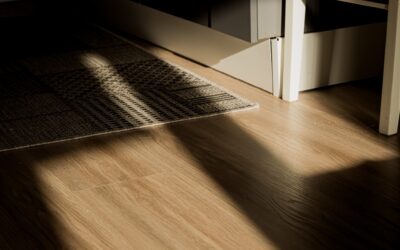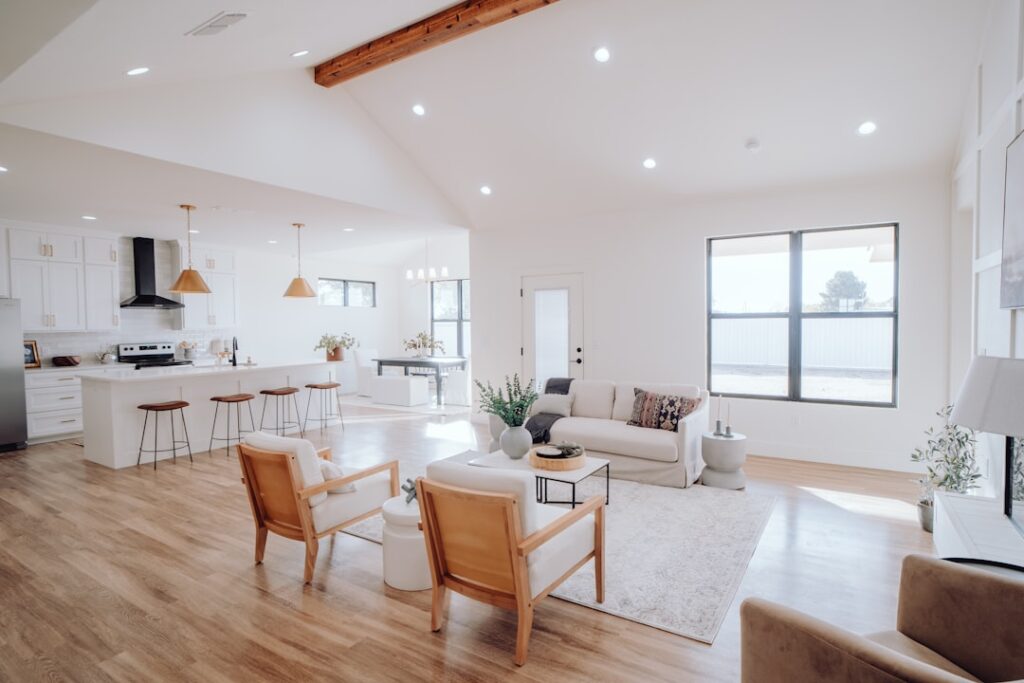
Hardwood is the look most American homeowners still want, but a 1,200 square foot install in white oak runs $14,000 to $22,000 once you add finish and labor. That’s why LVT wood products now account for the largest share of new flooring sold in the United States. Modern luxury vinyl tile planks waterproof to 100 percent, install over almost any subfloor, and the better products are genuinely hard to distinguish from real wood until you tap them.
What LVT Wood Actually Is
Luxury vinyl tile (LVT) sold as wood-look comes in plank format, typically 6 to 9 inches wide and 48 to 72 inches long. The build is layered: a backing layer for stability, a rigid or flexible core (PVC, SPC, or WPC), a printed decorative film carrying the wood image, and a clear wear layer ranging from 6 mil for builder grade to 30 mil for commercial-rated residential.
Two construction categories dominate the market. SPC (stone-plastic composite) has a dense rigid core made from limestone powder and PVC, runs about 4.5mm to 7mm thick, and feels firm underfoot. WPC (wood-plastic composite) is slightly thicker (6mm to 8mm), foamed for a softer step, and warmer to the touch. Both are waterproof, but SPC handles heavy furniture and rolling chairs better without indenting.
Where LVT Wood Beats Real Hardwood
- Waterproof: 100 percent in core, with no swelling from spills, mop water, or pet accidents
- Installs over concrete slab: no plywood subfloor required, click-lock floating systems lay over slab with 1mm moisture barrier underlayment
- Below-grade approved: works in basements where solid and engineered hardwood is not warrantied
- Price: $2.50 to $7 per sq ft material, versus $6 to $14 for engineered hardwood and $8 to $18 for solid
- Maintenance: damp mop with neutral cleaner, no refinishing cycles, no acclimation challenges
Top Brands That Look Like Real Wood
COREtec Pro Plus and Originals Premium
COREtec invented the WPC category and still leads in print quality. Pro Plus runs 7 by 48 inch planks with 20 mil wear layer at $3.50 to $4.50 per sq ft. Originals Premium scales up to 9 by 72 with 22 mil wear and runs $5 to $7 per sq ft. Both ship with attached cork underlayment and 4-side painted micro-bevels.
Shaw Floorte Pro
Shaw’s Floorte Pro 5, 7, and Endura lines use ScufResist Platinum finish and HD imagery scanned from actual reference boards. Wear layers run 20 mil on Endura, 12 mil on Floorte 5. Prices land between $3 and $5 per sq ft. The Paragon Tile Plus line crosses into 9 by 60 inch wide-plank territory.
Karndean Korlok
Korlok Select Reserve and Korlok Reserve offer 6 by 48 and 7.25 by 48 planks with deep EIR texture aligned to the print. K-Guard+ surface coating and 20 mil wear layer carry a lifetime residential warranty. Premium pricing at $5 to $7 per sq ft.
Mannington Adura Max Apex
HydroLoc Plus waterproof technology, 20 mil wear layer, 8 by 48 planks across a hardwood-focused print library. Mannington skews toward American species: hickory, walnut, white oak, and rustic distressed looks. Pricing runs $4.50 to $6 per sq ft.
Wear Layer: How Long It Lasts
Wear layer thickness in mils is the single most important durability spec. A 6 mil wear layer is builder-grade and rated for light residential traffic, typically 5 to 10 year warranty. A 12 mil layer suits moderate-traffic homes with kids or one pet, 15 to 20 year warranty. A 20 mil wear layer is premium residential, full lifetime warranty, and handles heavy traffic and pets without issue. A 30 mil layer is light commercial.
The wear layer is what scratches show on. Coatings like ScufResist Platinum, Karndean K-Guard+, and aluminum oxide ceramic bead finishes add scratch resistance beyond bare wear-layer thickness.
Plank Size and Realism
Planks under 6 inches wide read as vinyl. The visual proportions of real hardwood today are 7 to 9 inches wide and 60 to 86 inches long, often in mixed widths in the same box. Premium LVT wood matches those dimensions and includes 8 to 24 unique plank prints per pattern so visible repetition doesn’t break the illusion.
Installation Methods
Click-lock floating is by far the most common method for residential. Drop-and-lock or angle-tap-lock joinery from Unilin, Valinge, and i4F all work well. Acclimate planks 48 hours in the install space. Subfloor flatness must be within 3/16 inch over 10 feet. Concrete slab moisture should read below 75 percent RH or 3 lbs per 1,000 sq ft per 24 hours.
Glue-down LVT (4mm to 6mm flexible planks like Shaw 5th & Main or Mannington Spec) is required for commercial installs above certain square footages and any application with continuous rolling traffic. Pressure-sensitive adhesives from Roberts, Mapei, and Henry handle most residential glue-downs at $0.30 to $0.50 per sq ft material.
Underlayment Considerations
Most LVT wood ships with attached underlayment (IXPE foam or cork pad), and adding a second layer voids most warranties. Where the product is sold without attached pad, use only the manufacturer-approved underlayment. Adding generic foam under SPC causes joint stress and click failure.
Common Mistakes to Avoid
Don’t lay LVT over uneven subfloor expecting the click system to bridge it. Joints will telegraph and locks will pop. Don’t skip the moisture barrier on concrete slab even with attached underlayment, since slab vapor pressure can lift the floor over time. Don’t pair LVT wood with high-gloss baseboard or shoe; the contrast makes the floor read as plastic. Use matching matte-finish wood transitions and trims to sell the look.
Long-Term Care and Expected Lifespan
Premium LVT wood with 20 mil wear layer easily lasts 20 to 25 years in residential use. Clean weekly with a microfiber dust mop and damp-mop monthly with manufacturer-approved cleaners like Shaw R2X, Karndean Clean, or Mannington Ultra Clean. Skip vinegar, ammonia, and steam mops, all of which can degrade the wear layer over time.
Add felt pads under furniture legs and use chair mats under rolling office chairs. Even 20 mil wear layers eventually show traffic patterns at pivot points. Walk-off mats at entries reduce grit accumulation, the main long-term threat to any vinyl floor surface.
Prefer to explore on your own?
See how new flooring looks in your actual room in seconds — free, no signup.
Try the free Floor Studio →