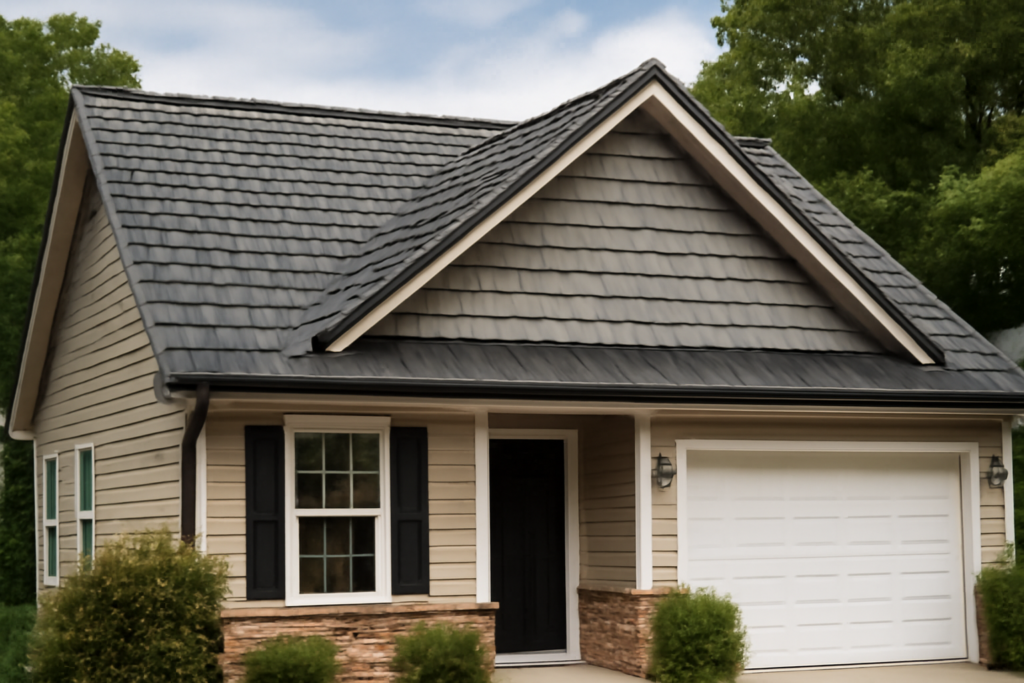
Plenty of homeowners want steel’s 50-year lifespan without the barn look, and the industry answered decades ago: a metal roof that looks like shingles is a stamped-panel system that reads as asphalt, slate, or wood shake from the curb. Modern stamped metal shingles are convincing enough that from 30 feet most people can’t tell — the giveaway used to be flat sheen and repeating patterns, and both problems have been engineered out with textured PVDF finishes, granular coatings, and multiple stamping dies per line. If your HOA has rejected standing seam or you simply don’t want ribs on a colonial, this category is where to shop.
How Stamped Metal Shingles Mimic the Real Thing
Manufacturers press 26- to 24-gauge steel (or .019 to .024 aluminum) through dies that emboss shadow lines, staggered butt edges, and surface grain. Three tricks sell the illusion. First, deep embossing: a good asphalt-look panel has 1/2 inch or more of relief so it casts real shadows, the same way an architectural shingle does. Second, randomized dies — premium lines rotate 3 to 6 die patterns so the roof doesn’t tile visibly. Third, finish texture: low-gloss PVDF paint with print-coat mottling for asphalt looks, or actual stone granules bonded in acrylic for products like DECRA, which are literally granule-surfaced like an asphalt shingle. Each “shingle” is really a panel covering 2 to 5 shingle-widths, typically around 12 by 48 inches to 15 by 60 inches, with four-way interlocks that hide all fasteners.
The Three Looks and Who Makes Them
Asphalt Shingle Look
The biggest segment. DECRA Shingle XD and Unified Steel (Westlake) Pine-Crest Shake/Cottage Shingle use stone-coated steel for a granular, dimensional-shingle appearance. In painted steel, ProVia Legacy Metal Shingle, Matterhorn Shingle (Westlake), and EDCO Arrowline Slate/Shake deliver the look with PVDF paint instead of granules — lighter and less abrasive to walk, though slightly shinier in raking sun.
Slate Look
Stamped slate profiles carry crisp rectangular tabs with beveled edges. EDCO Arrowline Slate, Matterhorn Slate, and aluminum options like Interlock Slate run convincing two-tone “blended” finishes that imitate quarry color variation. Real slate weighs 800 to 1,500 lbs per square; the metal version is 40 to 70 lbs, which means no structural upgrades on framing that could never carry stone.
Wood Shake Look
Deep-drawn shake profiles have the most relief — up to 5/8 inch — with striated grain. DECRA Shake XD, EDCO Arrowline Shake, Matterhorn Shake, and Interlock Cedar Shingle are the names to compare. In wildfire country this is the go-to: shake appearance with a Class A fire-rated assembly instead of kindling.
Cost: Stamped Metal vs. Asphalt vs. Standing Seam
- Architectural asphalt: $4.50 to $7.50 per sq ft installed. Cheapest up front, 22 to 28 year realistic life.
- Stamped metal shingles: $9 to $16 per sq ft installed depending on steel vs aluminum, granule vs paint, and roof complexity. Stone-coated steel typically lands $10 to $14.
- Standing seam: $10 to $18 per sq ft installed. Comparable to metal shingles, sometimes higher because of field-forming labor and trim work.
On a 2,200 sq ft roof, expect roughly $12,000 for asphalt, $24,000 to $30,000 for metal shingles. The payback argument: metal runs 40 to 60 years, so it outlives two asphalt roofs, and many insurers discount premiums 5 to 25 percent for Class 4 impact-rated metal in hail states. Resale appraisers commonly credit 1 to 6 percent of home value for a premium roof. If you’ll move within 8 years, asphalt wins the spreadsheet; past 15 years of ownership, metal usually does.
Installation Differences That Matter
Stamped shingles install differently from both asphalt and standing seam, and crew experience is the whole ballgame. Panels interlock on all four sides and fasten with concealed clips or direct nails/screws into the deck through a nailing flange. Stone-coated systems install either on battens (traditional, creates an air gap that helps in hot climates) or direct-to-deck with the newer profiles — check the specific product’s approval. Key differences:
- Order of operations is rigid. Interlocks mean you work in a set direction; tear-out of a mis-set panel mid-field is tedious.
- Underlayment is upgraded. Most manufacturers require a high-temp synthetic or peel-and-stick, not #15 felt.
- Flashings are system-specific. Valleys, sidewall, and hip/ridge pieces come from the manufacturer; an asphalt crew improvising flashings in the field is how these roofs fail.
- Some lines allow overlay. Certain stamped systems are approved for installation over one layer of asphalt shingles, saving $1,000 to $2,500 in tear-off — verify with local code, which usually caps total layers.
Walkability differs too: stone-coated steel on battens can dent if you step between supports, so foot traffic goes on the panel’s fastening zones. Painted aluminum shake dents more easily than 26-gauge steel — relevant under mature trees.
The HOA and Curb-Appeal Angle
This category exists substantially because of HOAs. Covenants written in the 1990s often ban “metal roofing” with vertical ribs by intent, picturing ag panel. Stamped shingle systems routinely win architectural review because samples in hand read as dimensional shingles, and several states (Texas, Colorado, Florida among them) restrict HOAs from banning impact-resistant or energy-efficient roofing outright. Bring the actual panel sample, the Class 4 UL 2218 impact rating, and the Class A fire rating to the review board. On the curb-appeal side, matte blends — weathered wood, charcoal, slate gray two-tones — photograph as premium; avoid single-color high-gloss options, which are the one place the metal still tells on itself.
Weight, Energy, and Insurance Numbers
Stamped metal’s spec-sheet advantages deserve hard numbers, because they drive real dollars. Weight first: painted steel shingle systems run 45 to 70 lbs per square and aluminum as little as 40, versus 240 to 320 for architectural asphalt. That makes overlay installs feasible where code permits and means zero structural concern on older framing. Energy: most lines offer cool-roof color options with solar reflectance high enough for ENERGY STAR or Title 24 compliance, and field studies of above-deck ventilated metal assemblies show summer cooling-load reductions in the 10 to 25 percent range compared to dark asphalt — more in hot-summer climates, less up north. Hail: Class 4 UL 2218 ratings are standard across the category, and in Texas, Oklahoma, and Colorado that routinely translates to 5 to 30 percent off the wind/hail portion of a premium; ask your agent for the exact schedule, because the discount alone can return $150 to $500 a year on a $3,000 policy. Fire: steel is noncombustible and the assemblies rate Class A, which matters for insurability in California WUI zones where some carriers now surcharge or decline wood roofs entirely. Wind warranties commonly cover 110 to 120 mph. None of these numbers make the aesthetic case by themselves, but stacked over a 40-year service life they close most of the price gap with asphalt before resale value even enters the conversation.
Choosing Between Systems
Pick granule-coated (DECRA, Unified Steel) when you want the closest texture match to asphalt and the quietest rain sound — the granules and batten air gap deaden drumming to roughly asphalt levels. Pick painted steel (EDCO, ProVia, Matterhorn) when you want lighter weight, a cleaner slate look, and a finish warranted against chalk and fade for 30-plus years; PVDF paint holds color better than granule acrylics in intense UV. Pick aluminum (Interlock, Classic Metal Roofing) within a mile of saltwater, full stop — steel edges eventually bloom rust in coastal spray no matter the coating. Whichever direction you go, a metal roof that looks like shingles succeeds or fails on installer certification: use a crew certified by that manufacturer, ask to see an address of a 5-year-old install, and go look at it in afternoon sun before you sign. Two contract details worth writing in: the flashing package must be the manufacturer’s system components (not shop-bent improvisations), and the warranty registration — often 30 to 50 years on finish and lifetime limited on the panel — should be completed in your name with paperwork in hand before final payment.