
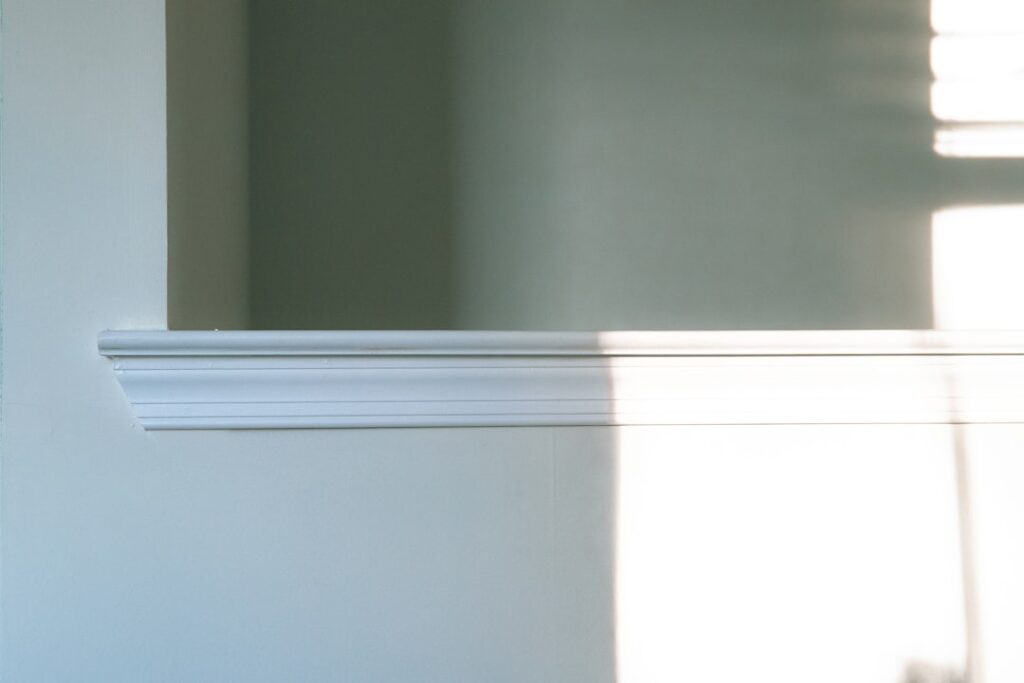
Walk through any new-build modern home and the first thing your eye registers is what is missing. The thick colonial casings, the stacked headers, the chunky stool and apron are gone, replaced by glass that meets drywall in a single crisp shadow line. Minimalist modern window trim is less about a specific product and more about a design philosophy: every line should be purposeful, every reveal calibrated to the millimeter, and every fastener invisible. Pulling it off requires more skill than slapping on a pre-mitered colonial casing, but the payoff is architecture that still looks current 20 years from now.
The Three Main Styles
Minimalist trim breaks down into three approaches, each with different cost and skill requirements:
- Drywall returns (trimless): drywall wraps directly into the window jamb, eliminating wood casing entirely. The most demanding to install but the cleanest look
- Flat 1x stock casing: a simple 3/4-inch by 3-inch flat board on all four sides, painted to match the wall. Architectural without being fussy
- Metal reveal trim: a thin aluminum or steel channel (often 1/4 to 3/8 inch wide) that frames the window edge and creates a deliberate shadow line
All three eliminate the traditional stool, apron, and stacked head jamb, which are the elements that read as fussy or traditional.
Drywall Returns: The Cleanest Look
A drywall return wraps the gypsum board around the rough opening so it dies into the window jamb itself. There is no wood between the wall and the glass, just a single 90-degree corner protected by metal corner bead.
The catch is that this technique is unforgiving. The window has to be installed dead plumb, the framing has to be perfectly square, and the drywall has to be hung with no gaps where the corner bead can flex. Use vinyl or paper-faced metal corner bead (Trim-Tex Bullnose or No-Coat brand) rather than rigid metal, because it survives the inevitable thermal movement around windows without cracking.
Budget-wise, drywall returns are paradoxically expensive. The materials cost almost nothing, but the labor for proper preparation runs 30 to 50 percent more than standard casing. Expect $80 to $150 per window in finishing labor.
Flat Stock Casing
If trimless feels too austere or your framing is not perfect enough to pull it off, flat 1×4 or 1×3 casing delivers most of the modern look at half the labor. Use poplar or finger-jointed pine for paint-grade, primed both sides before installation. Skip the back-band, skip the stool, and skip the apron.
Three details separate good flat casing from generic-looking flat casing:
- Mitered corners that are tight and pinned with 23-gauge headless pins so no nail holes show
- A consistent 1/4-inch reveal where the casing meets the jamb, marked with a story stick rather than measured each time
- Caulked top seam between casing and wall, but a deliberate shadow gap is acceptable in industrial-leaning designs
Metal Reveal Trim Systems
Aluminum reveal channels are the secret weapon of high-end modern builds. Brands like Trim-Tex F-Reveal, Fry Reglet, and Easy Bead create a clean recessed line where wall meets window. The channel becomes the trim, and there is no wood casing at all.
Reveal trim is friendlier to install than full drywall returns because the metal absorbs minor framing imperfections. Expect to pay $4 to $8 per linear foot for the profile plus standard drywall labor. Powder-coated black reveal trim against white walls is the look you see in nearly every modern lifestyle magazine.
Material Choices for Painted Trim
If you are sticking with traditional wood casing in a minimalist profile, the material affects how it ages:
- Poplar: hands-down the best paint-grade hardwood. Smooth, takes paint without grain telegraphing, holds detail
- MDF: dead flat, cheap, easy to cut. Avoid in bathrooms or anywhere it might get wet, where it swells
- Finger-jointed pine: budget-friendly but the joints will eventually print through paint
- PVC trim (Azek, Versatex): waterproof, dimensionally stable, paint adheres well. Great for minimalist exteriors
Color Strategy
Minimalist trim almost always lives in one of three palettes. Option one: trim painted the exact same color as the wall (Benjamin Moore Decorator’s White, Sherwin-Williams Alabaster, or whatever the wall already is) so the trim disappears as a frame and only registers as a subtle relief line. Option two: trim painted black or charcoal against pale walls, where the contrast becomes the design. Option three: natural rift-sawn white oak with a Rubio Monocoat Pure finish, which adds warmth without committing to a stained color.
Avoid white trim against light gray walls. The combination reads dated and unintentionally Cape Cod.
Common Installation Mistakes
Three things kill an otherwise nice minimalist install:
Visible nail holes on flat casing. The clean faces have nowhere to hide a 16-gauge brad. Switch to 23-gauge pins or use a small dab of color-matched putty wax that does not flash under raking light.
Inconsistent reveals around the window. The eye reads any variation greater than 1/16 inch as a mistake. Mark a story stick and check every corner.
Skipping caulk on outside corners of trimless drywall returns. The corner will hairline crack within a year if not properly bedded in setting compound and finished with flexible caulk.
Final Considerations
Minimalist modern window trim rewards patience over flashy products. The cleanest installations are usually the simplest profiles, executed with obsessive attention to reveals, plumb, and finishing detail. Spend the time on prep, choose one of the three core approaches, and you will end up with windows that frame views instead of competing with them.


