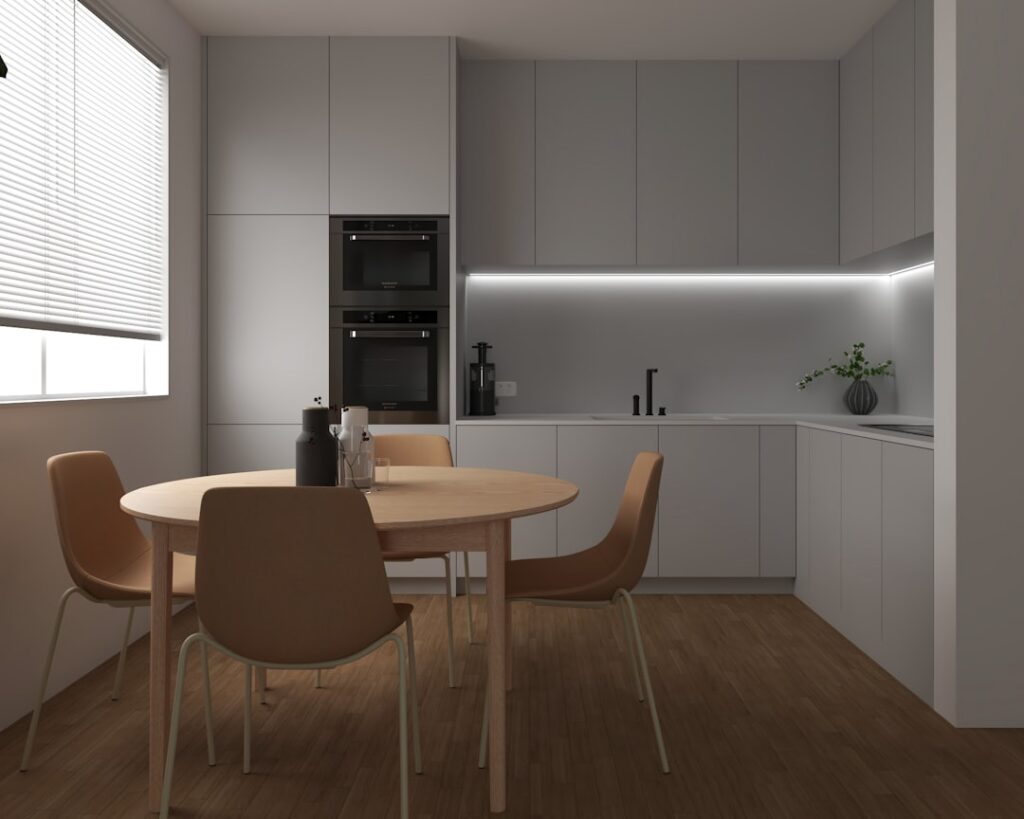
After years of hard, boxy kitchen islands with sharp 90-degree corners, designers and homeowners are embracing softer, more sculptural forms. A modern curved kitchen island replaces those rigid edges with flowing lines — a rounded end, a full oval, or a sweeping curved seating side. The look is undeniably striking, but curves also solve real problems: they improve traffic flow, eliminate hip-bruising corners, and create a more sociable gathering space. Here is what to weigh before you commit to one.
Why Curves Are Having a Moment
The trend toward curved islands is part of a broader movement away from cold, minimalist kitchens toward warmer, more organic spaces. A curve draws the eye, breaks up the boxiness of typical cabinetry, and creates a natural focal point. In an open-concept home where the kitchen flows into living and dining areas, a rounded island softens the transition and feels less like a wall of cabinets.
There is a practical case too. Sharp island corners are a genuine hazard in busy kitchens, especially for children, and they interrupt the flow of foot traffic. A rounded end lets people move around the island smoothly instead of navigating a corner, which is why curved islands work especially well in tighter kitchens where circulation is tight.
Popular Curved Island Shapes
“Curved” covers a range of designs, from a subtle softening to a fully sculptural statement. The main options are:
- Rounded-end island — a rectangular island with one or both ends curved into a semicircle; the most common and versatile choice
- Oval or elliptical island — a fully rounded form with no straight sides, dramatic and best in larger kitchens
- Curved-seating island — a straight prep side with a gently curved overhang on the seating side that wraps guests around it
- Kidney or crescent shape — a bold, asymmetrical sweep that becomes the sculptural centerpiece of the room
For most homes, a rounded-end island delivers the soft, modern look while keeping usable straight counter space for prep and appliances. Fully oval islands are stunning but sacrifice some flat working surface and require a large footprint to look right.
Material Considerations
Not every countertop material bends easily, and this is where curved islands get more expensive. The countertop is the biggest challenge because it must be cut and shaped to follow the curve.
Quartz and natural stone can be cut into curves, but the extra fabrication — CNC cutting the radius and polishing the curved edge — adds cost and labor. Some fabricators charge a premium of 20 to 40 percent over a straight top for the complex cuts. Materials like poured concrete and solid-surface (such as Corian) are naturals for curves because they can be molded or thermoformed into seamless flowing shapes without visible joints. Waterfall edges that wrap a curve are especially dramatic but require the most skilled fabrication.
The cabinet base itself must also be curved, which means custom or semi-custom cabinetry rather than stock boxes. Curved cabinet fronts, radiused end panels, or a bank of curved drawers all drive up the cost compared with a standard rectangular base.
Seating Around a Curve
One of the biggest advantages of a curved island is sociability. A curved seating side wraps guests slightly toward one another, encouraging conversation in a way a straight bar does not — the same reason restaurants use curved booths. Counter stools arranged along a gentle arc feel more inviting and inclusive.
Plan for at least 24 inches of width per stool along the curve, and provide 12 to 15 inches of knee clearance under the overhang for comfortable seating. Because a curve lengthens the usable seating edge compared with a straight run of the same footprint, you can often fit an extra stool or two. Backless swivel stools work particularly well along a curve, tucking neatly underneath and rotating to match the flow.
Sizing and Clearances
A curved island still needs to respect the standard kitchen clearance rules, and curves can actually make this easier. Maintain at least 36 to 42 inches of walkway on all sides — 42 to 48 inches is better on the cooking side where you need room to open the oven and stand back from the range.
Because a rounded end reduces the island’s overall footprint at the corners, a curved island can sometimes fit a walkway that a boxy island of the same length would block. Measure your kitchen carefully and, ideally, mock up the island’s outline on the floor with painter’s tape before committing. Walk the paths you use daily — to the fridge, sink, and range — and confirm the curve genuinely improves the flow.
What It Costs
A curved island costs more than a rectangular one of the same size, driven by custom cabinetry and complex countertop fabrication. As a rough guide, a standard mid-range island might run $3,000 to $7,000 installed, while a comparable curved island often lands in the $5,000 to $12,000 range or higher, depending on materials and the complexity of the curve.
The premium comes from three places: custom curved cabinet construction, the extra countertop fabrication and waste from cutting a radius, and skilled installation. If budget is tight but you love the look, a single rounded end on an otherwise straight island delivers most of the visual payoff at a fraction of the cost of a fully oval design.
Is a Curved Island Right for Your Kitchen?
A modern curved kitchen island is a bold, high-impact choice that softens a room, improves circulation, and creates a warm gathering spot. It rewards open-concept kitchens and homes where the island is the social heart of the space. Just go in knowing that curves cost more and require custom fabrication, so partner with an experienced designer and fabricator. Done well, a curved island becomes the sculptural centerpiece that makes the whole kitchen feel intentional and inviting.
Lighting a Curved Island
Lighting deserves special thought over a curved island because a single row of identical pendants — the standard approach over a rectangular island — can look awkward following a curve. Instead, designers often use a linear LED fixture that bends with the shape, a cluster of pendants at staggered heights, or a single large statement fixture centered over the widest part of the island.
The goal is for the lighting to echo and celebrate the curve rather than fight it. For task lighting, make sure the fixtures actually illuminate the work and seating areas, hanging roughly 30 to 36 inches above the countertop. A well-lit curved island reads as an intentional design feature; poorly planned lighting can undermine an otherwise beautiful shape.
Integrating Appliances and Storage
A curved island can still house the same functions as a straight one — a prep sink, a cooktop, a dishwasher, or a beverage fridge — but placement requires more planning. The straight portion of a rounded-end island is the natural home for appliances and the sink, since they need flat runs. Reserve the curved end for seating or open display shelving, where the shape adds interest without complicating installation.
Storage on the curved section often takes the form of custom radiused drawers or curved-front cabinets, which cost more but look seamless. Some designs use the curved end for open shelving or a display niche, turning a fabrication challenge into a design opportunity. Plan appliance and utility locations early, since running plumbing and electrical to a curved island is easiest before the base is built.
Frequently Asked Questions
Does a curved island cost more than a straight one? Yes. Custom cabinetry and complex countertop fabrication add 20 to 40 percent or more. A single rounded end is a budget-friendly way to get the look for less.
What countertop works best for curves? Poured concrete and solid-surface materials like Corian mold into seamless curves easily. Quartz and stone can be cut to a radius but cost more to fabricate.
Is a curved island good for small kitchens? It can be. A rounded end reduces the footprint at the corners and improves traffic flow, though a fully oval island needs a large kitchen to look right.