Ask an interior designer to name a ceiling fan that doesn’t look like a ceiling fan, and odds are the answer is the Maverick — the windswept, hand-carved-balsa icon that made this brand famous. A Monte Carlo ceiling fan occupies the slot between big-box commodity fans and $1,500+ boutique brands: design-forward styling, DC motors across most of the line, sizes stretching to a room-swallowing 88 inches, and street prices mostly in the $300-800 band. There is one naming wrinkle every shopper hits immediately — the brand technically no longer exists under that name — so let’s start there, then get into whether the fans deserve the design-world hype.
The Name Change: Monte Carlo Is Now Visual Comfort Fan
Monte Carlo Fan Company was founded in 1996 and spent years as the fan arm of Generation Brands (alongside lighting houses like Feiss and Sea Gull). Generation was acquired by Visual Comfort & Co. — the dominant designer-lighting group behind Circa Lighting and the Kelly Wearstler/Thomas O’Brien collections — and around 2022 the fan line was folded in and rebadged Visual Comfort Fan (VC Fan). Same factories, same engineering, same model families; new label. Practically: listings for the same fan appear under “Monte Carlo,” “Generation Lighting Fan,” and “Visual Comfort Fan” depending on the retailer’s catalog age, and older Monte Carlo model numbers (e.g., 8MAVR60BKD for a 60″ Maverick) carry over. Parts and warranty service route through Visual Comfort’s support channels today. If you’re comparing prices across sites, search the model number, not the brand name — you’ll find the identical fan under all three badges.
Design Positioning: The Designer’s Default Fan
The brand’s whole strategy is fans that photograph like furniture. Where Hunter and Harbor Breeze chase the $120 bedroom fan, Monte Carlo/VC Fan chases the vaulted great room in a design magazine: sculptural blades, matte and aged finishes (matte black, aged pewter, burnished brass, weathered oak), and collaborations within the Visual Comfort designer ecosystem. The look leans organic-modern and transitional rather than tropical or traditional — think spare three-blade silhouettes, not oak-and-brass five-blade classics. This is why the brand shows up constantly in architect and designer specs; it reads as intentional in a way commodity fans don’t.
The Models That Matter
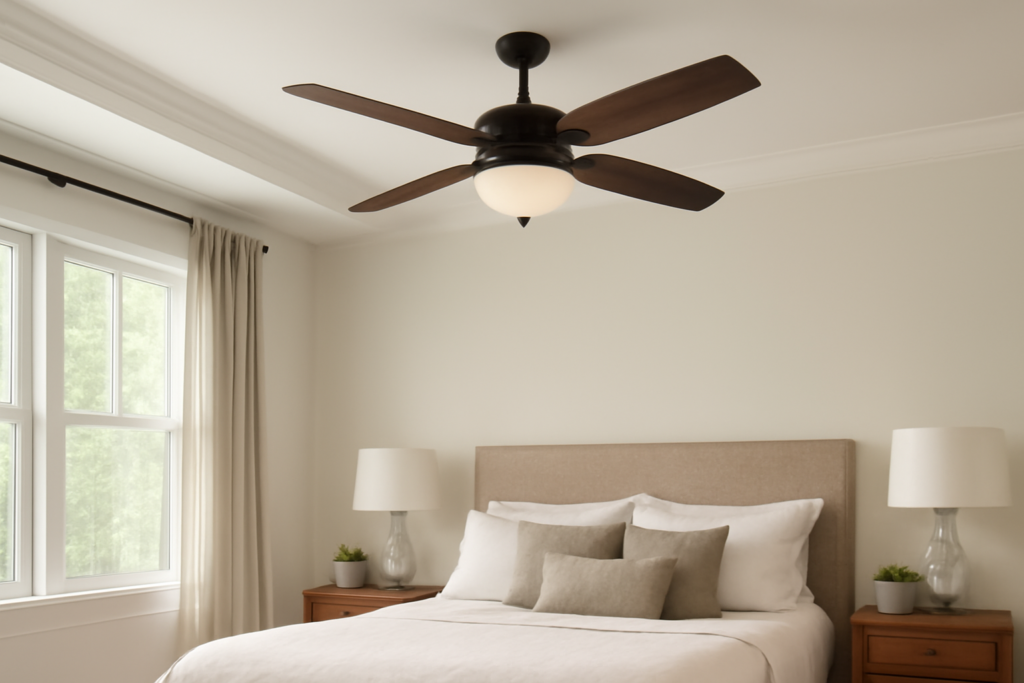
- Maverick — the franchise. Hand-carved balsa-wood blades with a raked, windswept profile; the “woodwind look” that half the industry now imitates (compare Fanimation’s Odyn or the wave of Amazon lookalikes). Sizes 52″, 60″, 70″, and the Maverick Max at 88 inches — one of the largest residential fans sold. DC motor, six speeds, remote included, optional LED kit. Typical street: $450-700 depending on size and finish ($700-900 for the Max). The 60″ in matte black with dark walnut blades is arguably the single most-specified designer fan in America.
- Vision / Vision Max — cleaner, flatter three-blade minimalism for modern spaces, up to 84″; $400-650.
- Clarity — budget-tier entry point around $250-350, DC motor, simpler blades.
- Cirque and Loft families — hugger/flush-mount and industrial-leaning designs for low ceilings, $300-500.
- Outdoor line — many Mavericks and Visions come in damp-rated versions, plus dedicated wet-rated models for exposed porches; verify the rating per finish, since the balsa-blade Mavericks are damp (covered porch) rather than wet rated.
DC Motors and Real-World Performance
Monte Carlo adopted DC motors earlier and more broadly than most mid-market brands, and it shows in the spec sheets: a 60″ Maverick moves roughly 6,000-7,000 CFM on high while drawing about 30 watts — a third the consumption of an equivalent AC-motor fan — with six speeds instead of three, near-silent operation, and instant reverse from the handheld remote. Big-room airflow is the brand’s quiet strength; the 70″ and 88″ Mavericks are legitimate answers for 400-600 sq ft great rooms where a 52″ fan just stirs the center. Two practical notes: DC fans are remote-dependent (wall controls are add-on accessories, and losing the remote means reordering, ~$50-80), and smart-home control is thinner than on Big Ass Fans or Modern Forms — some models support add-on WiFi/Bluetooth, but if native app/HomeKit control is a priority, Modern Forms wins that spec.
Warranty, Support, and Where to Buy
Warranty is a limited lifetime on the motor with shorter coverage (typically 1-2 years) on electronics, remotes, and finishes — competitive for the class; Hunter offers similar motor coverage, while the electronics term is where premium fans always feel fragile, whatever the brand. Support runs through Visual Comfort customer service, and replacement receivers, remotes, blades, and LED modules are orderable — a real advantage over no-name designer-look fans, where a dead receiver totals the fan. Distribution is broad: Build.com, Lumens, Wayfair, Amazon, Ferguson and lighting showrooms — but not the big-box aisle; Home Depot and Lowe’s carry it online-only at most. Watch for finish-specific pricing swings, and expect the popular matte black Maverick 60″ to hover in the $500s while less common finishes dip lower on closeout.
Versus Hunter and Minka-Aire
Against Hunter: Hunter owns the $100-300 mainstream with unbeatable retail availability, easier all-AC-motor simplicity, and pull-chain familiarity, but its design ceiling is lower — the comparable style pieces (Hunter’s own woodwind-style models) chase Monte Carlo’s lead. Buy Hunter for bedrooms and budget; buy Monte Carlo when the fan is a design decision. Against Minka-Aire: the closest true rival. Minka’s Light Wave (~$260) and Artemis (~$400-500) undercut the Maverick with similar sculptural intent, and Minka matches DC adoption. Monte Carlo counters with finer finish work, the balsa blade look Minka doesn’t quite replicate, the 88″ size, and stronger designer-channel cachet. Above both sit Modern Forms (smart features) and Big Ass Fans’ Haiku ($1,000-1,500, the engineering flex); below sit Fanimation’s mid-range and the Amazon lookalikes whose receivers are the part that fails.
Sizing and Installation Notes
Getting the size and mounting right matters more with statement fans, because an undersized showpiece looks worse than an undersized commodity fan. The working rules: 52″ fans suit rooms to about 225 sq ft; 60″ carries 225-400 sq ft; and the 70-88″ models are for genuinely large volumes — 400+ sq ft great rooms, where they also let you run lower, quieter speeds for the same air movement. Blade height should land 8-9 feet above the floor where ceiling height allows, which means flush or short-downrod mounting on 8-9 foot ceilings and progressively longer downrods as ceilings rise: roughly a 12″ rod at 10 feet, 18-24″ at 12 feet, and longer still under tall vaults, with angled-ceiling adapters handling pitches beyond the stock canopy’s limit (most VC Fan canopies accommodate moderate slopes out of the box; steep A-frames need the accessory mount). Installation itself is standard — a fan-rated ceiling box is mandatory, and the balsa-bladed models are actually lighter than they look, with most complete fans under 25 lbs. Budget an extra half hour for the receiver pairing and blade attachment on DC models, and keep the manual: the dip-switch and pairing procedures are what you’ll need when a remote gets replaced years from now.
Verdict: Who Should Buy One
A Monte Carlo/Visual Comfort fan is the right call when the fan will be seen — great rooms, vaulted primary bedrooms, covered outdoor living rooms — and the budget sits in the $350-800 middle where you want designer looks with real parts support behind them. The Maverick in particular remains the category-defining product: buy the 60″ for rooms up to ~20×20 feet, jump to 70″+ past that, and size up rather than down on vaulted ceilings with an appropriate downrod (12″+ drops for steep vaults). Skip the brand if you need a $150 workhorse (Hunter), native smart-home depth (Modern Forms), or pull-chain simplicity for a rental. As a piece of room design that also happens to move 6,500 CFM on 30 watts, it earns its spec-sheet ubiquity honestly. Shop by model number across the three brand names it’s listed under, order the spare remote receiver while the SKU is current, and the fan will still look deliberate when the sofa under it has been replaced twice.