The grout that fills your tile joints and the grout an engineer specifies under a steel column are two very different products. Non shrink grout is a high-strength, flowable cementitious material engineered to fill gaps under base plates, machinery, columns, and structural connections without shrinking as it cures. That last point is the whole purpose: ordinary cementitious mixtures shrink slightly when they dry, which would leave voids and reduce load transfer in critical structural applications. This guide explains what non-shrink grout is, where it is used, and how it is properly mixed and placed.
- What Makes Grout "Non Shrink"
- Where Non Shrink Grout Is Used
- Types of Non Shrink Grout
- Consistency: Flowable, Plastic, or Dry Pack
- Mixing and Placement Basics
- Safety and Best Practices
- Non Shrink Grout vs. Regular Grout and Concrete
- Choosing the Right Strength
- Curing for Maximum Strength
- Final Thoughts
What Makes Grout “Non Shrink”
When standard cement-based materials cure, they typically lose a small amount of volume, a phenomenon called shrinkage. In a tile joint that is harmless, but under a heavily loaded base plate it would create gaps that compromise full contact and even load distribution. Non-shrink grout is formulated with special additives that compensate for this, maintaining or slightly expanding its volume so it stays in full, tight contact with the surfaces it fills.
The result is a grout that transfers loads reliably, fills voids completely, and provides solid, gap-free bearing for structural and mechanical components.
Where Non Shrink Grout Is Used
This is a structural and industrial product, not a tile-setting material. Its common applications include:
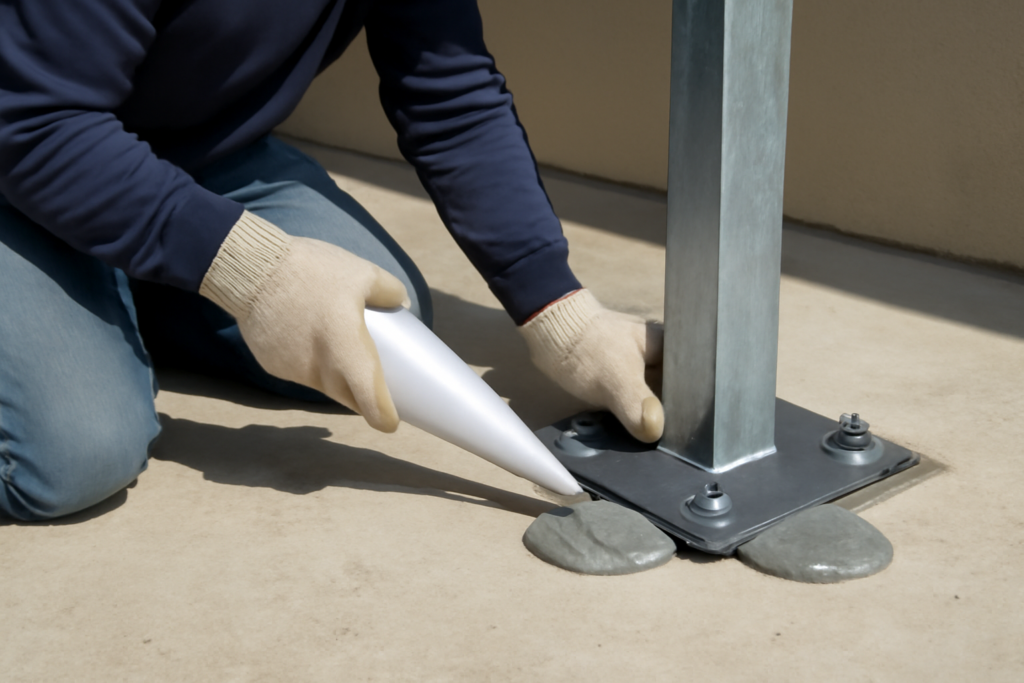
- Under base plates: Filling the space between a steel column base plate and the concrete foundation.
- Machine bases: Setting and leveling pumps, motors, and heavy equipment so vibration and load transfer evenly.
- Anchor bolts and bolt pockets: Securing anchor bolts and filling pockets in foundations.
- Precast connections: Filling joints and keyways between precast concrete elements.
- Structural repairs: Patching and filling where dimensional stability and strength matter.
If your project involves any of these, an engineer’s specification will usually call out the required grout strength and type.
Types of Non Shrink Grout
Non-shrink grouts come in a few formulations suited to different conditions:
- Cementitious non-shrink grout: The most common, mixed with water on site. Good general-purpose strength and value.
- Epoxy non-shrink grout: A multi-part resin grout with very high strength and excellent chemical, vibration, and impact resistance. Used in demanding industrial settings.
- Metallic and non-metallic versions: Some grouts contain metallic aggregate for added expansion and strength, while non-metallic versions avoid rust staining in exposed applications.
Always follow the project specification, since the choice affects strength, durability, and suitability for the environment.
Consistency: Flowable, Plastic, or Dry Pack
Non-shrink grout can be mixed to different consistencies depending on the placement:
- Flowable (fluid): A pourable mix that flows under a base plate to fill every void, ideal where the grout must travel into tight spaces.
- Plastic: A thicker, workable consistency for placements that need more body.
- Dry pack: A stiff, low-water mix packed and rammed into place by hand for situations requiring high strength with minimal flow.
Matching the consistency to the job is key to filling the space completely without voids.
Mixing and Placement Basics
Proper results depend on following the manufacturer’s instructions exactly. Use the specified water ratio; adding too much water weakens the grout and can reintroduce shrinkage and bleeding. Mix mechanically to a uniform, lump-free consistency, and use the grout within its working time before it begins to set.
Surface prep matters as much as mixing. The concrete should be clean, sound, and saturated surface-dry, meaning damp but with no standing water, so it does not pull water out of the grout. Place the grout from one side to push air out ahead of it and avoid trapping voids, and avoid working from both sides toward the middle. After placement, cure the grout properly, keeping it moist or covered as directed, so it reaches full strength.
Safety and Best Practices
As with any cement product, wear gloves and eye protection, since fresh grout is caustic and can irritate skin and eyes. For epoxy versions, follow the additional handling and ventilation guidance on the data sheet. For structural and load-bearing applications, the work should follow engineered specifications and, in many cases, be carried out by qualified contractors who understand the strength and placement requirements.
Non Shrink Grout vs. Regular Grout and Concrete
It is worth clarifying how this material differs from products people confuse it with. Tile grout is a fine cementitious filler for narrow joints between tiles, with no structural load-bearing role. Standard concrete and mortar can shrink as they cure, making them unsuitable for filling critical structural gaps where full contact is essential. Non-shrink grout is purpose-built to fill those gaps completely and bear loads without leaving voids.
- Tile grout: Cosmetic and protective filler for tile joints; not structural.
- Standard mortar/concrete: General construction use; can shrink and leave gaps.
- Non-shrink grout: High-strength structural filler that maintains volume for full, gap-free bearing.
Using the wrong product in a structural application can lead to voids, uneven load transfer, and failure, which is why specifications matter.
Choosing the Right Strength
Non-shrink grouts are rated by their compressive strength, typically given in pounds per square inch (psi), and the right strength depends on the load. Light to moderate applications may call for a standard grade, while heavily loaded base plates and high-vibration machinery require high-strength or epoxy formulations. The grout’s strength should meet or exceed what the project engineer specifies, and in many cases the grout is required to be stronger than the surrounding concrete. Never substitute a lower-strength product to save cost on a load-bearing connection; the specification exists for a reason.
Curing for Maximum Strength
Placing the grout correctly is only part of the job; curing determines whether it reaches its rated strength. Cementitious non-shrink grout needs to retain moisture as it cures, so it should be kept damp or covered with wet burlap and plastic, or treated with a curing compound, according to the manufacturer’s directions. Letting fresh grout dry out too quickly, especially in hot or windy conditions, can cause surface cracking and reduce strength. Protect the placement from rapid temperature swings and direct sun during the early curing period. Epoxy grouts cure chemically rather than by hydration, so they follow different timing and temperature requirements spelled out on the product data sheet.
Final Thoughts
Non-shrink grout is a specialized, high-strength material that fills critical structural and mechanical gaps without the shrinkage that would compromise load transfer. Choose the right type, cementitious or epoxy, and the correct consistency for your application, follow the manufacturer’s mixing and curing instructions precisely, and respect the engineered specifications for any load-bearing work. Used correctly, it provides the solid, void-free bearing that base plates, machinery, and structural connections depend on.