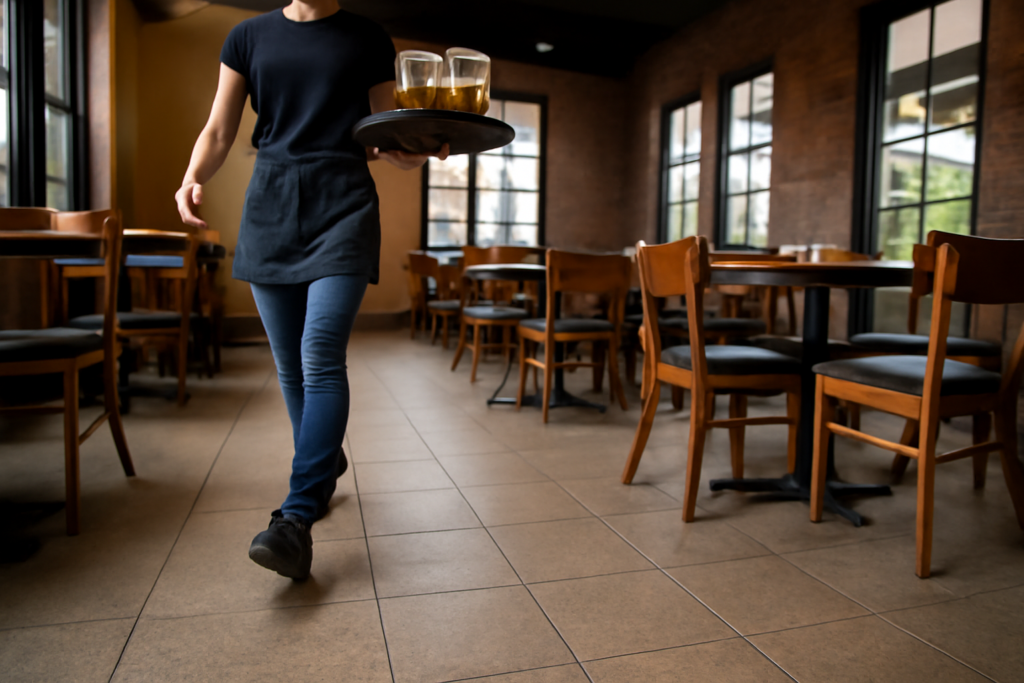
In a busy restaurant, the floor is a silent safety system, and choosing the right non slip flooring for restaurants can be the difference between a smooth service and a slip-and-fall lawsuit. Kitchens deal with grease, water, and constant foot traffic, while dining rooms need surfaces that stay gripping even when a server spills a tray. Slips, trips, and falls are among the most common causes of both employee injury and customer claims in food service, so the stakes are real. This guide covers the highest-traction flooring materials, the slip-resistance standards that matter, and what each surface costs to install and maintain.
- Understanding Slip Resistance Ratings
- Quarry Tile: The Kitchen Workhorse
- Epoxy and Urethane Resin Floors
- Slip-Resistant Luxury Vinyl and Safety Vinyl
- Textured Porcelain Tile for Dining Areas
- Sealed and Polished Concrete
- Matching Material to Cost and Zone
- Meeting Code and Reducing Liability
- Comfort and Fatigue for Staff
- Maintenance That Keeps Floors Non-Slip
- Don't Overlook Drainage and Coving
- Making the Right Choice
Understanding Slip Resistance Ratings
Before comparing products, learn the numbers that define traction. The current U.S. standard is the ANSI A326.3 dynamic coefficient of friction (DCOF) test.
- DCOF 0.42 or higher (wet): The minimum for interior floors expected to get wet. Restaurant kitchens should exceed this.
- DCOF 0.60 or higher: Recommended for greasy commercial kitchens and wet processing areas where oil compounds the risk.
- R-value (DIN 51130): A European ramp-test rating from R9 to R13. Kitchens should target R11-R12; heavy grease zones R12-R13.
Always ask the manufacturer for the tested DCOF and R-value in writing. A tile that looks textured may not meet code, and health and safety inspectors increasingly check.
Quarry Tile: The Kitchen Workhorse
Quarry tile has anchored commercial kitchens for decades, and it remains the default for good reason. This dense, unglazed clay tile is naturally slip-resistant, extremely durable, and holds up to grease, dropped pans, and hot spills. Abrasive-grit versions push traction to R12-R13.
Installed cost runs about $8-$15 per square foot including the mortar bed and grout. The grout lines are the maintenance point: they trap grease and require regular scrubbing and periodic sealing. Paired with a proper floor drain and a good degreasing routine, quarry tile lasts 15-20 years or more in a heavy kitchen.
Epoxy and Urethane Resin Floors
Seamless resin floors have become the modern standard for new commercial kitchens because they eliminate grout lines entirely. A troweled-on epoxy or, better, a urethane-cement (also called urethane mortar) system creates a monolithic, waterproof surface with anti-slip aggregate broadcast into the top coat.
Urethane-cement systems are the premium choice: they tolerate thermal shock from hot water and steam cleaning, resist food acids, and can be finished to an R11-R13 texture. Expect $6-$14 per square foot installed for epoxy and $10-$18 for urethane mortar. The seamless surface is easy to sanitize and meets HACCP-friendly hygiene goals, though it must be professionally installed over a properly prepped slab.
Kitchen vs. Dining Room Needs
Match the surface to the zone. Behind the line, prioritize maximum grip and cleanability, so quarry tile or urethane resin wins. In the dining room, you can dial back the aggressive texture for comfort and looks, using slip-rated LVP, sealed concrete, or porcelain that still meets the 0.42 DCOF threshold.
Slip-Resistant Luxury Vinyl and Safety Vinyl
Commercial-grade luxury vinyl tile and safety sheet vinyl offer traction with a warmer, quieter feel underfoot. Safety vinyl embeds silicon carbide or aluminum oxide grit directly into the wear layer, achieving R10-R11 ratings that hold up even when wet. It’s welded at the seams for a waterproof, hygienic finish popular in cafes, bakeries, and healthcare kitchens.
Costs land around $4-$9 per square foot installed. Vinyl is softer on servers’ legs during long shifts and dampens noise in a bustling dining room, though it won’t match tile or resin for lifespan in a heavy grease environment.
Textured Porcelain Tile for Dining Areas
For front-of-house spaces, textured or structured-finish porcelain delivers an upscale look with real slip resistance. Choose products explicitly rated at DCOF 0.42-plus, not polished versions. Porcelain resists staining from dropped food and wine, cleans easily, and comes in wood-look and stone-look planks that suit nearly any decor. Installed costs run $9-$18 per square foot. It’s ideal where appearance matters but safety still can’t be compromised.
Sealed and Polished Concrete
Polished concrete is trendy in industrial-style restaurants, but a glossy polish alone is slick when wet. To make it safe, installers add an anti-slip conditioner or a grit-infused sealer that raises the DCOF into compliance. Done right, it’s a durable, low-cost surface at $4-$10 per square foot for existing slabs. It works best in dining rooms and bar areas rather than the wettest kitchen zones.
Matching Material to Cost and Zone
- Urethane-cement resin — $10-$18/sq ft. Best seamless kitchen floor, R11-R13.
- Quarry tile — $8-$15/sq ft. Proven kitchen workhorse, high grip.
- Textured porcelain — $9-$18/sq ft. Best-looking dining option, 0.42+ DCOF.
- Safety vinyl / commercial LVT — $4-$9/sq ft. Comfortable, quiet, R10-R11.
- Grit-sealed concrete — $4-$10/sq ft. Budget dining and bar floors.
Meeting Code and Reducing Liability
Slip-resistant flooring isn’t only a safety courtesy; it’s frequently a code and insurance requirement. Local health departments and building codes often reference minimum slip standards for commercial food-service floors, and OSHA holds employers responsible for walking surfaces that are kept in a safe condition. When a claim arises, documentation matters: keep the manufacturer’s tested DCOF and R-value data on file, along with your cleaning logs.
Many general-liability carriers will also ask about floor safety during underwriting, and a documented non-slip surface with a maintenance protocol can influence premiums. Specifying a floor rated well above the 0.42 DCOF minimum, and being able to prove it, is a small step that protects the business if an incident ever reaches a courtroom.
Comfort and Fatigue for Staff
Traction is the headline, but underfoot comfort affects a restaurant too. Line cooks and dishwashers stand for eight to twelve hours, and a rock-hard floor contributes to leg and back fatigue that drives turnover. Resilient surfaces like commercial LVT and safety vinyl cushion joints better than tile or concrete, and anti-fatigue mats at fixed stations bridge the gap on harder floors.
There’s a balance to strike: the most cushioned surfaces aren’t always the toughest against grease and heat. Many operators use durable quarry tile or resin behind the line, then place drainage-through anti-fatigue matting at the fryer, grill, and dish pit to give staff relief where they stand longest. Those mats also add traction in the greasiest, most fall-prone spots.
Maintenance That Keeps Floors Non-Slip
Even the best surface turns dangerous if grease builds up. Traction depends as much on cleaning as on the material. Use an alkaline degreaser rather than a soap that leaves a slick film, deck-brush the floor rather than mopping (mopping just spreads grease into the texture), and rinse thoroughly. Keep floor mats at fryers and dish stations, mark wet areas clearly, and re-seal grout or concrete on schedule. A written cleaning protocol protects both your staff and your liability exposure.
Don’t Overlook Drainage and Coving
Two construction details quietly determine how safe a kitchen floor stays. First, floor drains and proper slope, typically 1/8 to 1/4 inch per foot toward trench or point drains, keep standing water from forming the slick puddles that cause most kitchen falls. A floor rated R12 does little good if water has nowhere to go.
Second, integral cove base, where the floor curves up the wall a few inches instead of meeting it at a hard 90-degree seam, eliminates the grimy corner where grease and mop water collect. Resin systems and welded safety vinyl both form seamless coving that’s easy to sanitize and prevents the edge buildup that undermines traction over time. These details cost a little more upfront but pay off in both safety and passing health inspections.
Making the Right Choice
The safest non slip flooring for restaurants pairs the material to the zone: urethane-cement resin or quarry tile behind the line where grease and water are relentless, and slip-rated porcelain, safety vinyl, or grit-sealed concrete out front where looks and comfort share the stage with safety. Always verify a wet DCOF of at least 0.42, aim higher in greasy areas, and back it all with a rigorous cleaning routine. Get those pieces right and you’ll cut injury claims, pass inspections, and keep both your team and your guests on their feet.
Prefer to explore on your own?
See how new flooring looks in your actual room in seconds — free, no signup.
Try the free Floor Studio →