Most outdoor falls happen on surfaces that felt perfectly safe when dry. Choosing genuine non slip outdoor flooring means looking past the showroom sample to how a material behaves with rain, algae film, morning frost, or wet pool feet on it. Traction is measurable, and the difference between a surface rated for wet barefoot traffic and a polished paver can be the difference between a great patio and an ER visit. This guide compares the main slip-resistant options for patios, walkways, steps, and decks, with real ratings, honest costs, and the maintenance each one demands.
How Slip Resistance Is Actually Measured
Two rating systems show up on spec sheets, and knowing them lets you cut through marketing claims. The first is DCOF, dynamic coefficient of friction, used widely for tile in the US. The commonly cited threshold is a DCOF of 0.42 for level interior floors that get wet; for outdoor and pool-adjacent surfaces, experienced installers look for 0.55 to 0.60 or higher, since the test understates real hazards like algae and sunscreen residue.
The second system is the European R-rating, from R9 (least grippy) to R13 (most). It appears on many porcelain pavers sold in North America. For covered patios, R10 is a floor; for exposed patios and walkways, R11 is the practical standard; for pool surrounds and ramps, R11 to R12. There is also an A/B/C barefoot wet rating on some products, where class B or C suits pool decks. If a product lists no rating at all, treat that silence as an answer.
Once your patio flooring is in place, think about how you’ll use the space. A gazebo adds shade and structure, while a good outdoor furniture set turns it into a spot you’ll actually want to hang out in. A deck box is also worth considering if you need somewhere to stash cushions and outdoor gear.
We may earn a commission when you purchase through our links.
Textured Porcelain Pavers
Structural porcelain pavers, usually 3/4 inch (2 cm) thick in 24 by 24 inch formats, have become the go-to upgrade surface for patios. The slip-resistant versions carry a molded texture, from fine sandpaper grit to pronounced stone relief, and quality lines advertise R11 ratings with wood, stone, and concrete looks that are hard to distinguish from the real thing at standing height.
Porcelain absorbs less than 0.5 percent water, which makes it effectively freeze-thaw proof and stain proof; spilled wine and grill grease wipe off. It can be dry-laid on gravel and sand, set on adjustable pedestals over a waterproofed roof deck, or mortared over a concrete slab. Expect $6 to $12 per square foot for materials and $10 to $22 per square foot installed depending on the base system. Weaknesses: individual pavers can crack under hard point impacts if the base is poorly compacted, cut edges need a diamond blade, and the most aggressive textures hold dirt and want a stiff-brush wash a couple of times a season.
Composite and PVC Decking
For raised surfaces, modern composite decking earns its popularity. Current-generation capped composites use embossed, deeper wood-grain texturing that performs far better wet than the slick first-generation boards from the early 2000s. Several manufacturers now publish wet traction data and offer enhanced-grain or ribbed profiles specifically for docks and pool surrounds.
Costs run $4 to $9 per square foot for boards, and $12 to $30 per square foot for a complete installed deck including framing. Composites never need sealing, will not splinter bare feet, and shrug off rot. On the con side, dark boards can hit 140°F or more in full summer sun, mold film can still grow on pollen and dirt left on the surface, and traction drops when that film is present, so a spring wash with soapy water and a soft brush is genuinely part of the safety plan. Where maximum grip matters, aluminum or fiberglass grit-strip stair nosings can be added to composite steps for $10 to $20 per tread.
Rubber Pavers and Tiles
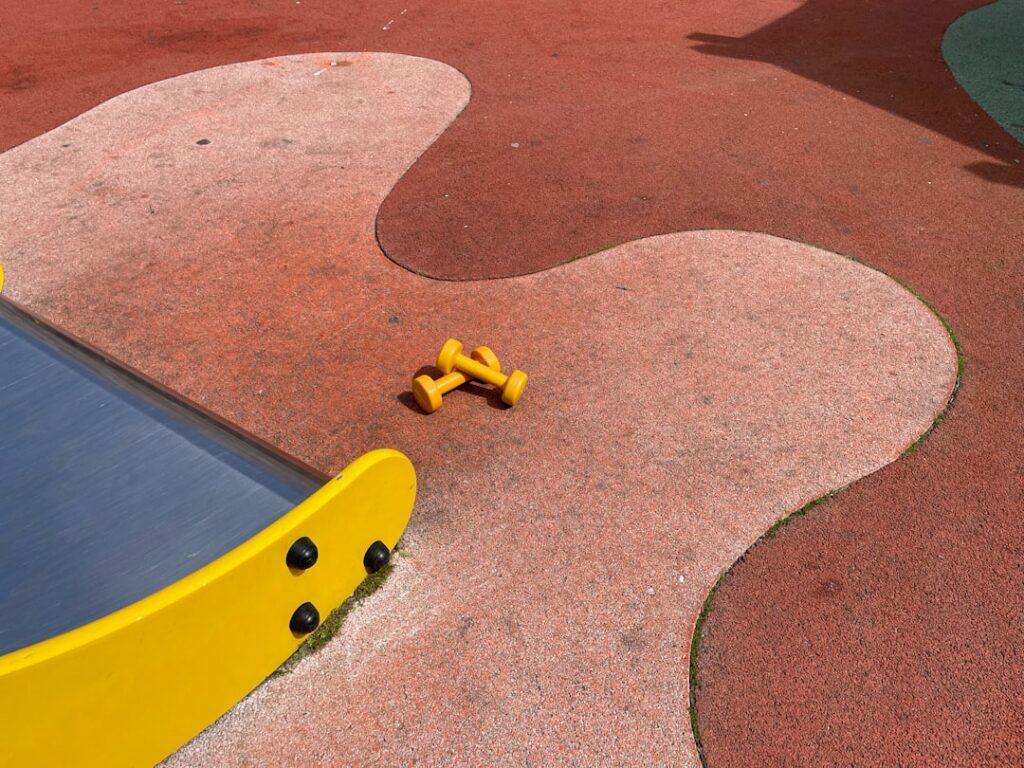
Recycled rubber tiles and pavers, typically 3/4 inch to 2 inches thick, offer the highest practical traction of any outdoor surface, wet or dry, plus fall-impact absorption that nothing else on this list matches. That combination makes them the default around play sets, hot tub surrounds, and on steps used by older adults. Interlocking or dowel-connected tiles lay over compacted gravel, pavers, or existing concrete with minimal prep.
Prices run $3 to $8 per square foot for standard tiles, more for playground-rated thicknesses. The tradeoffs are aesthetic and thermal: rubber reads utilitarian up close, dark colors get hot in direct sun, and cheap tiles can give off a rubber smell for the first weeks. Quality matters here; dense, urethane-bound tiles from established suppliers hold their edges for a decade, while bargain tiles can crumble at the corners in three to four freeze-thaw seasons.
Natural Stone and Concrete Done Right
Stone and concrete can be either the most slippery or among the most secure surfaces outdoors, entirely depending on finish. For stone, choose thermal-flamed granite, sandblasted bluestone, or tumbled travertine; avoid honed or polished anything outside. Travertine deserves special mention for pool areas: its open texture grips wet feet and it stays noticeably cooler than concrete or dark stone, though it needs sealing every one to two years and runs $8 to $15 per square foot installed on sand, more over new concrete.
For concrete, a broom finish applied at the pour is free traction, and it remains the best value walkway surface in America at $6 to $12 per square foot poured. Existing smooth or troweled concrete can be retrofitted three ways: an acid or mechanical etch, a broadcast anti-slip additive stirred into a sealer or paint (polymer grit or aluminum oxide, $10 to $20 per additive package covering 100 to 200 square feet), or a full textured overlay at $3 to $8 per square foot. Skip glossy film-forming sealers on any walking surface; wet, they behave like glass.
Comparing Costs and Traction at a Glance
- Rubber tiles: best wet traction, softest landing; $3 to $8 per sq ft; utilitarian look.
- Broom-finished concrete: excellent traction, lowest cost; $6 to $12 per sq ft poured; plain appearance, can crack.
- Textured porcelain pavers (R11): excellent traction, premium looks; $10 to $22 per sq ft installed; needs solid base work.
- Tumbled travertine: very good barefoot traction, stays cool; $8 to $15 per sq ft installed; periodic sealing.
- Enhanced-grain composite decking: good traction when clean; $12 to $30 per sq ft as a complete deck; heat and mold film are the watch-outs.
Climate and Site Factors People Forget
Freeze-thaw cycling is the silent killer of outdoor floors in the northern two-thirds of the country. Porous materials that absorb water, including some cheap ceramic tiles and low-grade natural stone, spall and flake after a few winters; porcelain, granite, rubber, and properly air-entrained concrete endure. Slope matters just as much as material: any patio or walkway should fall about 1/4 inch per foot away from the house so water sheets off instead of ponding, because standing water breeds the algae film that defeats even textured surfaces.
Shade is the other multiplier. A north-facing walkway under trees will grow slick biofilm on any material, so plan for an annual cleaning with a deck wash or diluted oxygen bleach, and favor the most aggressive textures in those zones. In snow country, confirm your surface tolerates plastic shovels and, ideally, calcium chloride or magnesium chloride deicers; rock salt pits concrete and corrodes some paver finishes.
Bottom Line Recommendations
Match the material to the job rather than hunting for one perfect product. For a showpiece patio, R11 textured porcelain on a compacted base is the strongest all-around choice. For budget walkways, broom-finished concrete is unbeatable. For pool surrounds and barefoot zones, tumbled travertine or class-B rated porcelain earn the premium, and for play areas or aging-in-place safety, rubber tiles win outright. Whatever you choose, non slip outdoor flooring only stays non slip when it is kept clean and drains properly, so build the 1/4 inch per foot slope and a yearly wash into the plan from day one.
Prefer to explore on your own?
See how new flooring looks in your actual room in seconds — free, no signup.
Try the free Floor Studio →