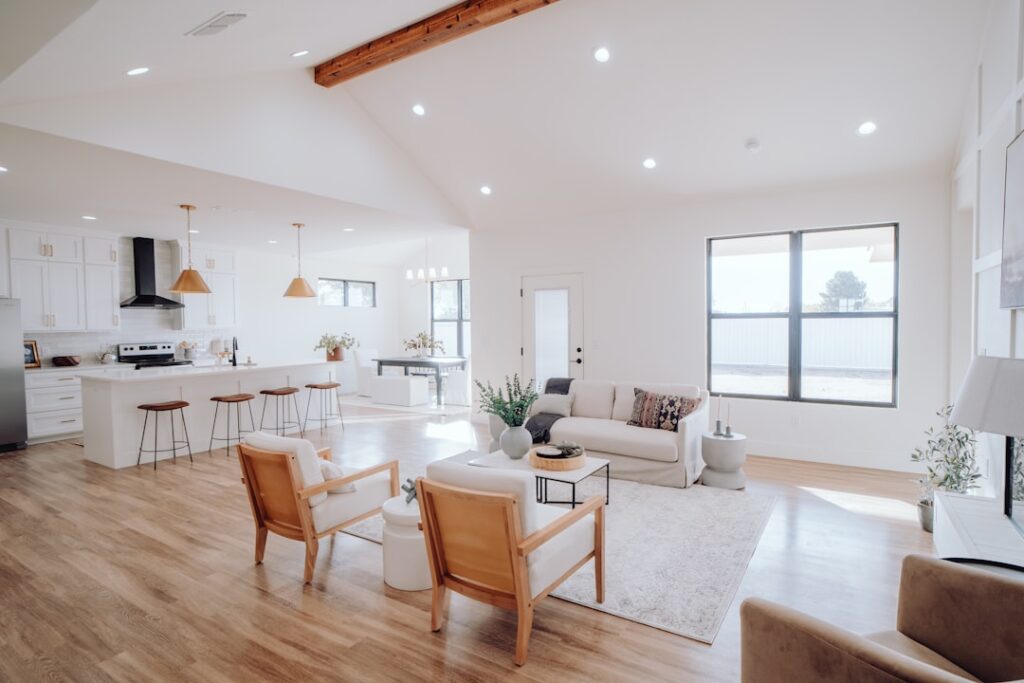
Scandinavian interior design treats flooring as a quiet backdrop rather than a feature, and the result is a tightly defined visual: pale European oak, wide planks, matte white-oiled finishes that show grain without yellowing under LED lighting. Nordic flooring in 2026 spans authentic Swedish and Danish imports from Kahrs, Junckers, and Dinesen alongside US-domestic engineered products that target the same aesthetic. Expect $7.99 to $19.99 per square foot for engineered Nordic-style oak and $25 to $55 for genuine Dinesen Douglas fir planks.
What Defines the Nordic Look
Wood species is European oak (Quercus robur), not American white oak — the European variety has finer grain, fewer mineral streaks, and a cooler base tone that reads pale gray-beige rather than the warmer yellow of US oak. Plank width is wide: 7 inch to 12 inch face widths are standard, with 14 inch and 18 inch panels available from Dinesen and Mafi for high-end residential.
Finish is the giveaway detail. Scandinavian manufacturers use white-pigmented hardwax oils — usually two to three coats of Osmo Polyx White, Rubio Monocoat Pure, or Kahrs’ proprietary Tone in Frost. The finish penetrates the wood rather than sitting on top, leaving a flat, almost chalky matte sheen that highlights grain texture under low-angle daylight from north-facing windows common in Nordic interiors.
The Authentic Brands
Kahrs, founded 1857 in Sweden, is the highest-volume Nordic flooring brand reaching the US — their Original 7-inch engineered oak line with whitewashed finishes runs $7.99 to $13.99 per square foot. Junckers from Denmark specializes in solid hardwood and engineered with hardwax oil finishes at $10.99 to $18.99. Dinesen is the luxury extreme — handcrafted Douglas fir and oak planks up to 15 inches wide and 49 feet long, priced $35 to $55 per square foot.
Mafi (Austrian, often grouped with Nordic) produces brushed and lye-treated European oak in 8-inch to 12-inch widths at $14.99 to $24.99. Boen (Norwegian) and Bauwerk (Swiss) round out the European import options, with US dealers in major metro markets stocking limited selection.
Pros That Justify the Premium
- Light amplification — pale oak reflects 50% to 65% of ambient light, brightening rooms with limited natural daylight
- Timeless aesthetic — Scandinavian design has held visual relevance for 70+ years without trend reversal
- Hardwax oil finishes are spot-repairable without sanding the entire floor
- FSC-certified wood from most Scandinavian mills meeting strict sustainable forestry standards
- Wide plank format minimizes visible seams in open-plan rooms with sightlines over 25 feet
- 25 to 30 year residential warranties from Kahrs, Junckers, and Mafi against manufacturing defects
Cons to Consider
Lighting sensitivity is the biggest design risk. Pale oak floors that look stunning in north-facing Scandinavian winter light can read flat and lifeless under warm 2700K LED bulbs common in US homes. Test a 2-foot sample under your actual room lighting before ordering — the difference between 2700K and 4000K bulbs over the same finish is dramatic.
Pet households face real durability concerns. White-oiled finishes show pet accident stains immediately because the finish penetrates rather than seals, and urine can leave dark tannin marks within hours that require sanding back to bare wood to repair. Households with dogs should consider water-based urethane finishes over Scandinavian-style oak instead of true hardwax oil.
Cost Per Square Foot in 2026
- Kahrs Original 7-inch engineered oak (Stockholm, Gothenburg collections): $7.99 to $13.99 material
- Junckers solid oak (UltraMatt or Sylva collection): $10.99 to $18.99 material
- Mafi 8-inch brushed oak (Country Vulcano, Vulcano Tiger): $14.99 to $19.99 material
- Boen Stonewashed engineered oak: $9.99 to $14.99 material
- Dinesen Douglas fir wide plank: $35 to $55 material turn-key
- Pro install labor (nail-down or float over plywood subfloor): $4.99 to $7.99
Installation Notes
Engineered Nordic oak typically installs three ways: floating with foam or cork underlayment, nailed down with 2-inch cleats through the tongue at 8-inch intervals, or full-spread glue down with moisture-cured polyurethane adhesive like Bostik Bestlay GreenForce. Wide planks 8 inches and over generally require glue-down or nail-down — floating installs over 7-inch wide can develop seasonal gapping that telegraphs through the open joints.
Acclimation is non-negotiable. European oak shipped from Sweden to Florida or Texas has experienced a 30% to 50% humidity drop in transit. Open the cartons in the install room and let the planks rest flat for 5 to 10 days at the same temperature and humidity the finished floor will see year-round. Skip this and the joints open within the first summer.
Finish and Maintenance
Hardwax oil finishes need re-oiling every 3 to 7 years depending on traffic — sooner in entry foyers and kitchens, longer in formal living rooms. Re-oiling is a clean-and-coat process: clean with Osmo Wash and Care or Rubio Monocoat Soap diluted at 4 ounces per gallon, dry overnight, then apply a single thin coat of matched maintenance oil with a microfiber pad. Total cost runs $0.40 to $0.80 per square foot DIY or $1.99 to $2.99 by a pro.
Spot-repair scratches with Osmo Polyx Color Oil matched to the original finish — apply with a cotton swab, let cure 12 hours, buff with a microfiber cloth. Avoid wax-based polishes, vinegar, ammonia, and any “shine restore” products; these build up on hardwax oil and turn the matte finish patchy-glossy over time.
Where Nordic Flooring Excels
Open-plan modern homes with floor-to-ceiling windows and 9-foot or higher ceilings showcase wide pale oak the way it was designed to perform. Coastal and Pacific Northwest markets where overcast daylight predominates are a natural fit because the pale finish brightens what would otherwise feel like a gray interior under cloud cover.
Boutique hospitality and high-end residential remodels in design-forward markets — Aspen, Park City, the Hamptons, Brooklyn brownstones — return the spend in resale and editorial coverage. Nordic flooring done correctly photographs as well in person as on Instagram, and that visual consistency is worth real money in luxury markets. Match the right brand to the right room and the floor will hold relevance for the next 30 years without renovation pressure.
Prefer to explore on your own?
See how new flooring looks in your actual room in seconds — free, no signup.
Try the free Floor Studio →