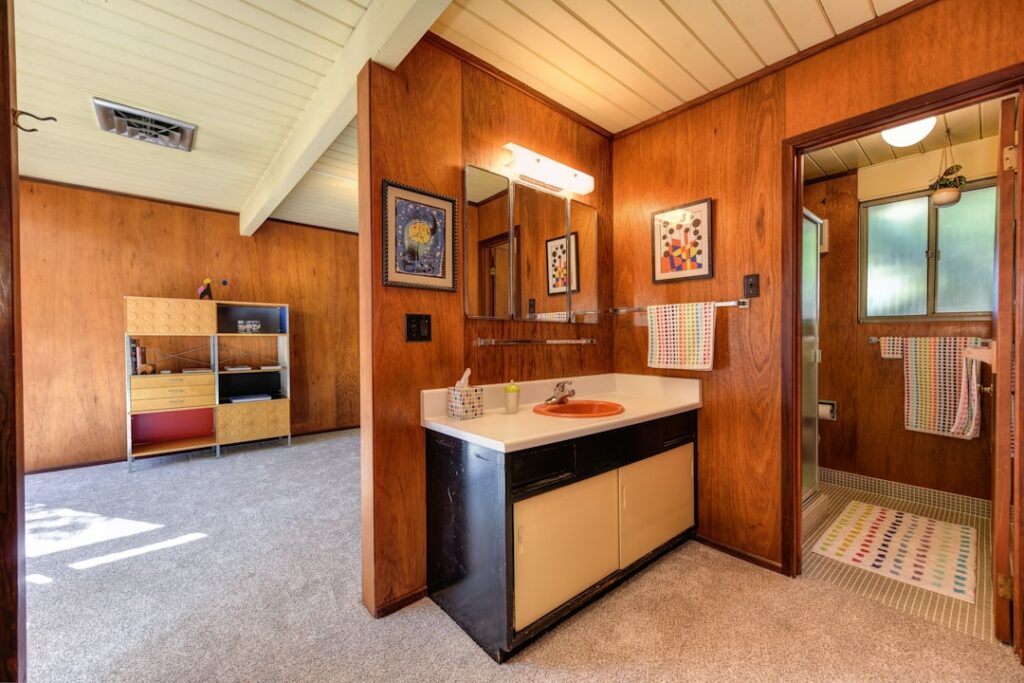
Walk into a house built between roughly 1945 and 1969 and you might still find one — a genuine original mid century bathroom with pastel tile, a built-in tub, and hardware that hasn’t been touched in decades. Homeowners who inherit one of these rooms usually land in the same fork in the road: restore it as a period piece, or gut it for something modern. Both paths have real merit, and the right call depends on the tile’s condition, your budget, and how much you actually love that seafoam-green or pink ceramic.
What Makes a Bathroom Genuinely Mid-Century
Before deciding what to do with the room, it helps to know what you’re actually looking at. True mid-century bathrooms from this era typically share a handful of signature features: small-format ceramic tile in pastel colors like pink, seafoam, turquoise, or butter yellow, often paired with black or white as an accent. Floors are commonly tiny hexagonal or penny-round mosaic tile, sometimes with a contrasting border. Fixtures tend to be cast iron with a thick porcelain enamel finish, and vanities were often built-in with laminate countertops in a boomerang or speckled pattern.
These rooms were built to last, and that’s part of why so many survive intact seventy-plus years later. The tile setting beds are typically full mortar rather than thin-set, which is one reason the tile is so hard to remove without damage — and also why it’s often still rock solid today.
The Case for Restoring the Original Bathroom
Restoration has picked up real momentum over the last several years, partly driven by a genuine design-world appreciation for mid-century materials and partly by cost. Ripping a bathroom to the studs runs $15,000 to $35,000 or more in many markets, while restoring an intact original room can often be done for a fraction of that.
- Deep clean and re-grout: A professional-grade tile and grout cleaning, followed by re-grouting cracked or discolored joints, can transform a tired-looking room for $500 to $1,500.
- Reglaze the tub and tile: Professional reglazing (also called refinishing) restores a chipped or dull porcelain tub and surrounding tile for roughly $400 to $700 for a tub alone, or $1,500 to $3,000 if you include the surrounding tile walls.
- Swap fixtures and hardware: New faucets, a period-appropriate showerhead, updated cabinet pulls, and a new mirror can modernize the feel without touching a single tile, usually for $500 to $2,000 depending on quality.
- Update lighting: Swapping outdated fixtures for reproduction or complementary modern lighting is one of the highest-impact, lowest-cost changes you can make, often under $500.
Buyers increasingly search for these rooms specifically. A well-preserved original bathroom photographed and marketed well can be a selling point rather than a liability, especially in neighborhoods where mid-century modern homes carry a premium.
The Case for a Full Update
Restoration isn’t always realistic. If the tile is cracked through to the substrate, if there’s evidence of water damage behind the walls, or if the plumbing and electrical haven’t been touched since installation, a full renovation may be the safer and ultimately cheaper long-term choice. Trying to patch around failing infrastructure often costs more in the end than addressing it head-on.
A full gut renovation typically runs:
- Budget-conscious remodel: $8,000 to $15,000 for a straightforward layout with mid-range tile, a new tub or shower, and updated fixtures.
- Mid-range remodel: $15,000 to $25,000, often including moving a fixture or two, better tile, and a new vanity.
- High-end remodel: $25,000 to $45,000+, especially if you’re reconfiguring the layout, adding a curbless shower, or using natural stone.
A full update also lets you address the things a restoration can’t fix — lack of ventilation, a cramped layout, low water pressure from old galvanized pipe, and outdated wiring that may not meet current code for a bathroom’s wet-location requirements.
What to Check Before You Decide
Don’t make this call on looks alone. A few practical checks will steer you toward the right decision.
- Tap the tile. A hollow, drum-like sound usually means the tile has debonded from the mortar bed behind it. Isolated hollow spots can sometimes be repaired; widespread hollow sound often means the whole wall needs to come down.
- Check the grout and caulk lines around the tub. Soft or spongy drywall near the tub, discoloration, or a musty smell points to water intrusion that needs to be addressed before any cosmetic work happens.
- Look at the plumbing type. Homes from this era commonly used galvanized steel supply lines, which corrode from the inside and restrict water flow over time. If you haven’t already repiped, a restoration is a good opportunity to at least replace supply lines even if you keep the tile.
- Test the exhaust fan or ventilation. Many original bathrooms from this period have weak or nonexistent ventilation, which accelerates tile and grout deterioration and promotes mold. Adding or upgrading a fan is worth doing regardless of which path you choose.
- Confirm the electrical is GFCI-protected. If outlets near the sink aren’t GFCI-protected, that’s a safety upgrade worth doing even in a light restoration.
A Middle Path: Selective Restoration
Plenty of homeowners land somewhere in between full preservation and full gut renovation. This usually means keeping the original tile walls and floor — the most expensive and labor-intensive elements to replicate — while updating the tub or shower enclosure, vanity, lighting, and fixtures. This hybrid approach keeps costs closer to $3,000 to $8,000 while still solving the functional pain points like poor water pressure, dated lighting, and worn-out hardware.
If you go this route, be careful with contractors during any adjacent work like re-piping or electrical updates — original tile is brittle by modern standards and easy to crack if someone leans a ladder against it or drops a tool. Make sure whoever you hire has experience working around vintage tile, not just installing new material.
Matching or Sourcing Period-Correct Materials
If a section of tile does need replacing, matching vintage colors is harder than it sounds — pastel glazes from this era have faded and shifted subtly over decades, and modern tile lines rarely match exactly. Salvage yards, architectural reclamation shops, and online vintage tile marketplaces are worth checking before assuming you need to replace an entire wall. Some manufacturers also produce reproduction lines in classic mid-century colorways, which can work well for accent tile or a shower niche even if they don’t perfectly match the original run.
Resale and Market Considerations
Whether restoration or renovation adds more value depends heavily on your local market. In neighborhoods with a strong mid-century modern identity, a beautifully preserved period bathroom can be a genuine selling point that differentiates a listing. In more generic suburban markets, buyers often expect a move-in-ready, contemporary bathroom and may discount a home with dated fixtures regardless of how well-preserved they are. Talk to a local real estate agent familiar with your specific neighborhood before committing tens of thousands of dollars either direction.
Is it worth restoring an original mid-century bathroom instead of remodeling?
If the tile is structurally sound and there’s no hidden water damage, restoration is usually far cheaper and preserves a design feature that’s genuinely back in demand. If plumbing, electrical, or the substrate are compromised, a full remodel is often the better long-term investment.
How much does it cost to reglaze a vintage tub and tile?
Reglazing a tub alone typically runs $400 to $700, while including the surrounding tile walls brings the cost to roughly $1,500 to $3,000, depending on square footage and condition.
Can I replace just a section of vintage tile instead of the whole wall?
Yes, if you can source a close color match through salvage tile or reproduction lines. Isolated hollow or cracked tiles can often be individually removed and replaced without disturbing the rest of the wall.
Does a preserved mid-century bathroom help or hurt resale value?
It depends on your market. In neighborhoods where mid-century modern design carries a premium, an intact original bathroom can be a selling feature; in more conventional markets, buyers may still prefer an updated space.