Walk into a 17th-century French chateau and you will see the same flooring pattern that just hit the top of the 2026 design trend lists. Parquets, those geometric assemblies of small wood pieces arranged in herringbone, chevron, or Versailles tiles, have outlasted every wood floor trend that came after them, and for good reason. They survive heavy traffic, hide minor scratches in their busy pattern, and add roughly 4-7 percent to home resale value compared to standard plank, according to NAR remodeling reports. After installing parquet floors for fifteen years across older brownstones and new construction, I can tell you the pattern matters less than the substrate prep and the finish system.
- The Three Patterns That Dominate the Market
- Wood Species Selection by Janka Hardness
- Solid Versus Engineered Parquet
- Brand Spotlight: Who Makes the Best Parquets
- Installation Methods and Real Costs
- Finishing and Long-Term Care
- Subfloor Prep: The Step That Makes or Breaks the Install
- Is Parquet Worth It for Your Home
The Three Patterns That Dominate the Market
Herringbone uses rectangular blocks, typically 4 by 16 or 5 by 24 inches, laid at 90-degree angles to form a zigzag. The ends are cut square. It is the workhorse pattern, accounting for about 60 percent of parquet installs I do.
Chevron uses the same proportions but cuts the ends at 45 degrees, so the blocks meet point-to-point in a continuous V. It looks more formal and runs roughly 25 percent more than herringbone because of the precision cuts. Versailles, the third major style, assembles small strips into 24- or 36-inch square panels with interlaced diagonals. It is what you see in the Palace of Versailles itself, and it commands the highest price tag.
Wood Species Selection by Janka Hardness
Parquet floors face the same wear as plank floors but with more seams, so species choice matters. The Janka hardness test measures resistance to denting in pounds-force.
- White oak: 1,360 Janka, the gold standard, takes stain beautifully
- Red oak: 1,290 Janka, slightly pinker, costs 15 percent less than white oak
- Walnut: 1,010 Janka, dark and dramatic but dents easier under heels
- Hard maple: 1,450 Janka, very light, hard to stain evenly
- Hickory: 1,820 Janka, dramatic grain variation, excellent for high-traffic homes
For families with kids and dogs, I recommend white oak or hickory. Walnut parquets look stunning in a formal dining room but will show every dropped fork within a year.
Solid Versus Engineered Parquet
Solid parquet blocks are typically 3/4 inch thick and can be sanded and refinished four or five times across their 80-100 year life. The downside is moisture sensitivity. Below grade or over concrete, solid parquet expands, contracts, and gaps.
Engineered parquet has a hardwood wear layer, usually 3 to 6 millimeters thick, bonded to a plywood or HDF core. The 4-6 mm wear layer engineered options can be refinished twice. Engineered handles concrete subfloors and radiant heat far better. Mannington Mountain View Walnut engineered herringbone runs about $9.50 per square foot; the solid equivalent runs $7-$8 but adds another $4-$6 in subfloor and acclimation costs over concrete.
Brand Spotlight: Who Makes the Best Parquets
Mirage out of Quebec produces the highest-quality engineered parquet I have installed. Their Imagine collection in 5/8 inch white oak herringbone runs $12-$14 per square foot with a seven-coat aluminum oxide finish that survives commercial-grade use. Mohawk’s RevWood Plus laminate parquet runs $4-$5 per square foot if you want the look without real wood.
Bruce Hardwood, owned by AHF Products, offers solid oak parquet tiles in the Natural Reflections line for $5-$6 per square foot, though they require a full glue-down install. Shaw’s Floorte Pro WPC and Mannington Mountain View round out the mid-market. For the high end, Hakwood and Element7 produce custom Versailles panels starting around $28 per square foot for the material alone.
Installation Methods and Real Costs
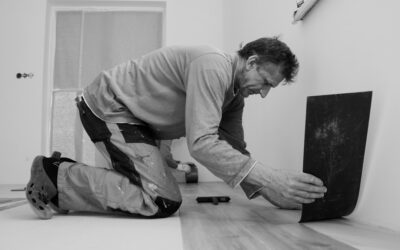
Three install methods apply. Full glue-down with a urethane adhesive like Bostik BST or Sika MB is the most common for engineered parquet, especially over concrete. Nail-down works only over plywood and requires a flooring nailer adjusted to avoid splitting the small blocks. Floating installs do not work for true parquet because the small pieces will not stay flat without adhesion.
Labor for herringbone runs $8-$14 per square foot. Chevron jumps to $12-$18 because of the miter cuts. Versailles panels are easier than they look, $10-$14 per square foot, because the panels lock together. Material plus install for a typical 300-square-foot living room lands at $14-$28 per square foot for herringbone in white oak engineered, and $24-$42 for chevron in walnut.
Finishing and Long-Term Care
Site-finished parquet gives you the smoothest surface but creates dust and requires you to vacate for two days. I use Bona Mega ONE waterborne polyurethane, three coats, with a Bona Traffic HD topcoat in high-traffic rooms. Total finish cost runs $2.50-$3.50 per square foot.
Prefinished parquet eliminates the dust and lets you walk on the floor the same day. The trade-off is microbevels between blocks, which collect grit. Maintenance is simple. Vacuum weekly with a soft brush attachment, damp-mop with Bona Hardwood Floor Cleaner, and avoid steam mops entirely. A recoat every 7-10 years with Bona Traffic HD costs $1.50-$2 per square foot and resets the wear layer.
Subfloor Prep: The Step That Makes or Breaks the Install
Parquet is unforgiving of subfloor flatness because the small pieces telegraph every dip. The NWFA standard calls for the subfloor to be flat within 3/16 inch over 10 feet. Most homes are not. Use a 10-foot straightedge to check, then self-level low spots with Mapei Ultraplan 1 Plus ($45 per 50-pound bag).
Over concrete, run a calcium chloride test for moisture vapor emission. Anything above 3 lb/1000 sq ft per 24 hours requires a moisture mitigation primer like Bostik MVP4 ($168 per 4-gallon pail) before adhesive goes down.
Is Parquet Worth It for Your Home
If you have an older home with original hardwood and want a pattern that signals craft, yes. If you are building new construction and want a floor that will not look dated in 2040, yes. If you have a budget under $10 per square foot installed and a slab subfloor, consider a luxury vinyl tile that mimics parquet from Karndean or Shaw Floorte instead. Genuine wood parquets reward you for decades; the cheap imitations show their seams within five years and chip at every traffic-heavy doorway.
Prefer to explore on your own?
See how new flooring looks in your actual room in seconds — free, no signup.
Try the free Floor Studio →