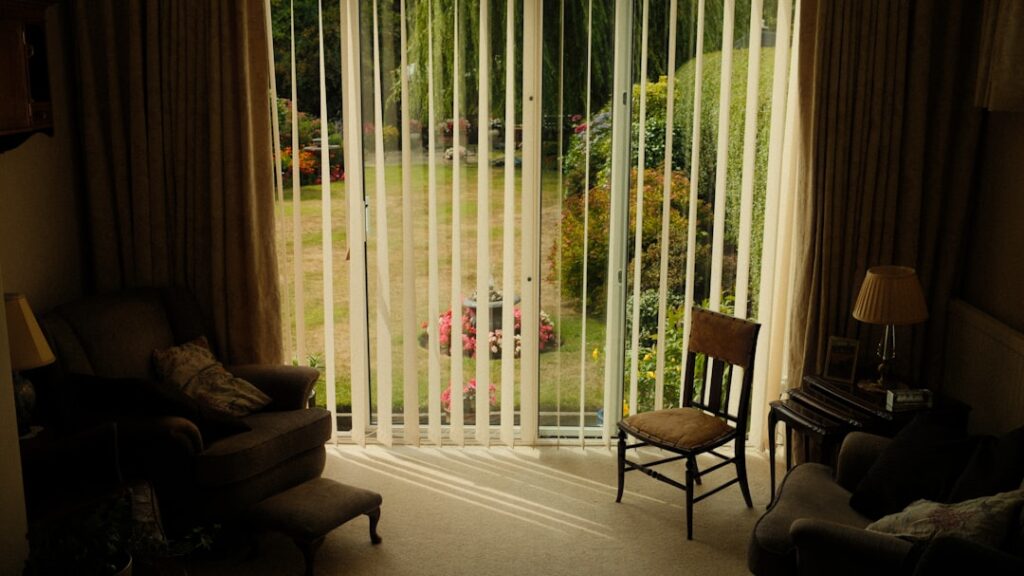
A sliding glass door is a 40-square-foot window that people walk through forty times a day — which is exactly why ordinary window treatments fail on it. Patio door blinds have to cover a huge pane, survive constant traffic, clear the door’s operating panel, and still let the dog out at 6 a.m. without a wrestling match. Four solutions actually work: vertical blinds, vertical cellular shades, sliding panel tracks, and between-glass blinds. Here is how they compare on price, light control, and daily livability.
- What Makes Slider Coverage Hard
- Vertical Blinds: The Default for a Reason
- Vertical Cellular Shades: The Insulation Play
- Sliding Panel Tracks: The Modern Look
- Between-Glass Blinds: Zero Maintenance, By Replacement Only
- Drapery: Don't Rule It Out
- Measuring and Mounting Without Regret
- Motorization: Worth It on a Door?
- Picking for Your Situation
What Makes Slider Coverage Hard
Three constraints shape every option. The treatment must traverse horizontally — anything that lifts and lowers (standard horizontal blinds, roman shades) becomes a two-handed ordeal on a 6-foot-wide door and blocks the walkway when half-raised. It must stack somewhere: whatever covers the glass has to park clear of the operating panel, so measure whether you have 10 – 18 inches of wall beside the frame for stackback. And it must take abuse — kids, pets, and elbows hit patio-door treatments daily, which is why flimsy solutions look shabby within two years. Standard slider dimensions run 60 – 72 inches wide by 80 – 82 tall for two-panel doors, 108 – 144 wide for three-panel; outside-mount everything, with 4 – 6 inches of overlap past the glass per side where wall space allows.
Vertical Blinds: The Default for a Reason
Vinyl or fabric vanes hanging from a traversing headrail remain the most common slider treatment because they solve every constraint cheaply: vanes rotate for instant light control, traverse fully clear of the doorway, and individual vanes replace for a few dollars when one cracks. A 72 × 80 inch vinyl set costs $50 – $150 at the home center; fabric or faux-wood vanes and custom widths run $150 – $500. The knocks are real but manageable — clattering in a breeze, a dated apartment-grade look in basic white vinyl, and clip wear over time. Two upgrades transform them: wider 4.5-inch fabric vanes with a chainless bottom, and a wand control instead of cords (cordless is also the child-safety standard now). If you want maximum function per dollar, verticals still win.
Vertical Cellular Shades: The Insulation Play
Vertical cellular (honeycomb) shades — Hunter Douglas Vertiglide and its competitors — run their pleated cells sideways, stacking into a slim 4 – 6 inch bundle at one end of the track. They bring the two things verticals lack: insulation and polish. A double-cell shade over a big glass door meaningfully cuts winter heat loss and summer gain (glass doors are the worst thermal hole in most walls), and the continuous fabric face looks like a soft wall rather than slats. Light-filtering and true blackout fabrics are available, and the tight side stack suits doors with little adjacent wall. Costs run $300 – $900 per door custom-made. Weaknesses: no vane-style tilt (the shade is open or closed across its width, though top-down options help), and fabric cells collect dust and pet hair at floor level.
Sliding Panel Tracks: The Modern Look
Panel-track systems hang three to five flat fabric panels, each 20 – 24 inches wide, on a multi-channel headrail; panels glide behind one another like a Japanese shoji wall. Closed, they present clean, uninterrupted fabric — available in solar-screen weaves that preserve the view, light-filtering linens, or blackout — and open, they stack into a tidy 2-foot column. They pair beautifully with modern interiors and double as room dividers. Pricing lands at $200 – $700 per door. The honest trade-off is operability: panels traverse by hand or wand and there’s no tilt, so fine-grained light control is limited, and the stacked column does cover one end of the glass unless you have wall to park it on. Choose panel tracks when aesthetics rank above adjustability.
Between-Glass Blinds: Zero Maintenance, By Replacement Only
Enclosed blinds — slim aluminum or cellular blinds sealed between the panes of the door’s insulated glass unit — never collect dust, never tangle, never get grabbed by a toddler, and operate by a magnetic slider or small motor on the glass face. They’re the standard recommendation for allergy households and pet chaos. The catch: you don’t add them to an existing door. Between-glass blinds come built into new doors (Pella, Andersen, Marvin, and most vinyl makers offer them) or as replacement glass units, adding roughly $300 – $800 per panel over plain glazing. Two more trade-offs worth knowing: color and style choices are limited, and if the blind mechanism fails in year twelve, the fix is replacing the sealed glass unit. If you’re already shopping doors, weigh this option alongside the door types themselves — our full patio doors comparison covers sliding, French, bifold, and multi-slide and what treatments suit each.
Drapery: Don’t Rule It Out
Not a blind, but the strongest budget alternative: floor-length curtains on a sturdy traverse or ripplefold rod cover a slider for $60 – $300, insulate surprisingly well in thermal-lined fabrics, soften the biggest hard surface in the room, and slide clear of the doorway faster than any blind. Mount the rod 6 – 12 inches above the frame and extend it 12 – 20 inches past each side so the open stack clears the glass completely. Many designers now layer drapery over solar-screen panel tracks — function from the track, warmth from the fabric.
Measuring and Mounting Without Regret
Order errors on door treatments are expensive and common, so measure like a pro. For outside mounts — the right call on virtually all sliders — measure the frame width and add 4 to 6 inches per side for light control plus whatever stackback room you’ve confirmed, then measure height from your intended headrail position to 1/2 inch above the floor so vanes and panels swing free. Use a steel tape, measure in three places, and record width before height (the industry convention custom shops assume). Check two clearances people forget: the door handle, which protrudes far enough to catch vanes on shallow-mount headrails (a 2 – 3 inch projection bracket solves it), and ceiling-mount situations where a transom or shallow soffit sits above the door — most vertical and panel-track systems mount to wall or ceiling equally well.
Installation itself is a one-hour DIY on wall studs or into the header framing above the door with 2-inch screws; drywall anchors alone will not survive a treatment that gets tugged daily. Level matters more than strength — a headrail 1/4 inch off level telegraphs into vanes that hang visibly crooked across a 6-foot span.
Motorization: Worth It on a Door?
Motorized traversing is genuinely useful on treatments you cycle twice daily, and prices have fallen: motorized vertical cellular and panel-track systems add roughly $200 – $400 per door, run on rechargeable battery wands or plug-in power, and pair with Alexa, Google, and scene schedules. The strongest cases are hard-to-reach doors behind furniture, whole-wall multi-slide treatments too heavy to hand-pull smoothly, and automated sunset privacy. Skip motors on a basic vertical blind you flick open on the way to the coffee pot — the wand is faster than the app.
Picking for Your Situation
Match the treatment to what your household actually does at that door: rental or tight budget — vinyl verticals; energy bills and cold glass — vertical cellular; modern aesthetic with moderate light-control needs — panel track; kids, pets, and zero patience for cleaning — between-glass (at replacement time) or short of that, wand-controlled verticals; warmth and softness on a budget — lined drapery. Measure the stackback space before you fall in love with anything, go cordless whichever way you go, and spend the extra $50 on the upgraded track and wand — on a door used forty times a day, the hardware is the product.