
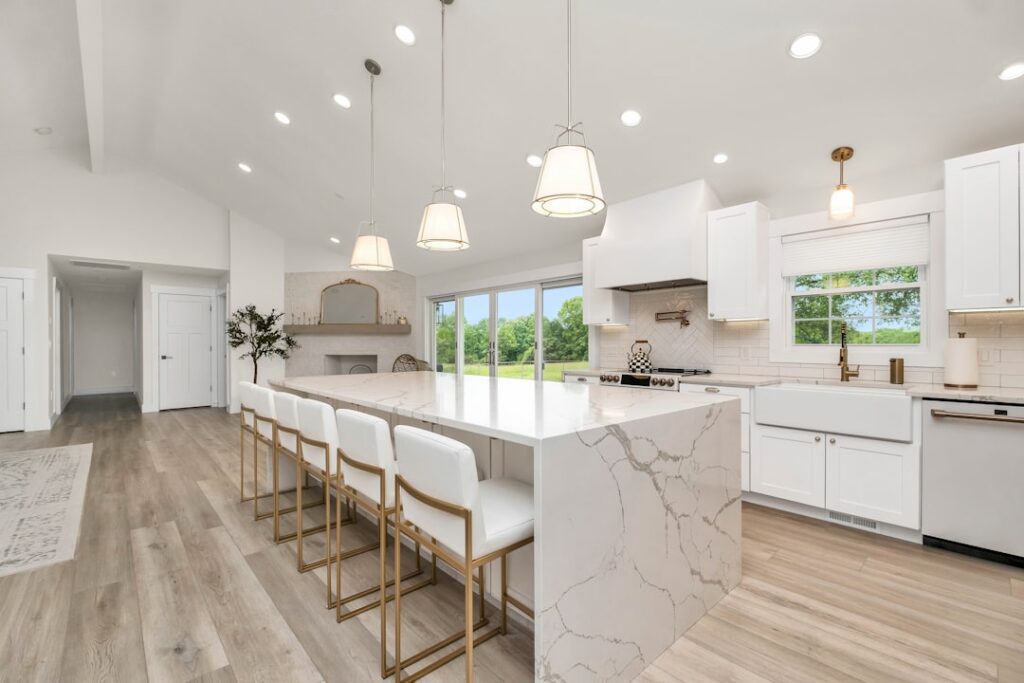
Well-chosen pendant lights kitchen island fixtures do more than illuminate your prep space; they anchor the room, define the island as a focal point, and set the entire kitchen’s style. Get the sizing, spacing, and height right and the result looks intentional and professional. Get them wrong and the lights feel cramped, crooked, or lost above an expanse of countertop. This guide gives you the rules of thumb designers actually use, plus advice on styles, bulbs, quantity, and installation so you can light your island with confidence.
Because the island is usually the visual centerpiece of a modern kitchen, its lighting deserves careful planning. The good news is that a handful of simple formulas take the guesswork out of it.
- How Many Pendants Do You Need
- Sizing Each Pendant
- Spacing Pendants Evenly
- Getting the Hanging Height Right
- Choosing a Style That Fits
- Bulbs, Brightness, and Controls
- Installation Basics
- Common Mistakes to Avoid
- Cost Expectations
- Coordinating Pendants With the Rest of the Kitchen
- Mixing Function and Statement
How Many Pendants Do You Need
Quantity depends on island length and pendant size. A common approach: for islands up to about 4 feet, one large pendant works; for 4 to 7 feet, two pendants are standard; for 7 to 10 feet, use three; and for longer islands, use a linear suspension fixture or four smaller pendants. Odd numbers (one or three) tend to look more dynamic and balanced than even numbers for many designs, but two evenly spaced pendants remain a timeless, symmetrical choice. Always keep spacing even and centered.
Sizing Each Pendant
Individual pendants should be proportional to the island and the room. A useful method: measure your island’s width and subtract about 12 inches; that total, divided among your pendants, suggests appropriate diameters. For most kitchens, individual pendants of 10 to 14 inches in diameter look right. Oversized statement pendants can run larger, but avoid fixtures so big they overwhelm the counter or so small they look like an afterthought. As a rough guide, the combined width of all pendants should span roughly one-half to two-thirds of the island’s length, never the full length.
Spacing Pendants Evenly
Even spacing is what separates a polished install from an amateur one. For two pendants, a common approach is to divide the island into equal thirds, placing one pendant at the one-third mark and the other at the two-thirds mark, so the outer spaces and the center gap look balanced. For three pendants, center one in the middle of the island and space the other two evenly on each side, typically 24 to 30 inches apart center to center. Keep at least 6 inches from the island edge to the nearest pendant so the lights hover over the counter, not the walkway.
Getting the Hanging Height Right
Height is the detail people most often get wrong. The bottom of each pendant should hang roughly 30 to 36 inches above the countertop. That places the light where it illuminates the work surface without blocking sightlines across the kitchen or hitting a tall cook in the head. On higher ceilings (9 feet and up), you can hang them slightly higher, around 36 to 40 inches above the counter, to keep proportions balanced. Always hang all pendants at exactly the same height unless you are deliberately staggering them, and measure from the finished countertop, not the floor.
Choosing a Style That Fits
Pendants come in a huge range of styles, so let your kitchen’s overall design lead:
- Clear glass globes: Versatile and airy, they suit transitional and modern kitchens and don’t visually crowd the space.
- Metal dome or barn shades: Warm, farmhouse, and industrial looks, often in black, bronze, or brass.
- Drum and fabric shades: Softer, more traditional light, good for casual and eclectic kitchens.
- Cage and Edison-bulb pendants: Industrial and vintage vibes that show off the filament.
- Linear suspension fixtures: A single elongated fixture with multiple bulbs, ideal for long islands and contemporary spaces.
Coordinate the pendant finish with your cabinet hardware and faucet for a cohesive look, and consider whether you want the fixtures to blend in or make a bold statement.
Bulbs, Brightness, and Controls
Pendant lighting is task and accent lighting combined, so brightness matters. Aim for enough total lumens to light the work surface; roughly 300 to 400 lumens per square foot of island counter is a solid target, split across your pendants. Choose LED bulbs in a warm to neutral white (2700K to 3500K) for an inviting kitchen glow, and match the color temperature to your other kitchen lighting. Put the pendants on a dimmer so you can crank them up for cooking and dim them for dining or entertaining. Dimming is one of the cheapest upgrades with the biggest impact on ambiance.
Installation Basics
Installing island pendants involves both electrical work and precise measuring. If wiring already exists in the ceiling above the island, hanging pendants is a moderate DIY task: shut off the breaker, verify power is off, mount the fixture’s bracket to a fan-or-fixture-rated box, connect the black-to-black, white-to-white, and ground wires, adjust the cord or rod to the correct height, and level everything. If there is no existing box over the island, running new wiring through a finished ceiling is a job for an electrician and may require patching drywall.
Because pendants hang low and are highly visible, take extra care to get them plumb, evenly spaced, and level with each other. Use a laser level or measure carefully from the ceiling and counter. A pendant hanging even a half-inch off from its neighbor is instantly noticeable.
Common Mistakes to Avoid
- Hanging too high or too low: Stick to 30 to 36 inches above the counter.
- Uneven spacing: Measure and divide precisely; eyeballing rarely looks right.
- Pendants too large or too small: Keep them proportional to the island length.
- Forgetting the dimmer: Full brightness only makes the space feel harsh at night.
- Mismatched color temperatures: Match the pendants to your recessed and under-cabinet lighting.
- Ignoring ceiling height: Scale the fixtures and hanging height to the room.
Cost Expectations
Pendant fixtures range widely: budget pendants run $30 to $80 each, mid-range designer pendants $100 to $250 each, and premium statement or linear fixtures $300 to $800 or more. For a typical two- or three-pendant install, plan on $150 to $600 in fixtures. If you hire an electrician to add wiring or install the lights, add $150 to $500 in labor depending on complexity.
Coordinating Pendants With the Rest of the Kitchen
Island pendants should never be chosen in isolation, because they share a room with recessed lights, under-cabinet lighting, and often a separate fixture over the sink or dining table. For a cohesive look, coordinate the metal finish of your pendants with your cabinet hardware, faucet, and any other visible fixtures, and keep the color temperature of every bulb in the kitchen consistent so the space reads as one warm, unified glow rather than a patchwork of tones. You do not have to match everything perfectly; a common trick is to let the island pendants be the bold statement while the recessed cans quietly disappear. But the finishes and light color should clearly relate. When the pendants echo the hardware and the whole kitchen glows at the same warmth, the room feels intentional and expensive.
Mixing Function and Statement
Island pendants pull double duty as both task lighting and jewelry for the room, and the best installations respect both jobs. If the island is a primary prep and homework zone, prioritize brightness and even coverage so no one works in a shadow, then choose a fixture style that also happens to look great. If the island is more of a showpiece in an open-plan great room, you can lean into a dramatic oversized or sculptural fixture and rely on other lighting layers to handle the heavy task work. Many homeowners strike the balance by choosing pendants with an attractive shade that directs ample light downward while still looking beautiful when off during the day. Deciding early whether function or drama leads will guide you to the right size, brightness, and style without regret.
Thoughtfully chosen pendant lights over a kitchen island reward you every day with better task lighting and a stronger design statement. Follow the sizing, spacing, and 30-to-36-inch height guidelines, match the style and color temperature to the rest of your kitchen, add a dimmer, and your island will look like it was designed by a pro.


