A hand-knotted Persian rug can be a century old and still look at home under a modern sectional — that is the trick most people miss. Designing a Persian rug living room is not about building a museum around an heirloom; it is about letting a richly patterned floor do the heavy lifting so the rest of the room can stay simple. Placed and styled correctly, a single Persian rug supplies color, history, and a sense of grounded permanence that no big-box floor covering can fake. Here is how to build the room around it.
What Makes a Rug “Persian”
True Persian rugs are hand-knotted in Iran, traditionally from wool or a wool-and-silk blend, and named for their region of origin — Tabriz, Kashan, Heriz, Kerman, and others each carry distinct patterns and palettes. Heriz rugs feature bold, geometric medallions in rust and navy; Kashan and Kerman lean toward intricate florals in softer tones. Knot density, natural dyes, and the abrash (subtle color variation from hand-dyeing) are marks of authenticity. Machine-made “Persian-style” rugs mimic the look at a fraction of the cost, and for a busy living room they can be the smarter buy — the design principles below apply either way.
Sizing the Rug to the Room
A Persian rug is a statement, and a too-small one undercuts the whole effect. In the living room, size up rather than down. Aim to fit at least the front legs of every seating piece on the rug, and ideally all four legs of the sofa for a grounded, gallery-like look.
- 8×10: works for a standard sofa-and-two-chairs grouping with front legs on the rug
- 9×12: the living-room workhorse; fits a full seating group with all legs on and still leaves a floor border
- 10×14 or larger: for open-plan great rooms and large sectionals
Leave 8 to 18 inches of exposed floor between the rug’s edge and the walls so the pattern has room to breathe. A Persian rug crammed wall to wall loses the framed, intentional quality that makes it special.
Building a Color Palette Around the Rug
The single best rule for a Persian rug living room: let the rug be the loudest thing in the room. Pull two or three colors from its field and border, then use them in a restrained way on your walls, upholstery, and accents. If the rug is a classic Heriz in rust, navy, and cream, a putty or oatmeal sofa lets the rug sing, while navy pillows and a rust throw tie the seating back to the floor.
Neutral walls — warm white, greige, soft clay — are almost always the right backdrop. They keep the room from feeling heavy and let the rug’s intricate pattern read as art. Save bold wall color for rooms where the rug is muted; a highly detailed antique rug plus a saturated accent wall usually competes rather than harmonizes.
Mixing Old Pattern with Modern Furniture
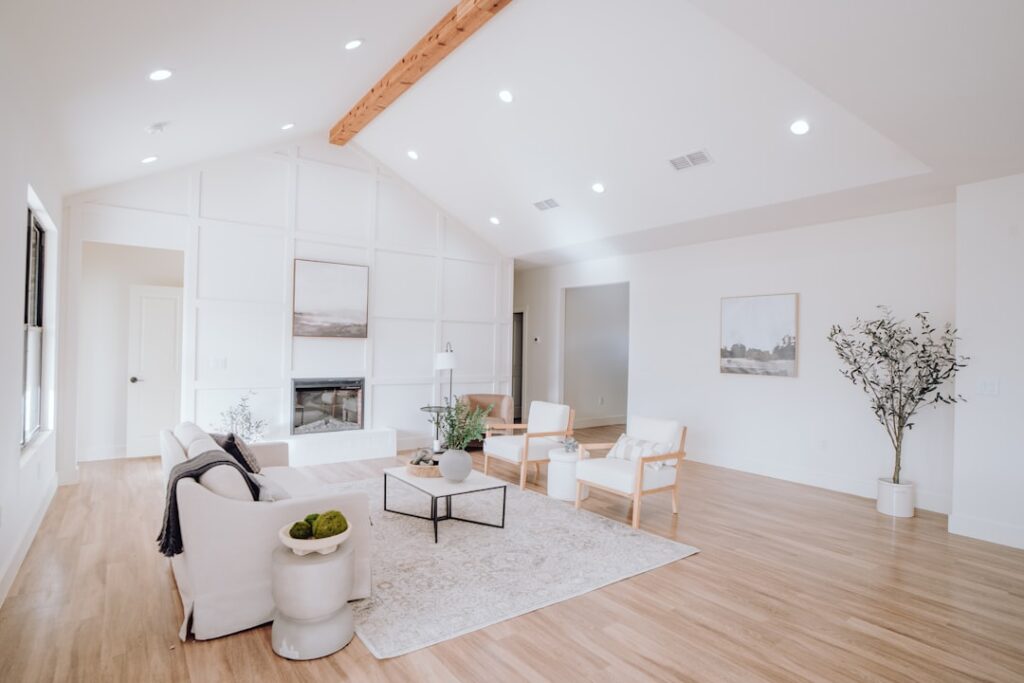
The most current way to use a Persian rug is to contrast it, not match it. Pair the ornate, traditional pattern with clean-lined contemporary furniture — a tailored sofa, a simple wood or metal coffee table, unfussy lighting. That tension between old and new is what makes the room feel collected and personal rather than dated. Rooms that pile traditional rug, traditional sofa, traditional drapes, and traditional lamps together can read stuffy; a single Persian rug against a modern envelope feels fresh.
Texture helps bridge the eras. Balance the tight, detailed weave of the rug with soft, plain textures elsewhere — a chunky knit throw, a linen sofa, a leather chair. Repeating one metal tone (aged brass suits warm Persian palettes) across lighting and hardware adds polish.
Layering and Placement Tricks
In a large or open room, layering a Persian rug over a larger natural-fiber base — a jute or seagrass rug — adds scale and a designer touch while protecting the finer rug from the full brunt of foot traffic. Center the Persian on top and let a border of the jute show around it. In a smaller room, skip the layering and let the Persian stand alone.
Anchor the coffee table over the center of the rug so the pattern frames it. If your rug has a strong central medallion, position seating so the medallion stays visible rather than fully hidden under a table — it is the focal point you paid for.
Living With a Persian Rug Day to Day
Wool Persian rugs are built to last generations, and their density actually hides soil and foot traffic better than most modern rugs — a practical bonus in a busy family room. Protect that longevity with a good rug pad, which cushions the knots, prevents slipping, and reduces wear where the pile compresses under furniture. Vacuum regularly with the beater bar off or raised, working in the direction of the pile, and never vacuum the fringe, which can pull and unravel.
Rotate the rug 180 degrees once or twice a year so sunlight and foot traffic wear it evenly — natural dyes can fade unevenly if one side sits in a sunny window. Blot spills immediately with water and a little mild soap; avoid harsh cleaners and steam, which can damage natural dyes and wool fibers. For antique or valuable pieces, use a rug specialist for deep cleaning every few years rather than a general carpet service.
Common Mistakes to Avoid
Beyond buying too small, the frequent errors are over-matching (turning the room into a theme instead of a home), hiding the rug under too much furniture, and skipping the pad. One more: fearing the pattern. Homeowners sometimes bury a beautiful rug under so much dark, heavy furniture that its detail disappears. Give it space, keep the surrounding palette calm, and let the craftsmanship show.
Buying: Authentic vs. Persian-Style
Budget will steer one of the biggest decisions. A genuine hand-knotted Persian rug is an heirloom-grade purchase — a quality 9×12 can run several thousand dollars and, for antique or finely knotted pieces, far more. In return you get natural dyes, decades of durability, and a rug that can actually appreciate in value. If that is out of reach, a machine-made “Persian-style” rug in polypropylene or wool captures the pattern and palette for $200 to $800 in the same size, and for a busy family living room the practical, stain-resistant synthetic is often the wiser buy. Neither choice is wrong; match it to how hard the room lives and how long you plan to keep it.
When shopping an authentic piece, check the back — hand-knotted rugs show the pattern clearly on the reverse, with slightly irregular knots and a soft, foldable feel. A perfectly uniform back with a grid-printed pattern signals a machine-made rug, which is fine as long as the price reflects it.
Layering Light Around the Rug
Lighting quietly makes or breaks a Persian rug living room. Because the palette often runs deep — rust, navy, burgundy, charcoal — a room that is under-lit can feel heavy. Layer in several sources: a warm overhead fixture, a couple of table lamps at seating height, and a floor lamp near the reading chair. Warm-white bulbs (around 2,700K) flatter the natural dyes and bring out the reds and golds, while harsh cool light can flatten them. Good lighting lets the rug’s detail read even at night, which is when most living rooms actually get used.
A Persian rug living room succeeds when the floor is clearly the star and everything else plays a supporting role. Size it generously, keep the walls and upholstery quiet, contrast the old pattern with clean modern lines, and care for the wool the way it deserves. Do that, and a single rug becomes the piece that makes visitors stop at the doorway.