Wet paint on outdoor metal furniture starts failing the day it leaves the factory — solvents flash off, film thickness varies, and the first chip invites creeping corrosion. That is why virtually every quality manufacturer switched to powder coating decades ago, and why powder coated aluminum patio furniture now dominates the mid-range and luxury outdoor market. The combination is genuinely hard to beat: a metal that cannot rust wrapped in a finish that resists chips, UV fade, and salt air. But not all powder-coated aluminum is equal, and the gap between a $300 set that chalks out in three summers and a $3,000 set that looks new in year fifteen comes down to details you can check before buying.
What Powder Coating Actually Is
Powder coating is a dry finishing process. Finely ground polymer resin — usually polyester for outdoor furniture, because epoxy chalks badly in UV — is given an electrostatic charge and sprayed at a grounded aluminum frame, so the powder wraps the part and clings evenly, including edges and inside corners where liquid paint runs thin. The coated frame then bakes at roughly 350-400°F for 10-20 minutes, melting and cross-linking the powder into a continuous film typically 2-4 mils thick — two to four times thicker than a sprayed paint coat. Good factories pretreat first: a multi-stage wash, then a chromate or zirconium conversion coating that gives the powder something to bond to. Skipped pretreatment is the root cause of most peeling you see on bargain furniture; the powder itself was fine, the prep was not.
Cast vs. Tubular (Extruded) Aluminum Frames
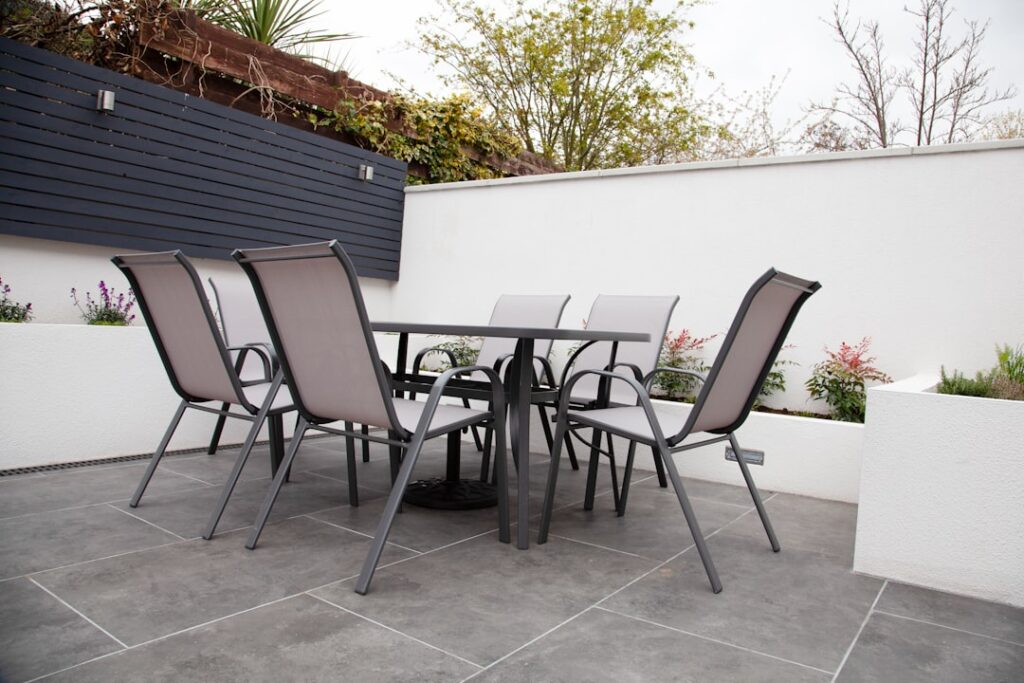
Powder coating goes over two very different aluminum constructions. Cast aluminum is molten metal poured into molds, producing solid, heavy, ornate parts — the scrolled arms and lattice tabletops on brands like Hanamint, Gensun, and Tropitone’s cast lines. Cast pieces weigh enough to stay put in wind (a cast dining chair runs 20-30 lbs), take intricate detail, and their thick sections shrug off dents. Tubular or extruded aluminum is hollow profile stock cut, bent, and welded into sleek modern frames — the material behind most sling chairs, chaises, and contemporary dining sets from Telescope Casual, Homecrest, and virtually all woven-wicker frames. Tubular is lighter (a sling chair can weigh 10-12 lbs), cheaper to produce, and easier to move, but thin-wall imports (under 1.2 mm wall) can dent and crack at welds. Neither is inherently better; cast suits traditional patios and windy sites, extruded suits modern designs and anyone who rearranges furniture often.
Why It Beats Paint — and Steel
Against liquid paint, powder wins on every durability axis: the film is thicker, harder (pencil hardness H-2H versus HB for most paints), flexes with the metal instead of cracking, and contains UV stabilizers that keep gloss and color far longer. Manufacturers routinely salt-spray-test powder systems to 1,000+ hours; automotive-grade paint jobs on furniture rarely see 500. Against steel and wrought iron, the argument is the substrate. Steel furniture rusts at every chip, weld pinhole, and drain hole from the inside out — the powder becomes a bandage over a wound. Aluminum forms a self-healing oxide layer; scratch it to bare metal and it dulls slightly but never bleeds rust down your pavers. The trade-offs: wrought iron’s extra weight is an asset in wind country, and steel frames run cheaper at entry level. For coastal and poolside use, aluminum is the only sensible metal.
Coastal Performance: The No-Rust Advantage
Salt air destroys ferrous furniture in two to four seasons, which is why powder coated aluminum owns the oceanfront market. Aluminum cannot rust, and a quality polyester powder resists salt-fog corrosion and UV in tandem. Two coastal caveats: first, salt crystals left sitting on the finish hold moisture and can cause filiform corrosion creeping under the coating from cut edges and screw holes, so a monthly freshwater rinse is the single most valuable habit within a mile of salt water. Second, hardware matters — insist on stainless steel fasteners and feet glides; plated-steel bolts on a cheap set will streak rust across a perfect aluminum frame.
Spotting Quality Before You Buy
- Coating thickness and evenness: look at inside corners, weld areas, and the underside of arms. Thin, translucent spots or orange-peel texture heavy enough to feel signal a rushed line. Quality coats run 2.5-4 mils, uniform everywhere.
- Welds: should be smoothed and fully coated, not lumpy or pinholed. Corrosion starts at raw weld pores.
- Wall thickness and weight: lift the chair. Extruded frames should feel rigid with no oil-canning flex in the seat rails; 1.5-2 mm wall is the quality zone.
- Pretreatment claims: brands that pay for real prep say so — look for “multi-stage pretreatment,” “chromate conversion,” or AAMA 2603/2604 spec references in the literature.
- Warranty: the honest tell. Fifteen-year frame warranties (Tropitone, Telescope, Winston) versus one-year coverage tells you what the maker expects.
- Hardware and glides: stainless bolts, nylon or stainless glides, and replaceable parts availability.
Care and Touch-Up
Maintenance is genuinely light. Wash frames two to four times a season with mild dish soap, water, and a soft brush; rinse and towel-dry. Once or twice a year, apply a coat of automotive spray wax or a dedicated product like Everbrite ProtectaClear on horizontal surfaces — it restores gloss and sheds water spots. Never use abrasive pads, magic erasers on gloss finishes, or solvent cleaners like acetone, which dull the resin. For chips and scratches: clean with isopropyl alcohol, feather the edge with 600-grit, and touch up with color-matched exterior enamel — many brands (Hanamint, Tropitone) sell factory touch-up paint pens and spray cans for $10-$25. A touch-up will never be invisible on metallic finishes, but on textured bronze and black — the two most common finishes — it disappears at conversation distance. Deep gouges to bare metal should be primed with a self-etching aluminum primer first. In snow country, storage indoors or under vented covers extends finish life, mostly by preventing water pooling and freeze cycling in seams.
Price Ranges and Value Picks
Expect three tiers. Entry ($250-$800 for a 5-piece dining set): thin-wall extruded imports from big-box brands — serviceable for 3-6 years inland, risky at the coast; check hardware and wall thickness hard at this level. Mid-range ($900-$2,500): the value sweet spot. Hanamint and Gensun cast-aluminum dining sets, Telescope Casual sling and MGP-top sets, and Homecrest deliver real pretreatment, 10-15-year frame warranties, and replacement-part support. A Hanamint Chateau 5-piece set around $1,800-$2,200 or a Telescope sling dining set near $1,400 are classic buy-once choices. Luxury ($3,000-$12,000+): Tropitone, Winston, Brown Jordan-tier lines with architectural-grade (AAMA 2604-class) powder, custom color programs, and 15-20-year structural warranties. Value verdict: the mid-range domestic brands hit the durability ceiling for most homeowners — beyond that you are buying design and finish options, not more years. Whatever the tier, powder coated aluminum patio furniture bought with stainless hardware and a real warranty is the closest thing outdoor furniture has to a permanent purchase.
Recoating: The Second Life Option
Because the substrate cannot rust, aluminum frames are worth refinishing when the coating finally chalks or chips beyond touch-up — usually year 12-20 on quality sets. A commercial powder coater can strip frames chemically or by blasting, re-pretreat, and re-coat for roughly $40-$90 per chair and $100-$250 per table, less than a third the cost of replacing a premium set. Cushions and slings get replaced at the same visit (Telescope and Tropitone both run re-sling programs through dealers, typically $60-$120 per chair), and the furniture comes back functionally new. This repairability is a quiet argument for buying the mid-tier or better set in the first place: a $250 import is landfill when its finish fails, while a $700 Hanamint chair is a candidate for a $75 refresh. DIY refinishing with rattle-can enamel over a self-etching primer works acceptably for a season or three, but it will never match baked powder for hardness or UV life — treat it as a bridge, not a restoration.
Wind, Weight, and Practical Living
The one genuine weakness of aluminum outdoors is mass. Sling chairs and lightweight extruded pieces slide and tip in gusts above roughly 30 mph, and a chaise can go airborne in a real storm. Mitigations that work: choose cast frames or sled-base designs for exposed decks, add weight bags or clip sets to umbrella-adjacent pieces, and stack-and-strap or store lightweight chairs when storms are forecast. On the flip side, that low weight is exactly what makes aluminum the right call for rooftop terraces with load limits, for anyone who rearranges seating weekly, and for seasonal storage — one person can carry two chairs at a time, which nobody says about wrought iron.