
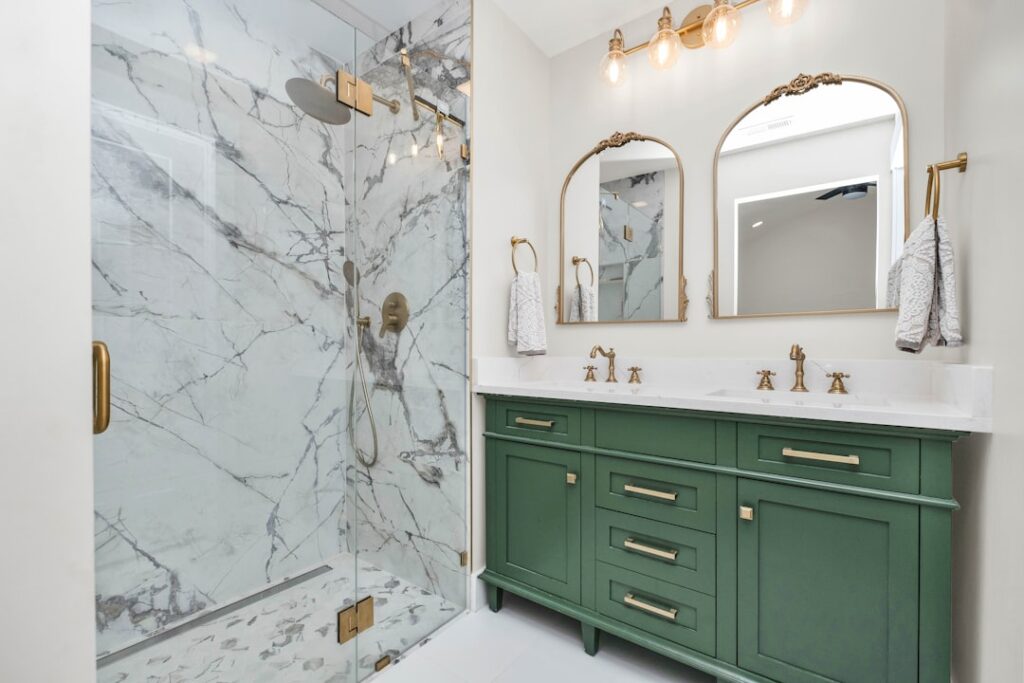
A custom tiled shower runs $7,000 to $15,000 and ties up your only bathroom for two to three weeks. A prefabricated shower, by contrast, drops in over a long weekend and lands somewhere between $400 and $4,500 installed. That math alone explains why prefab units now ship in roughly 60% of new American single-family homes. The challenge is picking a unit that does not look or feel like an afterthought.
- What Counts as a Prefabricated Shower
- One-Piece vs Multi-Piece Units
- Standard Sizes That Actually Stock at Home Depot
- Cost Ranges in 2026 Dollars
- Installation Timeline and What to Expect
- Where Prefab Falls Short
- Maintenance That Keeps a Prefab Shower Looking New
- How to Choose the Right Unit for Your Bathroom
- Common Installation Mistakes to Avoid
- Doors, Curtains, and Glass Options
What Counts as a Prefabricated Shower
Prefab simply means the walls and pan arrive molded, not built up tile by tile on site. The category covers everything from one-piece fiberglass surrounds in standard 60 by 32 inch sizes to high-end Onyx solid-surface kits with custom inlays. The defining feature is that joints, corners, and curbs are factory-formed, which eliminates most of the waterproofing risk that plagues custom builds.
You will see four main material classes: fiberglass-reinforced plastic (FRP), acrylic, cultured marble, and solid-surface composites. Each handles cleaning, impact, and resale value differently.
One-Piece vs Multi-Piece Units
One-piece showers are molded as a single shell, typically used in new construction because they will not fit through a 32-inch interior doorway. They are nearly leak-proof because there are zero seams, and they install fastest. Multi-piece kits arrive as a base plus three or four wall panels that snap or caulk together inside the room. Multi-piece is the standard for remodels.
If you are replacing a shower in an existing home, do not let a contractor talk you into demolishing a doorway to fit a one-piece. A quality four-panel acrylic kit with proper installation has the same lifespan, around 25 to 35 years, with minimal maintenance.
Standard Sizes That Actually Stock at Home Depot
Stocking sizes matter because special-order prefab units run six to eight weeks. The common dimensions are:
- 32 x 32 inch corner units: Smallest practical size, popular in half-bath conversions.
- 36 x 36 inch corner or alcove: The minimum size most adults find comfortable.
- 48 x 36 inch alcove: Replaces a small tub footprint cleanly.
- 60 x 32 inch tub-to-shower: The standard American tub-replacement size.
- 60 x 36 and 60 x 42 inch: Roomier walk-ins, often with built-in seats.
Cost Ranges in 2026 Dollars
Pricing has split sharply between budget and premium tiers. A basic FRP three-piece kit at Lowe’s still goes for $400 to $700. Mid-grade acrylic with a textured floor and built-in shelves runs $900 to $1,800. Premium solid-surface kits from Onyx, Swanstone, or Kohler Choreograph land between $2,500 and $5,500 for materials alone. Add $800 to $2,000 for installation labor in most US markets, more in coastal cities.
Installation Timeline and What to Expect
A straightforward swap takes two to three days for a competent contractor. Day one is demo and rough plumbing inspection. Day two is setting the pan, leveling, and dry-fitting walls. Day three is final caulking, trim, and door or curtain rod installation. Add a day if the subfloor needs replacement, which happens in roughly one in four older bathrooms once the old pan comes out.
If you are doing the work yourself, plan for a full weekend plus one weekday. The slowest steps are not the visible ones. They are setting the drain perfectly flush, shimming the pan dead level, and waiting 24 hours for caulk to cure before water testing.
Where Prefab Falls Short
A prefabricated shower will never match a tiled wet room for design flexibility. If you want a curbless entry, body sprays at custom heights, or a 6 by 4 foot footprint, you are headed back to tile. Prefab also signals “builder grade” to some buyers, though premium solid-surface units have largely closed that resale gap. Cultured marble, in particular, photographs beautifully and reads as upscale in mid-priced homes.
The other limit is repair. A deep gouge in fiberglass can be patched, but matching color is hit or miss. Acrylic scratches polish out with successively finer wet-dry sandpaper from 600 to 2000 grit, which is a real Saturday project but doable.
Maintenance That Keeps a Prefab Shower Looking New
Wipe walls down with a squeegee after each shower. This single habit doubles the cosmetic lifespan of any prefab unit. Avoid abrasive cleaners on acrylic and cultured marble. Stick with diluted dish soap or a dedicated bathroom cleaner like Method Daily Shower spray. Recaulk the pan-to-wall joint every five to seven years. That joint, not the panels themselves, is where 90% of leaks start.
How to Choose the Right Unit for Your Bathroom
Measure the rough opening before shopping. Note the location of your existing drain because moving it requires opening the subfloor. Decide between a center, left, or right drain configuration based on what is already plumbed. Pick a wall texture you can actually clean. Heavily veined “marble look” panels hide soap scum but trap mildew in the texture. Smooth panels show streaks but wipe clean in seconds.
For a 30 to 40 year old home, a quality acrylic prefabricated shower in the $1,200 to $2,500 installed range hits the sweet spot of durability, looks, and resale value. Spend more if you are staying long term and value the feel of solid-surface composites under bare feet.
Common Installation Mistakes to Avoid
The two failure modes I see most often are out-of-level pans and inadequate framing. A pan that is even 1/4 inch out of level will pool water at the low corner, eventually staining the surface and rotting the drywall behind the surround. Always shim the pan to dead level before fastening the flanges, and verify with a 4-foot level in both directions.
Framing matters too. The studs surrounding the unit must be plumb, square, and true to the manufacturer’s rough-opening dimensions. Do not force a slightly oversized unit into an undersized opening. The pressure cracks the corner welds within months. Take the extra 30 minutes to plane down the high stud or shim the low one.
Doors, Curtains, and Glass Options
Frameless glass doors elevate any prefab shower aesthetically and run $700 to $1,800 installed for a custom-fit panel. Semi-frameless doors at $400 to $900 hit the value sweet spot. Standard framed doors at $250 to $500 work fine but read as builder grade. For maximum flexibility and the lowest cost, a tension rod and curtain at $40 total covers all the bases. Whatever you choose, plan the drainage so water stays inside the unit and does not pool at the threshold.


