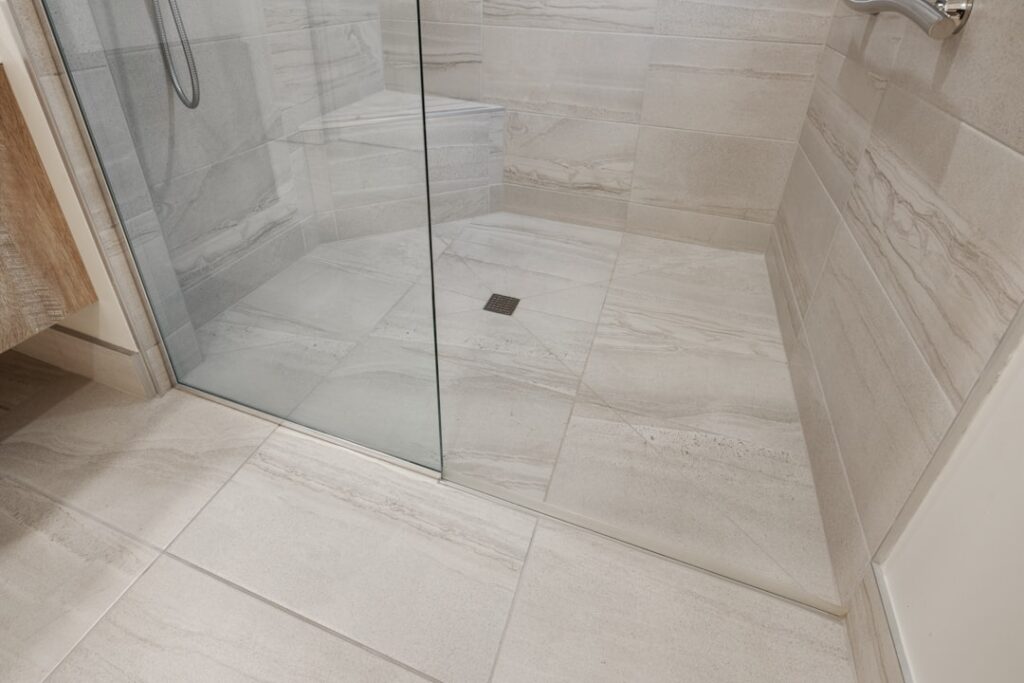
Water leaking under a shower door almost always traces back to one worn strip of vinyl, and a prime-line shower door bottom sweep is the part that fixes it for under $15. Prime-Line dominates the replacement-hardware aisle for a reason: it reverse-engineered sweeps, drip rails, and seals for practically every framed and frameless door built since the 1970s. The catch is that a prime-line shower door bottom sweep only works if you match the profile exactly, and there are more than a dozen profiles that look nearly identical hanging on the peg. This guide is about getting the right part number the first time.
- Why Prime-Line Owns This Category
- Know Your Door Type First
- Measuring: The Five Numbers That Matter
- Common Prime-Line Part Numbers
- Replacement Steps: Frameless Push-On Sweep
- Replacement Steps: Framed Drip Rail and Insert
- Troubleshooting Fit Problems
- Matching Sweeps When the Brand Is Unknown
- Lifespan and a Buying Tip
Why Prime-Line Owns This Category
Original shower door manufacturers rarely stock 20-year-old seals. Prime-Line — a hardware maker out of Redlands, California — built its business filling that gap, producing replacement rollers, sweeps, drip rails, and catches for defunct and current brands alike. Its parts carry M-series numbers (M 6259, M 6212, and so on), sold through Home Depot, Ace, Lowe’s, and Amazon, usually for $8 to $20 per piece. When a glass shop quotes you a service call to reseal a door, the part in the tech’s van is very often a Prime-Line strip.
Know Your Door Type First
Sweep profiles divide by door construction, so identify what you have before touching part numbers.
- Framed doors: glass wrapped in aluminum. The sweep is usually a vinyl insert that snap-fits into a channel in the bottom rail, or a drip rail screwed to the outside face with a flexible vinyl fin.
- Frameless doors: bare 3/8 or 1/2 inch glass. The sweep is a clear polycarbonate channel that pushes onto the bottom edge of the glass, with one or two wiper fins hanging down.
- Bypass sliders: often no sweep at all on the panels, but a drip rail on the inner face and vinyl bumpers where panels overlap.
Framed-door parts and frameless-door parts do not interchange, ever. A push-on frameless sweep sized for 3/8-inch glass will not grip 1/4-inch framed glass, and a snap-in vinyl bead has nothing to snap into on a bare panel.
Measuring: The Five Numbers That Matter
Pull the old sweep off (it slides out of a channel or pulls off the glass edge) and take it to the bench. You need:
- Glass or channel thickness. For frameless, measure the glass with calipers: 1/4, 5/16, 3/8, or 1/2 inch. For framed, measure the slot width in the rail.
- Overall length. Sweeps come in 32, 36, and 37-inch stock lengths; buy longer and cut down with shears or a fine hacksaw.
- Fin drop. The distance from the bottom of the glass or rail to the curb, usually 1/2 to 1 inch. Too short leaks; too long drags and howls.
- Fin count and angle. One wiper, two wipers, or a wiper plus an angled deflector fin that kicks water back into the shower.
- Profile shape. Match the cross-section of the old part exactly — T-slot insert, snap-in bead, push-on U-channel, or screw-on drip rail.
If the original sweep is missing entirely, measure the gap between door bottom and curb at both ends (out-of-level doors vary), then choose a sweep whose fin drop covers the larger number by about 1/8 inch.
Common Prime-Line Part Numbers
Numbers vary by retailer packaging, but these families cover the bulk of doors I service:
- M 6259 — clear push-on bottom sweep for 3/8-inch frameless glass, 36-inch length, dual fin. The single most-used frameless sweep.
- M 6226 / M 6227 — push-on sweeps for 1/2-inch heavy glass doors.
- M 6212 — one-piece vinyl sweep insert for framed swing doors, T-style, 36 inches.
- M 6war-style drip rails (M 6203, M 6204) — screw-on aluminum drip rails with vinyl inserts for framed doors, typically 32 or 36 inches with end caps.
- M 6109 — bottom seal for framed sliding doors, snap-in style.
Take the old part and your measurements to the store peg or the online listing and compare the printed cross-section diagrams — Prime-Line prints the profile silhouette on every package, which is the fastest way to confirm a match. When in doubt between two profiles, buy both; the wrong one costs less than a second trip.
Replacement Steps: Frameless Push-On Sweep
- Open the door and pull the old sweep straight down and off; stubborn ones release with a plastic putty knife and a heat gun on low.
- Scrape residual silicone or scale off the bottom 1 inch of glass with a razor held flat, then wipe with isopropyl alcohol.
- Cut the new sweep to the exact glass width minus 1/16 inch using shears, deflector fin oriented toward the shower interior.
- Lubricate the channel with a drop of dish soap in water and press it onto the glass edge, working from the hinge side.
- Close the door and check the fin contact along the curb — even, light contact is right. Heavy contact means the drop is too long; trim or re-seat.
Replacement Steps: Framed Drip Rail and Insert
- Back out the two or three screws holding the old drip rail, or slide the vinyl insert out of its channel with pliers.
- Clean the bottom rail channel — 20 years of soap scum will fight the new insert.
- Cut the new rail or insert 1/16 inch shy of the door width, reusing the old end caps if the new pack lacks them.
- Mount screw-on rails with the vinyl fin angled into the shower, bedding the screws in a dab of clear silicone to seal the holes.
- Operate the door a dozen times and watch for drag; a properly fitted insert whispers, it does not squeal.
Troubleshooting Fit Problems
Sweep will not stay on the glass: the glass is thinner than the channel spec — recheck with calipers, since plenty of “3/8” doors are actually 5/16. Door drags after replacement: fin drop is too long or the door has sagged on its hinges; adjust hinges before cutting the fin. Still leaking at the corners: add Prime-Line splash-guard corner dams ($6 a pair, part M 6218-style) at the curb ends, which stop the sideways sheet of water a sweep cannot catch. Water wicking under the curb itself is not a sweep problem at all — that is failed caulk or tile, a different repair entirely.
Matching Sweeps When the Brand Is Unknown
Half the doors I service have no legible brand anywhere — the label wore off in 1998. The identification workflow that works: photograph the sweep cross-section straight-on against a ruler, measure glass thickness with calipers, and compare against Prime-Line’s online profile diagrams, which show every M-number as a dimensioned silhouette. The Swisco and STB Trading catalogs carry overlapping profiles too, so if Prime-Line lacks your exact shape, cross-reference the same silhouette there. Between the three catalogs I find a match better than 95 percent of the time.
For the last few percent — usually European enclosures with metric extrusions — a universal adhesive-backed sweep is the fallback. It sticks to the door face rather than gripping the edge, seals adequately, and costs about $15. Not elegant, but it beats replacing a whole door because one vinyl strip went extinct.
Tools worth having on hand
- Digital calipers ($20) — the difference between 5/16 and 3/8 glass is invisible by eye
- Heavy shears or a fine-tooth hacksaw for cutting vinyl and polycarbonate cleanly
- Plastic putty knife and heat gun for releasing old sweeps without scratching glass
- Isopropyl alcohol and a flat razor for cleaning the glass edge before refitting
Lifespan and a Buying Tip
Vinyl sweeps harden and split on a 3-to-7-year cycle depending on water chemistry and cleaning habits; chlorine-heavy cleaners accelerate the cracking. When one goes, replace rather than patch — a $12 part protects the bathroom subfloor, and rot repair starts around $1,500. My habit on service calls is to note the part number with a marker on the inside of the bottom rail after each replacement. The next swap becomes a five-minute job with no measuring at all, and any Prime-Line rack in the country will have the strip waiting.