Owens Corning built its name on pink insulation and Duration shingles, but its synthetic roof underlayment deserves a closer look before your next tear-off. ProArmor underlayment is the company’s workhorse synthetic — a woven polypropylene sheet that replaces two or three rolls of #15 felt with a single 10-square roll a crew can throw over a ranch roof before lunch. I have had it under my hands on a couple dozen roofs now, and it has earned a spot in the rotation alongside the better-known Titanium and Rhino products. Here is what you actually get for your money, where it shines, and the couple of places I would spec something else.
What ProArmor Is and the Core Specs
ProArmor is a mechanically attached synthetic underlayment: a woven polypropylene scrim with a coated top surface, designed to go between the roof deck and shingles, metal, or shakes. The numbers that matter on the label:
- Roll size: 42 inches by 286 feet — right at 1,000 square feet, or 10 squares of coverage per roll before overlaps. Figure roughly 9 squares of net coverage after standard laps.
- Weight: about 25 pounds per roll. One person carries it up a ladder without drama; the equivalent felt coverage weighs three to four times that across multiple rolls.
- Walking surface: Owens Corning’s “Fusion Back Coating” paired with a grippy, fabric-like top texture. Traction is genuinely good on dry 6/12 and 8/12 pitches, and noticeably better than smooth-film budget synthetics when morning dew burns off.
- UV exposure rating: 60 days. Some spec sheets and distributor listings float 90, but Owens Corning’s published number is 60 — plan your dry-in windows around that, not the optimistic figure.
- Codes and standards: meets ASTM D226 and D4869 as an alternative to felt, carries ICC-ES evaluation coverage, and is a listed component in Owens Corning’s Total Protection Roofing System.
- Warranty: covered by a limited warranty on its own, and it extends system warranty eligibility (including the 50-year Platinum Protection option) when installed with Owens Corning shingles by a Preferred or Platinum contractor.
Printed lap lines and a fastener pattern grid run the length of the sheet, which speeds layout and keeps a green helper’s cap nails on schedule.
Fastening and Overlap Requirements
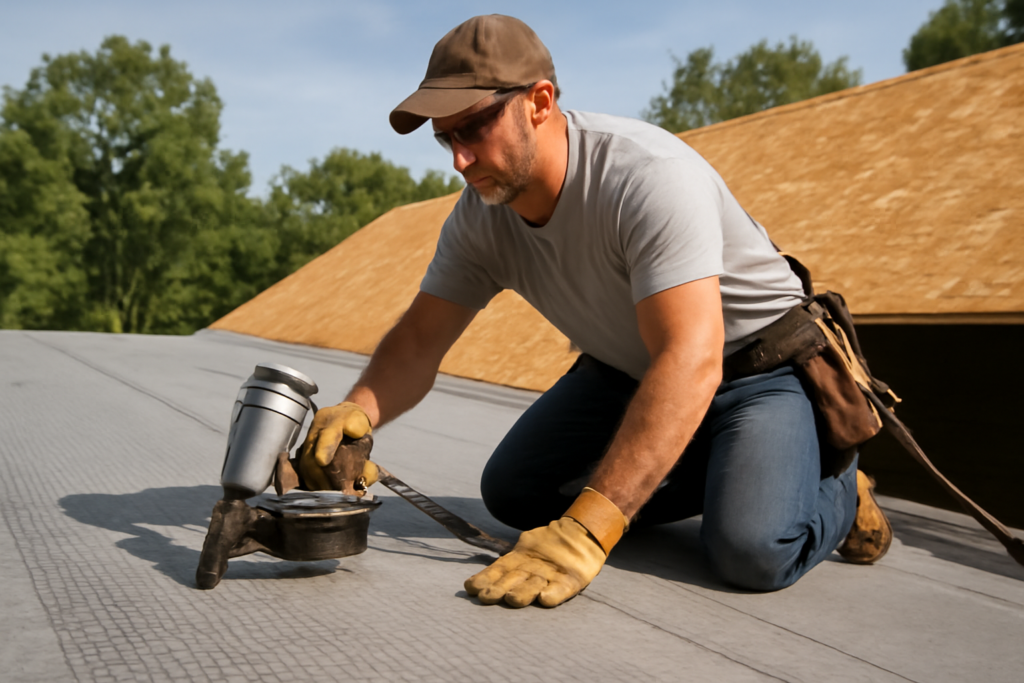
ProArmor is a mechanically fastened product, and Owens Corning wants plastic cap nails or cap staples — not smooth roofing nails, and not staples without caps, both of which tear through synthetics in wind. On a standard same-day-cover job, fasten roughly every 12 inches along laps and 24 inches in the field; if the underlayment will ride exposed for days or you are in a high-wind zone, tighten the field pattern to about 12 inches. A 3,000-count pail of 1-inch plastic cap nails runs about $35 and covers a typical house.
Overlaps follow familiar felt logic: 4-inch horizontal side laps and 6-inch end laps, with laps increasing on low slopes. ProArmor is approved down to a 2/12 pitch when you double-lap it (a 24-inch overlap creating two-ply coverage); below 2/12 it is out, and you are in self-adhered or low-slope membrane territory. Run it horizontally starting at the eave, shingle-style, so every course sheds onto the one below. In ice dam country, your high-temp self-adhered ice barrier still goes down first at eaves and valleys — ProArmor covers the field, not the ice and water zones.
ProArmor vs. Felt: An Unfair Fight
Against #15 and #30 felt, the comparison is short. Felt tears at nail heads under foot traffic, wrinkles when it takes on overnight moisture (and those wrinkles telegraph through thin laminate shingles), dries out and cracks with UV inside a week or two, and comes in 2-square or 4-square rolls that keep the crew climbing the ladder all morning. ProArmor lays flat, resists tear-through dramatically better, tolerates two months of exposure, and covers 10 squares per carry.
Cost used to be felt’s trump card, but the gap has nearly closed. Thirty-pound felt runs $25 to $30 for a 2-square roll — call it $12 to $15 per square — while ProArmor lands around $9 to $12 per square. When the synthetic is cheaper per square, lighter, faster, and safer to walk, the only reason to roll felt is a spec that literally requires it, and those are getting rare.
How It Sits Against Titanium and RhinoRoof
Within the synthetic class, ProArmor competes in the value-to-midgrade lane. Titanium UDL25 and UDL30 offer step-up options with heavier scrims and, on the UDL30, a longer 6-month exposure rating; RhinoRoof U20 is the high-volume budget entry that undercuts ProArmor slightly on price with a lighter sheet. ProArmor’s pitch is balance — better traction and hand than the bargain sheets, at a price meaningfully below the premium tier — plus the system-warranty tie-in if you are already installing Duration shingles. If your project needs months of exposure before cover, or you want a full peel-and-stick deck, look elsewhere. For the standard reroof that gets dried in this week and shingled next, that extra spend buys you little.
Install Notes From the Field
A few practical observations that do not show up on the spec sheet. The sheet handles wind better than lightweight synthetics simply because it has some body, but a 42-inch-wide sail is still a sail — on breezy days, fasten as you unroll rather than dry-rolling long runs. The printed grid is more useful than it sounds; laps stay honest across a 40-foot run without chalk lines. Traction is very good dry and acceptable with light dew, but like every coated synthetic it gets slick with frost or pollen film, so treat early starts with respect and harness up on anything over 6/12.
Two cautions. First, ProArmor is a vapor barrier for practical purposes, like nearly all polypropylene synthetics — it belongs over a vented attic assembly, and if you have a cathedral ceiling or unvented deck, sort out your ventilation and condensation plan before choosing any non-breathable underlayment. Second, do not leave it as a long-term temporary roof. Sixty days of UV tolerance means it survives a scheduling hiccup, not a winter. I have seen synthetics left exposed past their rating turn chalky and brittle at the laps, and the warranty will not follow you there.
Pricing and Where to Buy
Expect to pay $90 to $120 per 10-square roll at Lowe’s, roofing distributors like ABC Supply and Beacon, or online — about $0.09 to $0.12 per square foot of coverage. Regional pricing swings with freight, and pro-desk pricing knocks 10 to 15 percent off for multi-roll orders. A 25-square roof needs three rolls plus your ice barrier, so the whole field underlayment line item on a typical house is $270 to $360 in material. Against a total reroof bill of $12,000 to $20,000, upgrading from felt costs essentially nothing and sometimes saves money outright.
Availability is one of ProArmor’s quiet advantages. Because Owens Corning products stock at big-box stores as well as pro yards, a crew that comes up one roll short on a Saturday can have it patched by noon instead of losing the day — something you cannot always say for distributor-only brands. Check the label when buying, though: retail shelves sometimes mix ProArmor with the lighter Deck Defense and titanium-colored competitors, and the 42-inch by 286-foot roll dimensions are the quickest way to confirm you grabbed the right product.
The Bottom Line: Who Should Buy ProArmor
ProArmor makes the most sense in three situations. If you are getting an Owens Corning shingle roof anyway, using it keeps the assembly inside one manufacturer’s system and preserves eligibility for the extended Platinum warranty — a real tiebreaker. If you are a homeowner supplying materials for a straightforward reroof with same-week cover, it delivers premium-feeling traction and tear resistance at a value price. And for metal roof dry-ins under 60 days, it is a solid field layer paired with high-temp membrane at the critical zones. Skip it for unvented assemblies, low-slope sections under 2/12, or projects that will sit exposed past two months. Inside its lane, ProArmor is exactly what a modern synthetic should be: boring, flat, grippy, and cheap enough that choosing felt no longer makes sense.