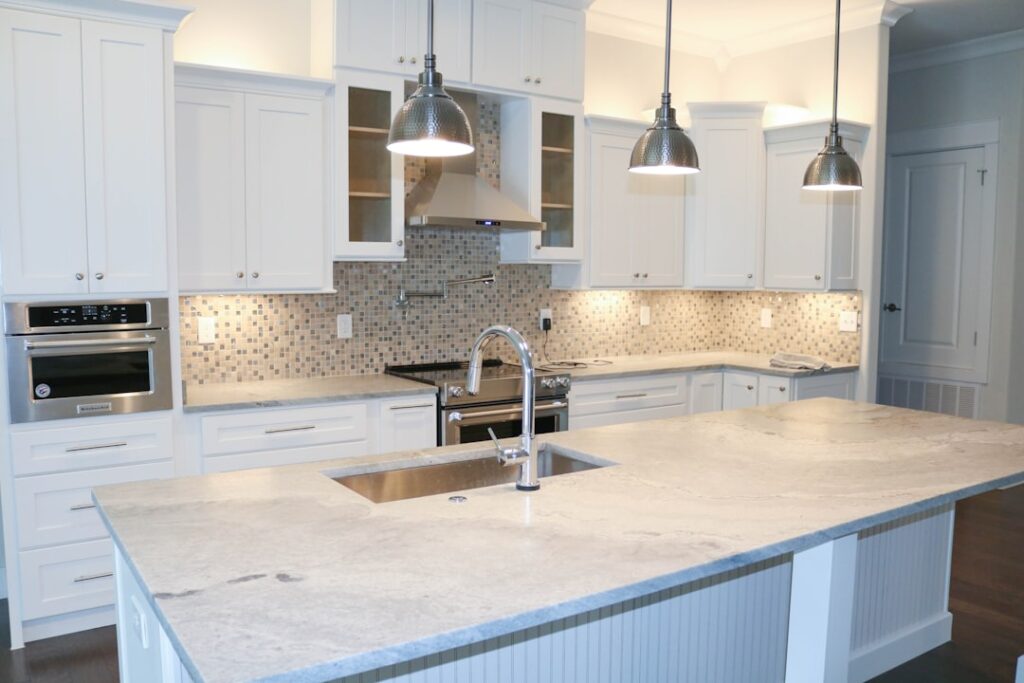
Replacing countertops is one of the highest-impact kitchen upgrades you can make. New countertops change the entire look and feel of a kitchen, boost your home’s resale value, and improve daily functionality. With over 30 years of experience in home renovations, we have handled every type of countertop replacement imaginable. This guide covers everything you need to know, from when to replace to what it costs and how long it takes.
- When to Replace Your Countertops
- Cost of Replacing Countertops by Material
- DIY vs Professional Installation
- Keeping Your Existing Cabinets
- Replacement Timeline: What to Expect
- Removing and Disposing of Old Countertops
- Hidden Costs to Budget For
- How to Choose the Right Replacement Material
- Frequently Asked Questions
When to Replace Your Countertops
Not every worn countertop needs full replacement. Here are the signs that tell you it is time for replacing countertops rather than attempting repairs:
Visible damage beyond repair: Deep cracks, burn marks, large chips, and extensive scratching that covers a significant portion of the surface. Minor chips in granite or quartz can be filled with epoxy, but widespread damage warrants replacement.
Peeling or bubbling laminate: When the laminate layer separates from the substrate, especially around sinks and dishwashers where moisture is present, the damage will only spread. Spot repairs rarely last.
Permanent staining: Natural stone that has absorbed deep stains despite professional cleaning attempts. Porous materials like marble and unsealed granite can develop stains that penetrate beyond the surface.
Outdated appearance: If your countertops are dragging down the entire kitchen design, replacement offers the best return on investment. Cosmetic updates like painting work for 3-5 years but eventual replacement delivers a permanent solution.
Planning a kitchen renovation: If you are updating cabinets, appliances, or layout, replacing countertops at the same time saves money compared to doing it as a separate project later.
Before selling your home: Kitchens sell houses, and countertops are the first thing buyers notice. Replacing worn laminate with quartz or granite before listing often returns 50-80% of the investment in higher sale price.
Cost of Replacing Countertops by Material
The total cost of replacing countertops depends on the material, the size of your kitchen, edge profile selection, and your geographic location. Here are current 2026 prices for a standard 40-square-foot kitchen:
Laminate: $800 to $1,600 installed. Budget-friendly and available in hundreds of patterns. Lifespan of 10-15 years.
Butcher block: $1,200 to $2,800 installed. Warm, natural look with repairable surface. Requires regular oiling. Lifespan of 15-25 years.
Solid surface (Corian): $1,600 to $3,600 installed. Seamless appearance, repairable scratches. Lifespan of 15-25 years.
Granite: $1,600 to $4,000 installed. Natural stone beauty with excellent durability. Requires annual sealing. Lifespan of 25-50 years.
Quartz: $2,000 to $4,800 installed. Engineered stone with zero maintenance. Most popular choice in 2026. Lifespan of 25-50 years.
Quartzite: $2,800 to $6,000 installed. Premium natural stone, extremely hard. Requires sealing. Lifespan of 30-50+ years.
Marble: $3,000 to $7,000 installed. Luxury natural stone, softer and more porous than granite. Requires regular sealing. Lifespan of 25-50 years with proper care.
These prices include material, fabrication, templating, and professional installation. Removal and disposal of existing countertops typically adds $200 to $500.
DIY vs Professional Installation
Some countertop materials lend themselves to DIY installation while others absolutely require professional handling. Here is an honest assessment:
Good for DIY:
- Butcher block: Pre-made slabs need only cutting to size. Weight is manageable for one or two people. Basic tools required.
- Tile: Requires patience and precision but uses standard tiling tools and techniques most homeowners can learn.
- Laminate: Pre-formed laminate countertops from home centers come ready to install. Flat-lay laminate sheets require more skill but are still DIY-friendly.
Requires professional installation:
- Granite, quartz, quartzite, and marble: Stone slabs weigh 15-20 pounds per square foot. A standard L-shaped kitchen countertop weighs 400-600 pounds. Professional fabricators use CNC machines for precise cuts and employ trained crews for safe installation.
- Solid surface: Seamless joints require certified fabricator techniques. Most solid surface warranties are void without professional installation.
DIY installation saves $500 to $2,000 in labor costs depending on the material. However, a botched stone countertop installation can damage cabinets, walls, and the slab itself. For materials costing $50 or more per square foot, we strongly recommend professional installation.
Keeping Your Existing Cabinets
One of the most common questions about replacing countertops is whether you can keep your current cabinets. The answer is almost always yes, with a few considerations:
Structural integrity: Cabinets must be level, plumb, and structurally sound to support new countertops. Stone countertops are significantly heavier than laminate. If your cabinets sag or wobble, they need reinforcement or replacement before new countertops go on.
Layout changes: If you are keeping the same layout (same sink location, same appliance positions), existing cabinets work perfectly. Moving the sink or adding an island requires cabinet modifications.
Height considerations: Standard countertop height is 36 inches from the floor. If your existing cabinets produce a comfortable working height with the current countertop thickness, replacement countertops of similar thickness will maintain that height. Thicker stone slabs (3 cm vs. 2 cm) add approximately half an inch.
Backsplash issues: Removing old countertops sometimes damages the backsplash or the wall behind it. Plan for minor drywall repair and touch-up painting. If the old countertop had an integrated backsplash, you will need a new backsplash solution.
Plumbing connections: The plumber disconnects and reconnects the sink and faucet during countertop replacement. If your faucet is old, this is a good time to upgrade since the cost of installation is already covered. Budget $150 to $300 for a plumber’s time.
Replacement Timeline: What to Expect
Understanding the timeline helps you plan around the disruption to your kitchen. Here is a realistic schedule for a professional countertop replacement:
Week 1: Material selection and deposit. Visit a stone yard or showroom to select your slab. Pay a deposit (typically 50%) to reserve your material and schedule the templating appointment.
Week 2-3: Templating. A fabricator visits your home and creates a precise digital template of your countertop layout, including sink cutouts, edge profiles, and seam locations. This takes about one hour.
Week 3-5: Fabrication. The fabricator cuts and polishes your countertop slabs using the template. Fabrication takes 5-10 business days depending on the fabricator’s workload.
Installation day: A crew removes your old countertops, installs the new ones, and connects the sink. The actual installation takes 3-6 hours for a standard kitchen. A plumber reconnects water lines the same day or the following day.
Total timeline: 3 to 6 weeks from initial deposit to completed installation. Busy seasons (spring and summer) may extend the timeline. Laminate and butcher block replacements are faster since they do not require custom fabrication, often completing in 1-2 weeks.
Removing and Disposing of Old Countertops
Old countertop removal is included in most professional installation quotes, but here is what the process involves:
Disconnect plumbing: The sink, faucet, and garbage disposal must be disconnected before countertop removal. A plumber handles this or the installation crew if they are qualified.
Disconnect appliances: Cooktops and dishwashers attached to the countertop need disconnecting. Gas cooktops require a licensed professional for disconnection and reconnection.
Remove the countertop: Laminate countertops are screwed to the cabinets from below and can be removed in sections. Stone countertops are typically held in place by gravity, adhesive, and clips. The crew carefully lifts sections and carries them out.
Disposal options: Most installers include disposal in their quote. Alternatively, you can handle disposal yourself. Laminate goes in a standard dumpster or to the landfill. Stone pieces can sometimes be repurposed as garden stepping stones, small tabletops, or workshop surfaces. Some recycling facilities accept natural stone.
Disposal cost: If not included in installation, expect to pay $150 to $400 for countertop removal and disposal. Renting a small dumpster for DIY disposal costs $200 to $350.
Hidden Costs to Budget For
The quoted price for replacing countertops rarely covers everything. Budget an additional 15-20% for these common extras:
Plumbing: $150 to $300 for sink disconnection and reconnection. More if you are upgrading the faucet or moving the sink location.
Backsplash removal and replacement: $200 to $800 depending on material. If the old backsplash is damaged during countertop removal, it needs replacing.
Drywall repair: $100 to $300 for patching and painting walls behind the old countertop and backsplash.
Sink and faucet: If your existing sink does not fit the new countertop (different mounting style or size), a new sink costs $100 to $500. New faucets run $150 to $400.
Edge profiles: Basic eased or beveled edges are usually included. Ogee, bullnose, or waterfall edges add $10 to $30 per linear foot.
Seam placement: Larger kitchens require seams where two slabs meet. Complex layouts with multiple seams may incur additional fabrication charges.
Cabinet reinforcement: If cabinets need leveling or reinforcement to support heavier stone, expect $200 to $500 for a carpenter.
How to Choose the Right Replacement Material
With so many options available, here is how to narrow down the best material for your situation:
Budget under $2,000: Laminate or butcher block. Both offer attractive options at affordable prices. Laminate is lower maintenance while butcher block adds warmth and character.
Budget $2,000-$4,000: Granite or quartz. This is the sweet spot for most homeowners. Quartz offers zero maintenance while granite provides natural stone beauty with annual sealing.
Budget over $4,000: Premium quartz, quartzite, or marble. These materials deliver luxury aesthetics and exceptional durability (quartzite) or timeless beauty (marble).
For heavy cooking: Granite or quartzite for heat resistance. These natural stones handle hot pots without damage.
For low maintenance: Quartz, hands down. No sealing, no special cleaners, no periodic maintenance of any kind.
For resale value: Quartz and granite both appeal to buyers and return 50-80% of their cost at sale. White and gray tones are the safest choices for broad buyer appeal.
Frequently Asked Questions
How much does it cost to replace countertops?
The average cost to replace kitchen countertops is $2,000 to $4,500 for a standard 40-square-foot kitchen with granite or quartz. Laminate replacement costs $800 to $1,600. Premium materials like quartzite or marble run $3,000 to $7,000. These prices include materials, fabrication, and professional installation.
Can I replace countertops without replacing cabinets?
Yes, in most cases you can keep your existing cabinets when replacing countertops. The cabinets must be structurally sound and level. Professional installers assess your cabinets during the templating visit and will flag any issues that need addressing before installation.
How long does countertop replacement take?
The entire process from material selection to completed installation takes 3-6 weeks for stone countertops. The actual removal and installation happens in one day, typically 3-6 hours. Laminate and butcher block replacements can be completed in 1-2 weeks since they do not require custom fabrication.
Is replacing countertops a good investment?
Yes. Kitchen countertop replacement returns 50-80% of the investment in higher home value. Beyond resale, new countertops improve daily functionality and the enjoyment of your kitchen. Upgrading from laminate to stone is one of the most impactful home improvements per dollar spent.
Should I replace countertops before selling my house?
If your current countertops are visibly worn or outdated, replacing them before listing your home is usually worthwhile. Focus on broadly appealing materials like white or gray quartz. Avoid trendy or bold choices that may not appeal to all buyers. Consult your real estate agent for market-specific advice.