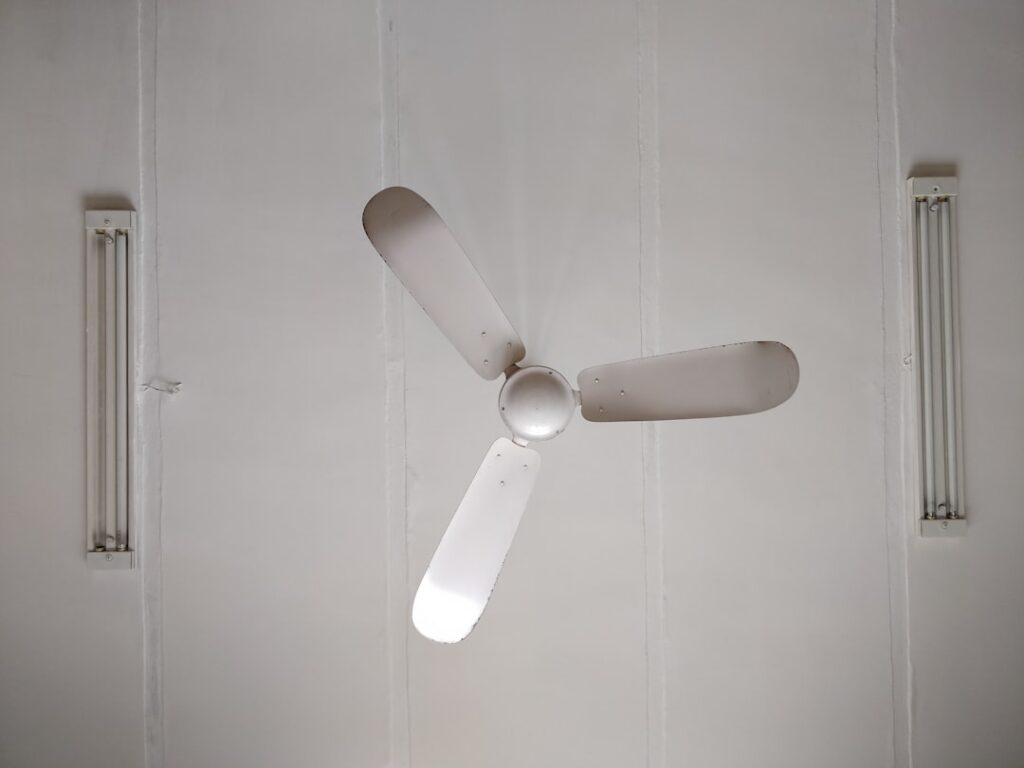
Plenty of people want moving air but hate looking at a fan — designers have grumbled about “ceiling propellers” for decades. The retractable ceiling fan is the industry’s answer: acrylic or ABS blades that fold or slide into the fixture body when the motor stops, leaving what looks like a chandelier, drum pendant, or flush light on the ceiling. Flip the switch and centrifugal force swings the blades out to full span. It is genuinely clever engineering with genuinely real trade-offs, and knowing both sides is the difference between loving one and returning it.
- How Retractable Blades Actually Work
- The Fandelier Crossover
- Airflow: The Honest Numbers
- Models and Prices
- Installation and Sizing Notes
- Reliability: What Actually Goes Wrong
- Retractable vs. Fixed Fandelier vs. Enclosed: Choosing Among the Hybrids
- Living With One: A Six-Month Owner's Checklist
- Bottom Line
How Retractable Blades Actually Work
Most retractable fans use no motors or servos for the blades at all — just physics. Each blade pivots or telescopes on a hinge at the hub, resting tucked against or inside the housing at rest. When the motor spins up, centrifugal force swings the blades outward within a second or two, expanding a 24-inch fixture into a 36-to-48-inch fan; when it stops, springs or gravity fold them home. A smaller group uses telescoping blades that slide out in sections, and a few premium models add mechanical assists. The elegance is the simplicity — nothing to fail electronically — but the hinges themselves become the fan’s weak point: they must stay smooth and evenly lubricated for the blades to deploy symmetrically, and a sticky hinge means one blade extends late, announcing itself as a brief wobble on every start.
The Fandelier Crossover
Retractable fans overlap heavily with the “fandelier” — the chandelier-fan hybrid that has become one of lighting’s fastest-growing categories. The typical retractable fandelier wraps the folded blades inside a crystal-trimmed drum or a caged frame with candelabra-style LEDs, so at rest it reads as a legitimate dining-room or bedroom fixture. That solves the oldest problem in interior design arguments: the room that needs a chandelier moment and airflow in the same ceiling position. If you like the hybrid concept but want full-time visible styling rather than a disappearing act, the broader chandelier ceiling fan category covers fixed-blade fandeliers too — the retractable versions simply add the vanishing trick at a modest cost and complexity premium. Dining rooms, primary bedrooms, closets-turned-offices, and entry landings are where these fixtures consistently earn their keep.
Airflow: The Honest Numbers
Retractable blades are shorter and lighter than conventional blades, and the deployed spans run 36 to 48 inches versus the 52-inch standard — so temper expectations. Typical retractable fans move 1,500–3,500 CFM on high, against 4,000–6,000 for a standard 52-inch fan. In a 12 x 12 bedroom or over a dining table, that is comfortable, gentle circulation that lets you bump the thermostat a couple degrees; in a 350 sq ft great room it will feel cosmetic. Two spec-sheet rules protect you: buy only models that publish a CFM figure, and favor DC motors, which deliver more low-speed control and quieter operation — relevant because thin acrylic blades generate more air noise per CFM than broad wooden ones at high speed. Reverse mode is worth confirming as well; many retractable designs are single-direction, which costs you the winter destratification trick.
Models and Prices
The market splits into three tiers. Budget ($120–$250): Amazon-native brands — Orillon, Moooni, DUMAIWAY and similar — dominate with 33-to-42-inch retractable fandeliers, tri-color LEDs, and remotes; quality varies, so filter for ETL/UL listing, a metal (not plastic) hub, and reviews older than six months that mention blades still deploying evenly. Mid-range ($250–$500): better-built retractables and crystal fandeliers from Parrot Uncle and River of Goods, with improved hinges and dimmable LEDs. Premium ($500–$1,200): the polished end — Fanimation and Craftmade hybrid designs and high-spec DC fandeliers — where you get smooth deployment, warrantied motors, and light quality that genuinely replaces a chandelier. Across all tiers the integrated LED is usually non-replaceable as a lamp, so check whether the driver and panel are serviceable parts; on a fixture this decorative, the light dying is the fixture dying.
Installation and Sizing Notes
Installation mirrors any ceiling fan: a fan-rated electrical box marked “Acceptable for Fan Support,” a bracket-and-canopy hang, and a remote receiver tucked in the canopy — most retractables are remote-only, so plan on the RF wall controller if you want switch control, and never put a standard dimmer on one. Weights are modest (12–25 pounds), which helps in older ceilings. Size by deployed span, not resting size: keep blade tips 18–24 inches from walls and, over a dining table, choose a fixture whose retracted diameter suits the table (roughly half to two-thirds the table width, hung 30–36 inches above it) while the deployed span still clears any chandelier-adjacent cabinetry. Clearance matters vertically too — blades must sit 7 feet above the floor when deployed, and drum-style retractables hang deeper than they look in photos, so check the fixture’s overall height against an 8-foot ceiling before ordering.
Reliability: What Actually Goes Wrong
Three failure patterns account for most complaints. First, asymmetric deployment — one blade lags or sticks, causing start-up wobble; the fix is cleaning the hinge tracks and a silicone-based (never oily, dust-grabbing) lubricant twice a year. Second, blade yellowing and brittleness — clear acrylic blades UV-yellow near sunny windows and can crack at the hinge after years of folding cycles; replacement blade sets run $20–$50 where brands support them, which is itself a reason to buy from brands that sell parts. Third, remote receiver failure, the same weak point as any remote fan — a $25–$45 universal receiver revives most. Dust is the quiet enemy: folded blades stack close together and collect grime in the housing, so add the fixture to your seasonal cleaning list while the power is off and the blades are extended by hand.
Retractable vs. Fixed Fandelier vs. Enclosed: Choosing Among the Hybrids
Three fixture families now compete for the “fan that doesn’t look like a fan” job, and the right pick depends on which compromise you prefer. Retractables give the cleanest at-rest look and the widest deployed span of the three, at the cost of moving parts that need occasional attention. Fixed-blade fandeliers — clear acrylic blades permanently extended around a chandelier body — trade a slightly busier silhouette for zero deployment mechanics and typically 10–20 percent more airflow at the same size. Fully enclosed drum fans hide blades behind a diffuser permanently, winning on safety and low-ceiling clearance but giving up the most CFM. A practical decision tree: dining room where looks rule and dinner is the main event — retractable; bedroom where the fan runs all night — fixed fandelier or a conventional fan, for airflow and silence; bunk room or 7-foot ceiling — enclosed. Price-wise the three overlap heavily in the $200–$600 band, so let the room’s ceiling height and run hours make the call rather than the showroom photo.
Living With One: A Six-Month Owner’s Checklist
- Monthly: wipe the housing; run the fan briefly if it has sat unused so hinges cycle.
- Quarterly: with power off, extend blades by hand and clean both faces; inspect hinge pivots for grit.
- Twice yearly: a whisper of silicone lubricant on the pivots; check canopy and bracket screws for vibration loosening.
- Any start-up wobble: stop, clean the lagging blade’s hinge, and re-test before adding balance weights — weighting a sticky hinge treats the symptom.
Ten minutes a season keeps the vanishing act smooth for years.
Bottom Line
A retractable ceiling fan is a style solution first and an air mover second — perfect for dining rooms and bedrooms where a visible fan loses the design argument, and wrong for big spaces that need serious CFM. Buy a DC-motor model with published airflow, UL/ETL listing, serviceable parts, and a fan-rated box behind it; keep the hinges clean; and you get the rare fixture that is a chandelier at rest and a breeze on demand.