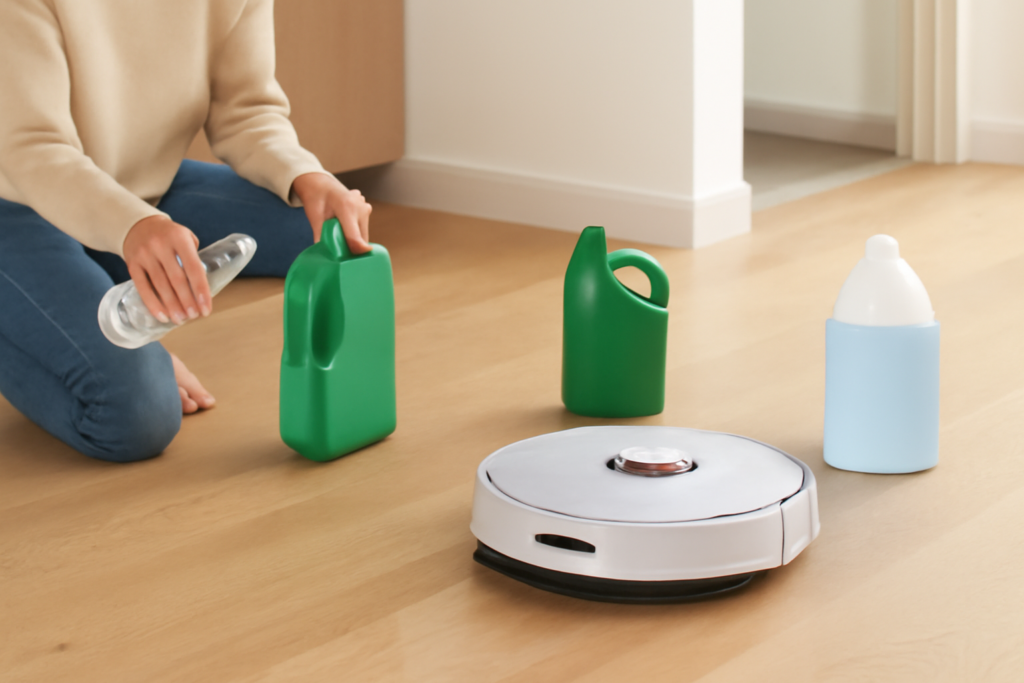
If you own a Roborock robot vacuum with a mopping function, the detergent you pour in the tank matters more than most owners realize. The right Roborock floor cleaning solution keeps floors streak-free and protects the pump and internal lines from clogging, while the wrong one — dish soap, vinegar, or a foamy household cleaner — can gum up the system and leave sticky residue behind. After running several Roborock models across tile, LVP, and sealed hardwood, here is what actually works.
Why the Cleaning Solution Choice Matters
A robot mop is not a bucket and rag. It pumps liquid through narrow tubes, a valve, and a fine dispensing system onto a spinning or vibrating pad. Anything that foams excessively, leaves a film, or dries thick will eventually clog those narrow passages. That is why the fluid you use is a maintenance decision as much as a cleaning one.
The goal is a low-foaming, residue-free, neutral-pH cleaner that dilutes fully in water. Get that right and the floors dry clean with no streaks and the machine keeps running smoothly.
Roborock’s Official Cleaning Solution
Roborock sells its own branded floor cleaning solution designed specifically for its mopping systems. It is a low-foam concentrate you dilute with water in the clean-water tank. Because it is formulated for the machine, it will not over-foam or leave the kind of residue that clogs the pump — and using it keeps you clearly within the manufacturer’s guidance.
A bottle typically runs $15 to $25 and lasts a long time because you use only a small measured amount per tank fill. Always follow the dilution ratio printed on the label; more concentrate does not clean better and increases residue risk.
Can You Use Third-Party Solutions?
You can, but choose carefully. Many owners successfully use third-party robot-mop detergents that advertise as low-foaming and safe for robotic mops. The key criteria are the same regardless of brand:
- Low-foaming or no-foam — foam is the number-one cause of clogs and error codes
- Residue-free / no-rinse — it should not leave a film that attracts dirt
- Neutral pH — safe for sealed hardwood, tile, and vinyl
- Fully water-soluble — no oils, no wax, no thickeners
When in doubt, defer to Roborock’s own solution to avoid any warranty questions. Using an off-label cleaner that damages the pump can complicate a warranty claim.
What You Should Never Put in the Tank
This list saves machines. Do not add any of the following to your Roborock’s water tank:
- Dish soap: foams heavily, clogs lines, and leaves a slippery film
- Vinegar: its acidity can degrade seals and pump components and etch stone floors
- Bleach or ammonia: corrosive to internal parts
- Essential oils or fragrances: oily residue clogs the fine dispensing nozzles
- Standard multi-surface sprays: most foam far too much
Even if a homemade mix cleans your floor once, the residue accumulates in the tubing over weeks and leads to weak dispensing or a failed pump.
Floors to Be Careful With
Robot mops apply water, and water is not welcome on every floor. Unsealed hardwood and unsealed natural stone should not be wet-mopped by any robot. On laminate, use the driest mop setting or skip mopping entirely, since laminate’s fiberboard core dislikes moisture at the seams.
Sealed tile, LVP, and sealed hardwood are the sweet spot for robot mopping. Even then, use the appropriate water-flow setting — low for wood, higher for tile — so the floor dries quickly and no water pools in grout lines or plank seams.
Keeping the System Clog-Free
The best cleaning solution still needs a maintenance routine to keep dispensing evenly. Build these habits:
- Empty the clean-water tank after each use if you added detergent, so solution does not sit and dry in the lines.
- Run a plain-water cycle periodically to flush the tubing.
- Rinse and air-dry the mop pad after every run to prevent mildew and odor.
- Descale as recommended if you have hard water — mineral buildup clogs the pump like residue does.
- Clean the dispensing nozzles if you notice uneven wetting on the pad.
Getting Streak-Free Results
Streaks usually come from too much detergent, not too little. If floors look hazy, cut back the concentrate and run a rinse pass with plain water. Make sure the mop pad is clean before each run; a dirty pad smears grime rather than lifting it. For self-washing docks, keep the dock’s dirty-water tank emptied so the pad rinses in clean water.
Bottom line, the safest bet is Roborock’s own low-foam concentrate at the labeled dilution, with a quality third-party robot-mop detergent as an acceptable alternative if it meets the low-foam, residue-free, neutral-pH criteria. Match the water-flow setting to your floor, keep the tank and pad clean, and the right roborock floor cleaning solution will leave your floors streak-free while protecting the machine for the long haul.
Why the Right Solution Matters
Robot mop owners are often tempted to pour in whatever floor cleaner is under the sink, but that is a mistake with these machines. Roborock and most robot-mop makers specify a low-foaming, robot-safe solution because ordinary sudsy cleaners create foam that can damage the pump and sensors, and residue can gum up the mopping pads and internal lines. The dedicated solution is formulated to clean effectively while protecting the machine.
Always dilute it exactly as directed, since an over-concentrated mix leaves sticky residue that streaks the floor and attracts dirt.
Maintaining Pads and Tanks
A robot mop only cleans as well as its pads and water are clean. Rinse or replace the mopping cloth regularly, because a dirty pad just smears grime around. Empty and rinse the clean-water tank if the machine will sit unused, so old solution does not grow bacteria or clog the lines. On models with a self-washing dock, clean the dock tray periodically too. If your floors ever look hazy after mopping, the usual culprit is too much solution or a saturated pad, not the machine itself. For sealed hard floors like tile, luxury vinyl, and sealed wood the system works well; just avoid running a wet mop function on unsealed wood or laminate that moisture can damage.
Prefer to explore on your own?
See how new flooring looks in your actual room in seconds — free, no signup.
Try the free Floor Studio →