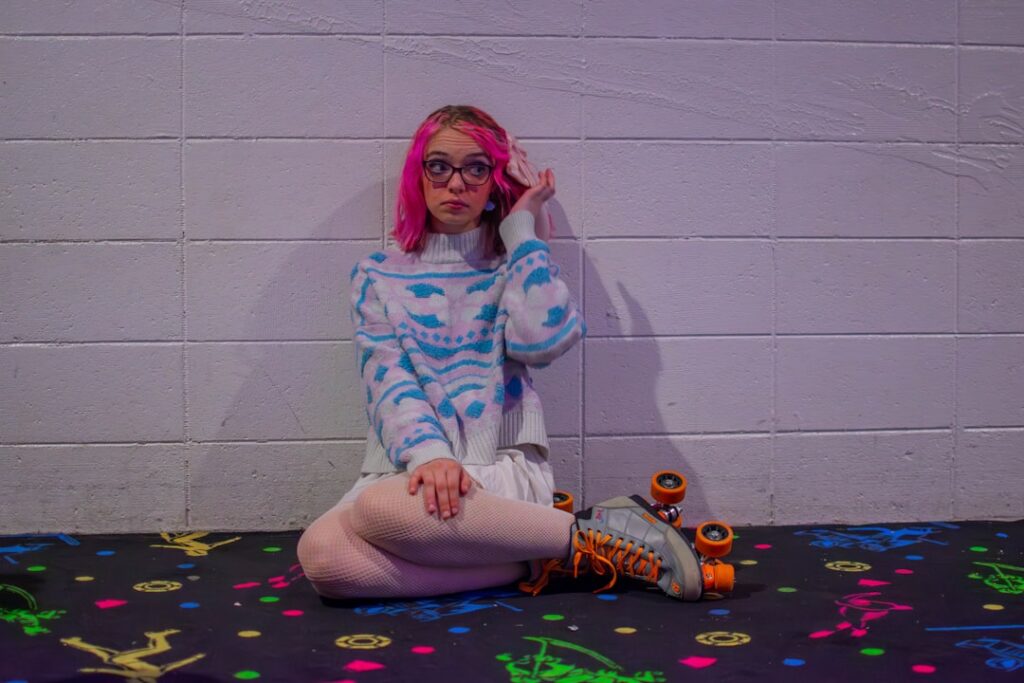
Every few years a flooring trend comes out of nowhere, and this one came out of 1986. Roller rink carpet — the black or deep purple loop carpet exploding with neon squiggles, confetti shapes, cosmic swirls, and shapes that glow under blacklight — has jumped from skating rinks and bowling alleys into basements, game rooms, home theaters, and arcades built in spare bedrooms. I have now sourced and installed it for enough clients to say it is a real product category with real suppliers, not just a Pinterest fantasy. Here is where this carpet comes from, what it costs, where it actually works in a house, and the mistakes that make a fun floor look like a mistake.
What This Carpet Actually Is
The stuff you remember from the rink was never a residential product. It is commercial-grade cut-pile or loop carpet, almost always solution-dyed nylon or polyester printed or tufted with high-contrast patterns on a dark ground. The dark base hides gum, soda, and a decade of shoe traffic; the frantic pattern hides stains and seams; and the fluorescent elements react to UV blacklight so the room comes alive when the house lights drop. Rinks, bowling centers, movie theaters, arcades, and laser tag arenas all buy from the same handful of specialty mills, and that commercial DNA is good news for homeowners: this carpet is built for abuse that no living room will ever deliver.
Most of it today comes as broadloom in 12-foot rolls, and increasingly as carpet tiles, which matter for home buyers because tiles ship in small quantities and install without a stretcher. The fluorescent yarns are the signature: under ordinary light you see bright neon accents; under a UV blacklight the neon elements fluoresce hard while the dark ground disappears, which is the entire party trick.
Where to Buy It
This is the question I get most, because you will not find rink carpet at the local flooring showroom. The market splits into a few channels:
- Specialty entertainment-flooring mills. Joy Carpets is the big name — their “Neon Lights” line and similar collections are the genuine article, blacklight-reactive and rated for commercial traffic, sold as broadloom and tiles. Flagship House and other rink/FEC (family entertainment center) suppliers serve the same market. Expect roughly $3 to $7 per square foot for the material.
- Home theater carpet retailers. Online shops serving the home-cinema crowd carry cosmic and “movie theater” patterns in broadloom and tile, often with small minimums, in the $4 to $9 per square foot range.
- Commercial carpet tile lines. Several mainstream commercial mills make high-energy geometric tiles that read as rink-adjacent without the blacklight yarns — a more restrained way to get the look, around $2.50 to $5 per square foot.
- Salvage and liquidation. When rinks and bowling alleys renovate, their carpet sometimes hits auction sites and liquidators for under $1 per square foot. Genuine vintage patina, but inspect for worn traffic lanes, smoke smell, and dried adhesive on the back — much of it was glued down and does not come up reusable.
Order physical samples before committing. The scale of these patterns is enormous — motifs can repeat every three to six feet — and a pattern that looks balanced on a phone screen can feel like static in a 12×14 room. Also confirm the words “UV reactive” or “fluoresces under blacklight” explicitly if the glow matters to you; plenty of neon-looking carpet uses ordinary dyes that go dead under UV.
Where It Works in a House (and Where It Does Not)
The rooms where I have seen rink carpet succeed share one trait: they are destinations, not pass-throughs. Basement game rooms and arcades are the natural habitat — the carpet ties together pinball machines, a bar, and neon signage like nothing else, and basements’ controlled lighting lets the blacklight effect land. Home theaters are the second-best fit, and there is a functional argument beyond nostalgia: dark, busy, low-sheen carpet is genuinely what commercial cinemas use because it kills light reflection and hides popcorn-adjacent sins. Kids’ and teen hangout rooms, band/rehearsal rooms, and garage lounges round out the list.
Where it fails: open-concept main floors, rooms with big windows (sunlight both washes out the drama and fades fluorescent dyes faster than standard solution-dyed colors), and anywhere you plan to sell soon with mainstream buyers — this floor is a personality decision, and appraisers have no column for radness. In a resale-sensitive house, do it in tiles so the next owner can swap to gray in a weekend, or contain it to one clearly themed room where it reads as intentional.
Design: Commit or Skip It
Half-hearted rink carpet looks like a mistake; committed rink carpet looks like a vision. The floor is the loudest voice in the room, so build the rest of the room to back it up. Keep walls dark — black, charcoal, deep navy — so the carpet’s neon reads as intended and the blacklight effect concentrates on the floor and any UV posters. Add actual blacklight: inexpensive UV LED strip or flood fixtures on a separate switch (roughly $30 to $100 to do a room) so the space has a “day mode” and a “rink mode.” Neon or LED-neon signs, arcade cabinets, a mirror ball over the open floor — lean in. For furniture, go simple and solid-colored; a patterned sofa on this carpet is visual warfare. One restraint that helps: pick carpet whose accent colors number three or four, then repeat exactly those colors in the room. The confetti-everything patterns with nine colors are the hardest to decorate around.
Installation Notes From the Field
Nothing exotic here, but a few specifics matter. Broadloom versions are commercial-weight and stiffer than residential plush; over concrete basements I prefer a glue-down or double-stick installation with a commercial cushion rather than stretch-in, which matches how rinks install it and keeps seams tight under game-room furniture traffic. Pattern matching across seams is the labor cost driver — those big repeats can add 10 to 20 percent waste, so measure with the repeat in mind, and expect installed totals of roughly $6 to $12 per square foot all-in for broadloom. Tiles are the DIY route: pressure-sensitive adhesive or tabs over a clean slab, quarter-turn or monolithic per the pattern’s design, and a basement game room becomes a weekend project. Whichever format, address slab moisture first like any basement job — a calcium chloride or RH test, and a vapor-appropriate adhesive if the slab runs damp.
Living With It
Commercial solution-dyed fiber is about the most forgiving carpet made. Vacuum regularly, treat spills like any carpet (blot, mild detergent, rinse), and hot-water extract once a year or so. The dark ground and hyperactive pattern hide almost everything, which is exactly why rinks chose it. The one aging behavior to know: fluorescent yarns are the first thing to dull, especially with sunlight exposure, so keep UV film or blackout treatments on any windows if the glow is the point. A quality rink-style carpet in a residential room will outlast your interest in it — fifteen years is nothing for this construction — which is one more argument for tiles if you suspect the retro fever might break.
Budget summary for a typical 300-square-foot basement game room: $900 to $2,100 for the carpet in broadloom, $1,800 to $3,600 installed with commercial cushion, or roughly $1,000 to $1,800 in tiles you lay yourself over a weekend — plus another $150 or so for blacklight fixtures and UV window film. Salvage hunters can cut the carpet line under $300 if a local rink renovation hits the auction sites at the right moment.
My honest take: this is the most fun flooring trend of the decade precisely because it is unapologetic. If you have a basement, a blacklight, and a pinball machine or three, roller rink carpet is a hundred square feet of pure joy at bargain commercial prices. Just commit to the bit, buy the UV-reactive real thing from a mill that supplies actual rinks, and give the room a light switch that makes it 1986 on demand.