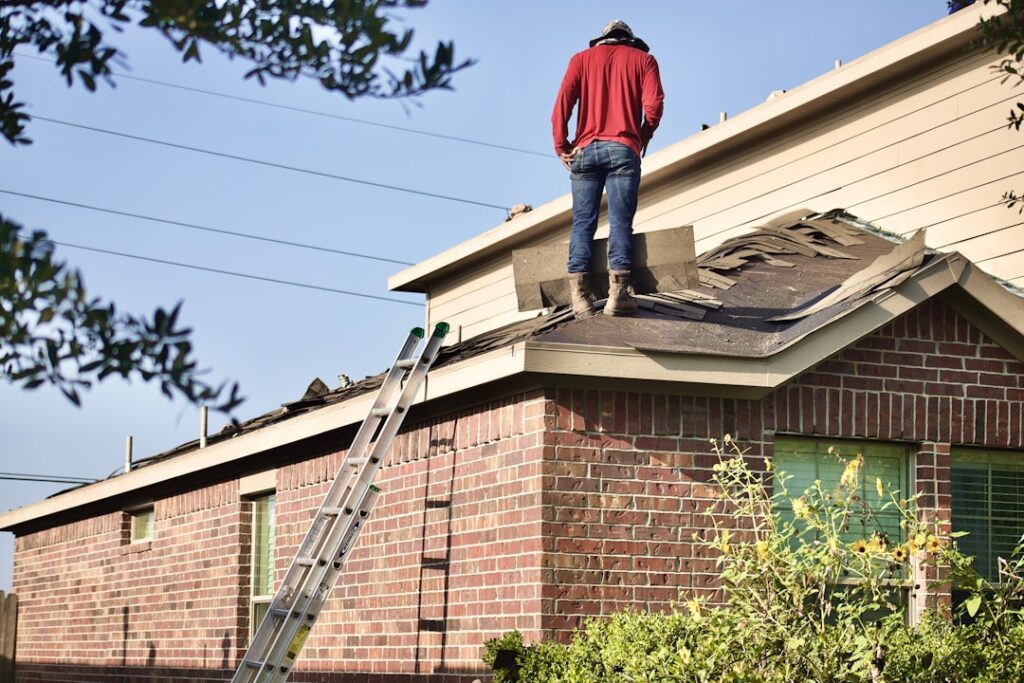
Falls from ladders send more than 100,000 Americans to emergency rooms every year, and a large share of them happen during the two most routine moves in roofing: stepping from ladder to roof and back again. A roof ladder means two things depending on who is talking — the extension ladder you climb to reach the roof, and the hook-equipped ladder that lies flat on the slope so you can work on the roof surface itself. Both are simple tools with unforgiving failure modes. This guide covers choosing the right ladder, the setup rules that prevent most accidents, and when a hook ladder earns its place in your garage.
- Access Ladders: Getting to the Roof
- The Setup Rules That Do the Actual Life-Saving
- Hook Ladders: Working On the Slope
- Choosing and Rigging a Hook Setup
- Ladder Alternatives Worth Knowing
- Ladder Length by Eave Height
- Roof Ladder FAQ
- Can I lean a ladder directly against a gutter?
- What angle should a roof access ladder sit at?
- Are roof hook ladders safe on a ridge vent?
- Care, Inspection, and Retirement
Access Ladders: Getting to the Roof
For reaching a roof edge, the tool is an extension ladder, and sizing is where most homeowners go wrong. The ladder must extend at least 3 feet above the roof edge so you have rails to hold while stepping on and off — the transition is where falls happen. A single-story eave at 10 feet needs at least a 16-foot extension ladder once you account for overlap and setback; a two-story eave at 17-19 feet needs a 24- or 28-footer. Buy by duty rating, not just length: Type II (225 lb) is light-duty, Type I (250 lb) or Type IA (300 lb) is the sensible minimum once you add a tool belt and a bundle of anything. Fiberglass rails (Werner D6200 series, Louisville FE3200) cost 20-30 percent more than aluminum but do not conduct electricity — non-negotiable if there is any chance of contacting a service drop. Expect $200-$400 for a quality 24-foot fiberglass Type IA.
The Setup Rules That Do the Actual Life-Saving
Nearly every ladder accident violates one of five basics:
- The 4-to-1 angle. Base sits 1 foot from the wall for every 4 feet of height to the support point. Test it: toes at the ladder feet, arms straight out — your palms should meet the rung at shoulder height.
- Solid, level footing. Both feet on firm ground; use leg levelers on slopes, never bricks or scrap. Soft lawn calls for a ladder leveler with plate feet or a board spiked in place.
- 3 feet above the edge, tied off. Extend past the eave and secure the top — a lashing to a gutter spike, an eye screwed into fascia, or a ladder stabilizer bracket that spans the gutter.
- Three points of contact, always. Haul tools up with a rope bucket, not your hands.
- Belt-buckle rule. Keep your torso between the rails; overreaching tips more ladders than wind does.
A ladder stabilizer (standoff) like the Werner AC78, about $40-$60, is the single best accessory — it bridges the gutter, widens the top bearing, and stops the sideways skid that gutters invite.
Hook Ladders: Working On the Slope
The second kind of roof ladder solves a different problem: standing on a pitch too steep or too fragile to walk. A hook ladder — either a purpose-built unit or a standard sectional ladder fitted with a roof hook kit — lies flat on the roof plane with a large curved hook (usually with a wheel) that rolls up the slope and drops over the ridge. The hook grabs the far side of the ridge, and the ladder becomes a fixed rail down the slope: you climb it, kneel on it, and distribute your weight across many rungs instead of two boot soles. Roofers use them for steep-slope shingle work; chimney sweeps and solar installers live on them. They are also the correct way to work on fragile coverings — slate, clay tile, and brittle old cedar — where distributed load prevents the breakage a walking foot causes.
Choosing and Rigging a Hook Setup
You have two buying paths. Clamp-on roof hooks (Acro 11084, Qualcraft 2481) cost $60-$120 a pair and bolt to the top rungs of an aluminum sectional or extension segment you already own — check that your ladder’s rung profile is compatible and rated for it. Purpose-built roof ladders with integrated hooks and wheels run $250-$500 in 12-to-20-foot lengths. Rigging rules: roll the ladder up the slope on its wheels with the hook facing up, flip it at the top so the hook seats fully over the ridge onto the opposite plane, then load-test with a hard tug before trusting it. The hook must bear on structure through the ridge — never hook onto a ridge vent’s plastic baffle. On metal roofs, add padding to protect the finish, and treat wet metal as unclimbable. A hook ladder supplements fall protection on steep pitches; above 6/12, a harness on a properly anchored line is still the standard the pros work to.
Ladder Alternatives Worth Knowing
Some jobs are better served by different gear. Articulating multi-position ladders (Little Giant Velocity, about $200-$350) handle odd access points and double as staging but are heavy and slower to deploy. For gutter cleaning alone, a stabilizer-equipped extension ladder beats climbing onto the roof at all. Repeated roof access — solar maintenance, a widow’s walk, chronic gutter trees — may justify permanent solutions: fixed access ladders, or at minimum a dedicated tie-off anchor ($30 hardware, an hour to install at a rafter) that makes every future climb safer. And know the walk-away conditions: winds above roughly 20 mph, wet or frosty surfaces, ground too soft to trust, or any electrical service drop within 10 feet of your setup path. No task on a residential roof is urgent enough to override those.
Ladder Length by Eave Height
| Eave Height | Building Type | Minimum Extension Ladder |
|---|---|---|
| 9-10 ft | Single story, low eave | 16 ft |
| 11-13 ft | Single story, tall foundation or 9-ft ceilings | 20 ft |
| 17-19 ft | Two story | 24-28 ft |
| 24-26 ft | Two story over walkout / three story | 32-36 ft |
These minimums bake in the 3-foot extension above the edge, the 4-to-1 setback, and the 10-15 percent of length lost to section overlap. When in doubt, size up — a too-long ladder can be choked down; a too-short one gets used dangerously.
Roof Ladder FAQ
Can I lean a ladder directly against a gutter?
Aluminum gutters are not rated to carry a loaded ladder, and the smooth face invites a sideways skid — the classic setup for a fall. Use a standoff stabilizer that spans the gutter and bears on the roof or wall, or position the rails against the fascia between gutter sections. If you must contact the gutter briefly, place the rails over gutter spikes or hangers where there is structure behind the metal, and tie off the top.
What angle should a roof access ladder sit at?
The 4-to-1 rule: one foot of horizontal setback per four feet of vertical height to the support point, which works out to about 75 degrees. Steeper risks tipping backward as you climb; shallower loads the rails toward buckling and slides the feet. The arms-out test — toes at the feet, palms landing on a rung at shoulder height — verifies it in five seconds without math.
Are roof hook ladders safe on a ridge vent?
Only if the hook reaches structure. A hook bearing on the plastic baffle of a ridge vent can crush it and release without warning. Seat the hook past the vent so it bears through shingles onto the framing of the opposite plane, or use a hook with a long reach that spans the vent entirely. On any doubtful ridge, load-test with a hard downward tug at the eave end before committing weight.
Care, Inspection, and Retirement
Ladders fail from damage more than age. Before every use, sight down the rails for bends and cracks, check that rungs are tight and dry, verify the rope-and-pulley and rung locks on extensions, and confirm rubber feet are intact — worn feet on smooth concrete are a classic skid. Fiberglass rails chalk and weaken with UV, so store the ladder indoors or under cover, hung horizontally on brackets. Retire any ladder that has been dropped hard, struck by a vehicle, or shows rail damage; a bent aluminum rail loses capacity you cannot see. A quality Type IA fiberglass extension plus a stabilizer and a $100 hook kit is a lifetime kit for most homeowners — about $400 all-in, or the price of one urgent-care visit you will never need to make.