A rug that is too small is the single most common decorating mistake in American living rooms, and it makes even a beautiful space feel cheap and disconnected. The rug rules for living room design are simple once you know them: get the size right, place the furniture correctly on it, and leave the proper border of floor showing around the edges. Follow these guidelines and your rug anchors the seating, defines the space, and pulls the whole room together. Ignore them and you end up with a “postage stamp” floating awkwardly in the middle. Here is how to do it right.
The Golden Rule: Go Bigger Than You Think
Almost everyone buys too small. As a baseline, the rug should be large enough that the front legs of every major seating piece, the sofa and chairs, sit on it. A rug that only reaches the coffee table and floats in the center disconnects the furniture and shrinks the room visually.
When in doubt, size up. A larger rug makes a living room feel more expansive and intentional, while a small one makes it feel cluttered and unbalanced. This single principle fixes more rug mistakes than any other.
The Three Placement Approaches
There are three accepted ways to position furniture relative to the rug, each suited to different room sizes.
- All legs on — Every leg of every seating piece sits fully on the rug. This is the most luxurious look and works best in large rooms with a big rug.
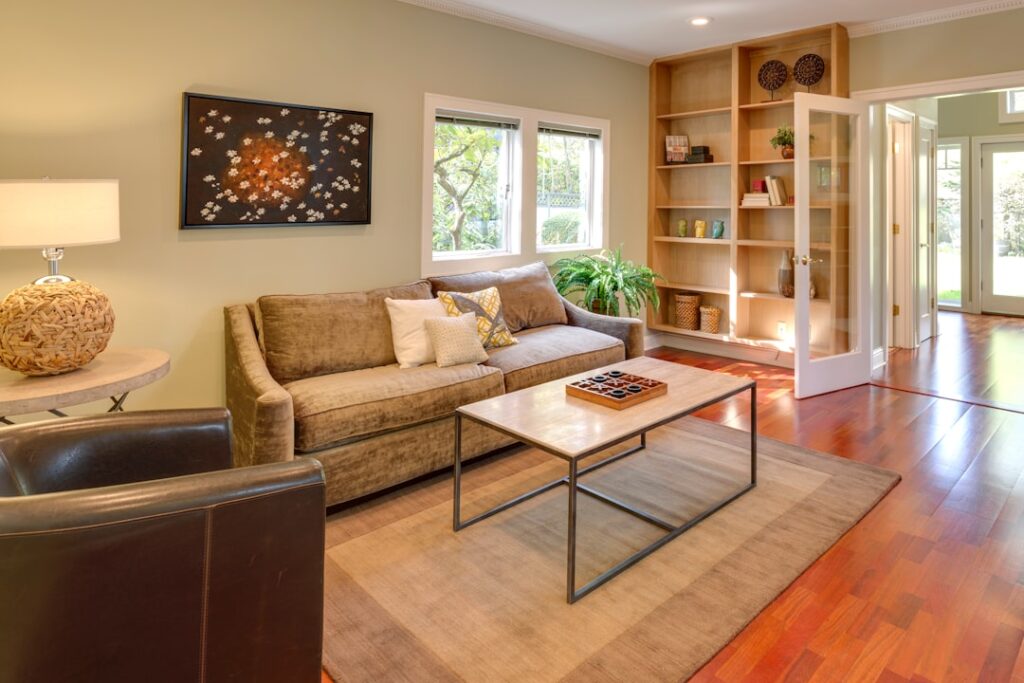
- Front legs on — The front legs of the sofa and chairs rest on the rug while the back legs sit on the floor. This is the most popular and versatile approach for typical living rooms.
- All legs off (floating) — The rug sits entirely in front of the seating, defining a central zone. Reserve this for small rooms or apartments where a tiny rug is unavoidable, and keep at least the coffee table on it.
For most homes, the “front legs on” method delivers the best balance of cohesion and value.
The Border Rule
Leave a consistent strip of bare floor showing around the rug rather than running it wall to wall. The ideal border is roughly 8 to 24 inches of exposed flooring on all sides, with 10 to 20 inches being the sweet spot for most rooms.
This frame of floor lets the rug read as an intentional design element rather than wall-to-wall carpet. Keep the border even on all sides so the rug looks centered and deliberate. In a very large open room, you can run a slightly wider border; in a small room, stay near the lower end.
Matching Rug Size to Room
Standard rug sizes line up with common living room dimensions. Here is a quick guide:
- 5×8 feet — Small living rooms or apartments; usually a “front legs off” floating placement.
- 8×10 feet — The most common living room size, ideal for a “front legs on” layout with a standard sofa and two chairs.
- 9×12 feet — Larger rooms; can achieve “all legs on” with a typical seating group.
- 10×14 feet and up — Great rooms and open-concept spaces where you want all furniture fully on the rug.
Measure your seating arrangement, then choose the rug that lets the front legs reach comfortably with that 8-to-24-inch border to spare.
Centering and Alignment
Align the rug with the primary seating group, not necessarily the geometric center of the room. The rug should sit square to the sofa and parallel to the longest wall so the whole arrangement feels organized.
Allow about 18 inches between the front edge of the sofa and the coffee table, and make sure the coffee table sits centered on the rug. In open-plan spaces, use the rug to carve out the living zone distinctly from the dining or kitchen areas.
Shape, Pile, and Practical Choices
Rectangular rugs suit the vast majority of living rooms because furniture is rectangular. Round rugs work in small, square seating nooks or under a round table. For pile, a low to medium pile is the most practical in a high-traffic living room, while a plush high pile adds cozy luxury in a formal sitting area.
Always use a quality rug pad underneath. It keeps the rug from sliding, adds cushioning, protects the floor beneath, and makes the rug feel more substantial underfoot. A pad cut about an inch smaller than the rug on all sides stays hidden.
Layering and Color Tips
If your existing rug is too small to replace, layering a smaller patterned rug over a large neutral one (like jute or sisal) is a designer trick that achieves correct sizing while adding texture. Keep the base rug big enough to satisfy the leg and border rules.
For color, a rug can either ground a busy room with a calm neutral or become the statement piece that ties the palette together. Pull one or two accent colors from the rug into your pillows and decor to make the whole room feel cohesive.
Common Mistakes to Avoid
A handful of errors show up again and again in living rooms. The biggest is the too-small rug that strands the furniture and floats like an island; sizing up fixes it instantly. Another is pushing all furniture against the walls and leaving a small rug marooned in the middle, which disconnects the seating from the floor covering entirely.
Watch the proportions too. A rug should relate to the seating group, not be crammed wall to wall, and it should not stop awkwardly halfway under the sofa with the front legs hanging off the edge. Inconsistent borders, wide on one side and tight on another, make a room look unbalanced even when everything else is right.
Rugs Over Carpet and Hard Floors
The rules hold whether you have hardwood, tile, or wall-to-wall carpet. Over hard floors, a rug warms the space and absorbs sound, and a good pad keeps it from sliding. Over existing carpet, a rug can still define a seating zone and add pattern, just choose a low-pile rug and a specialty pad designed to grip carpet so it does not creep underfoot.
In either case, the leg placement and border rules still apply. The rug should be large enough to anchor the seating with at least the front legs on it, framed by an even strip of the floor or carpet around the edges.
Putting the Rules Together
Get these living room rug rules right and the rest of the room falls into place: size up rather than down, set at least the front legs of your seating on the rug, leave an even 8-to-24-inch border of floor showing, and center everything on the primary seating group. Add a good rug pad, choose a practical pile, and pull your accent colors through the space. Do that, and your rug will anchor the room exactly the way it is supposed to.