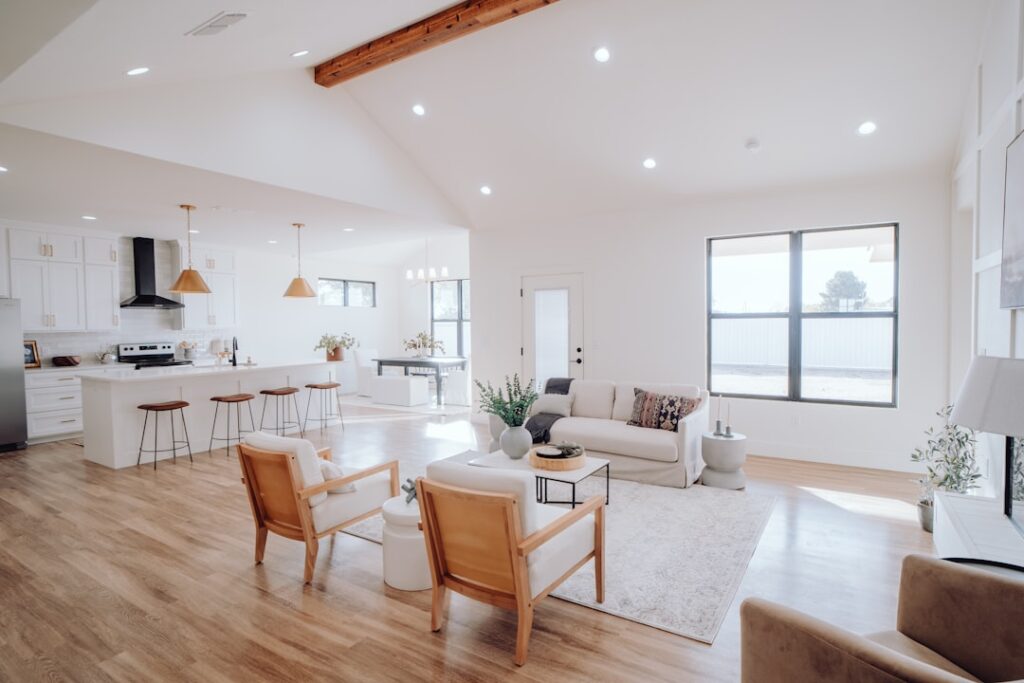
Running one floor from the front door to the back bedroom is the single biggest design shift in residential flooring over the last 15 years. Open-concept layouts demanded it, real estate agents started staging it, and rigid-core vinyl made it affordable. But choosing the same flooring throughout house isn’t just an aesthetic decision. It changes how rooms feel, how much you spend, and how forgiving your floor is in the bathroom, kitchen, and basement. The honest answer is yes, with limits.
Why Continuity Reads as Upscale
A single flooring material visually expands a home. The eye doesn’t stop at room transitions, so 1,800 square feet feels closer to 2,200. Real estate photography sells homes faster when there are no jarring threshold breaks between hallway carpet, kitchen tile, and living room hardwood. National Association of Realtors data has consistently linked uniform flooring with shorter days-on-market.
Beyond resale, continuity simplifies furniture placement. Area rugs define zones instead of installed flooring doing the work. Move your sofa from living room to den next year and you don’t fight with conflicting wood directions or tile lines.
Cost Math Across the Whole Home
Buying one material in volume cuts unit cost by 8 to 15 percent versus mixing three or four floors. A 2,000 square foot home in mid-grade engineered hardwood at $4.50 per square foot lands around $9,000 in material; a mixed scheme with carpet bedrooms, tile bath, and hardwood public areas often hits $11,500 to $13,000 for materials before labor.
Labor savings are larger. Installers charge mobilization fees per material type. One crew laying SPC vinyl throughout costs $2,500 to $4,000 in labor on a 2,000 square foot home. The same home with three different materials runs $5,500 to $7,500 because you’re paying carpet installers, tile setters, and hardwood crews separately, each with minimums.
The Material Almost Everyone Picks
Rigid-core LVP wins about 70 percent of whole-house installs we see today. It runs over concrete and plywood subfloors, handles bathroom moisture, survives kitchen spills, and works on stairs with stair-nose adapters. COREtec Pro Plus, Shaw Paragon Plus HD, and Mohawk SolidTech Plus all offer 20 to 22 mil wear layers with attached cork or IXPE underlayment at $3.99 to $6.99 per square foot.
Engineered hardwood is the second most common choice at around $5 to $9 per square foot. It looks higher-end than vinyl, but you’ll need to swap to porcelain in primary bathrooms and laundry rooms where water exposure is constant. That’s still continuity in the main living spaces, just not the wet rooms.
Where Same-Throughout Genuinely Fails
Hardwood in a full bathroom is a maintenance trap. Even with a urethane finish, a leaking toilet wax seal or a kid splashing in the tub will cup planks within months. Same goes for laundry rooms, mudrooms with direct exterior access, and finished basements below grade.
Tile in bedrooms is the opposite mistake: hard underfoot, cold in winter, and acoustically harsh. If you want porcelain throughout for durability, you’ll spend on radiant heat ($8 to $15 per square foot installed) and area rugs to make bedrooms livable.
True same flooring throughout house works best with vinyl or laminate. Use porcelain or wood-look tile in the bathrooms and call the rest continuous.
Direction, Plank Width, and Layout
Run planks parallel to the longest wall of the largest room, then carry that direction through hallways and into smaller rooms. Switching direction at a doorway looks unintentional unless you’re using a deliberate inlay transition.
Plank width matters for whole-house installs. Five to seven-inch planks read traditional and forgiving. Wider 8 to 9-inch planks photograph beautifully but expose subfloor imperfections more aggressively, requiring floor flattening to within 3/16 inch over a 10-foot radius.
Transitions to Wet Rooms
If you run LVP or engineered hardwood everywhere except bathrooms, plan transitions carefully. A flat Schluter Reno-T profile in brushed nickel handles flush-to-flush meetings between vinyl and tile cleanly. For height differences, a Reno-Ramp adapts up to 5/8 inch elegantly.
Avoid wood T-moldings between vinyl and tile. The vinyl’s slight movement against the rigid tile edge causes the T-molding to lift within a year. Spend the $25 to $40 per linear foot on a Schluter aluminum profile.
Brand Spotlight: COREtec and Mohawk RevWood
COREtec Pro Plus Enhanced Plank in oak visuals has become the default whole-house spec for builders and remodelers. The 7 by 48 inch planks with 20 mil wear and attached cork pad install over almost any subfloor with minimal prep. Pricing at $4.50 to $5.99 per square foot at flooring stores undercuts the equivalent engineered hardwood by half.
For homeowners who want a wood feel underfoot but full waterproofing, Mohawk RevWood Plus uses a wood-composite core with a high-pressure laminate top layer. At $4.79 to $5.79 per square foot, it’s quieter than vinyl and looks more convincing than budget laminate.
Long-Term Living With One Floor
Plan for replacement, not repair. When SPC vinyl scratches deep enough to expose the core, the patch never matches. Order 10 to 15 percent overage at install and store the extra in climate-controlled space for inevitable repairs after furniture drops or pet damage.
Vacuum weekly with a hard-floor brush head. Damp-mop monthly with manufacturer-approved cleaner (Bona for hardwood, Shaw R2X for vinyl). Skip steam mops on every floor type. Done right, the same flooring throughout house ages as one cohesive surface for 15 to 25 years.
The Verdict
Choose continuous flooring if you have an open layout, you’re staying long enough to enjoy it, and you accept tile in wet rooms. Skip it if you have distinct architectural zones, formal-and-casual program separation, or strong personal preferences that conflict with one material doing everything. For most homes built after 1990, one floor wins on cost, resale, and daily livability.
Prefer to explore on your own?
See how new flooring looks in your actual room in seconds — free, no signup.
Try the free Floor Studio →