
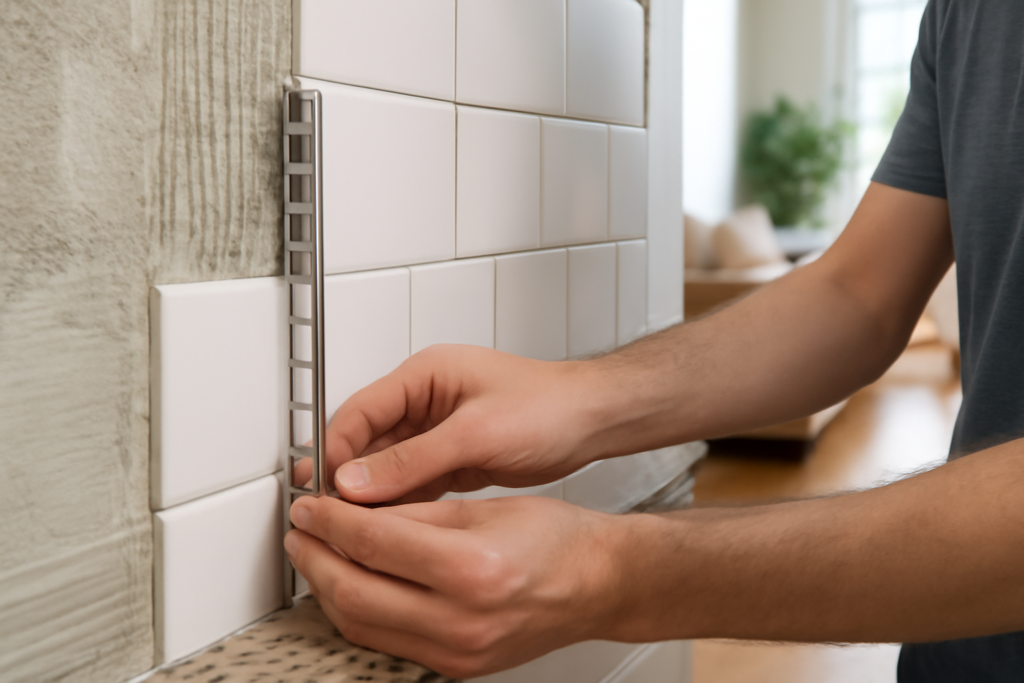
The line between a DIY tile job and a professional one often comes down to a thin strip of metal at the edges. Schluter tile edge trim, made by Schluter Systems, has become the industry standard for finishing and protecting exposed tile edges. These extruded metal profiles tuck under the tile and give you a clean, durable border at countertops, backsplashes, shower walls, and floor transitions. This guide covers the main profiles, the materials and finishes available, and how to install them correctly.
Why Edge Trim Matters
Exposed tile edges are both unsightly and vulnerable. A cut edge can show the unglazed body of the tile, feel sharp, and chip from everyday impact. Edge trim solves all three problems at once. It covers the raw edge for a finished look, protects the corner from damage, and creates a clean transition where tile ends or meets another surface. Schluter profiles do this with a slim, modern face that integrates into the installation rather than looking like an afterthought.
The Two Most Common Profiles
Schluter makes a broad lineup, but two profiles cover the vast majority of residential uses.
- Schluter-JOLLY features a slightly rounded or angled face that finishes outside corners and edges of walls, backsplashes, and countertops. It is the everyday workhorse for wall tile edges.
- Schluter-RONDEC has a distinctly rounded, bullnose-like profile that gives a soft, finished edge, popular on countertops and shower curbs where a smooth corner is desired.
Both install the same way, with a perforated anchoring leg set into the thinset beneath the tile. The choice between them is mostly about the look of the visible edge.
Materials and Finishes
Schluter profiles come in a range of materials, each suited to different settings.
- Anodized aluminum is the most common and affordable, available in many finishes
- Stainless steel offers maximum durability and is ideal for high-wear or wet areas
- Brass and other metals provide warmer or specialty looks
- Color-coated aluminum matches grout colors for a blended appearance
Finishes range from brushed nickel and chrome to matte black, brass, and bronze, so you can coordinate the trim with your faucets, hardware, and overall design. Matching the trim finish to your fixtures is one of the easiest ways to make a tile installation feel cohesive.
Where to Use Schluter Edge Trim
These profiles solve edges all over the home. Common applications include:
- Backsplash edges where tile ends against the wall or counter
- Shower wall corners and the top of tiled walls
- Tiled countertop edges and curbs
- Outside corners on tiled columns and half-walls
- Transitions between tile and adjacent surfaces
Anywhere a tile edge is exposed and would otherwise need bullnose or a polished edge, a Schluter profile offers a clean, durable alternative.
How to Install Schluter Tile Edge
Installation is straightforward, but it must happen as you set the surrounding tile, since the anchoring leg gets buried.
- Measure and cut the profile to length with a hacksaw or metal-cutting miter saw, cutting 45-degree miters where two pieces meet at a corner
- Apply thinset along the edge where the trim will sit
- Embed the perforated leg into the thinset so the trim face sits flush with the tile surface
- Set the adjacent tile tight against the trim, maintaining a normal grout-width gap on the face
- Grout the joint between the tile and the trim along with the rest of the installation
The most important point is to plan for the trim before you set the bordering tiles, since the anchoring leg has to be covered by the field tile to hold securely.
Tips for a Clean Result
A few details elevate the finish. Cut miters carefully at corners so the two faces meet in a tight, clean line. Keep the trim face perfectly flush with the tile so there is no step between them. Wipe grout off the metal promptly, since some finishes can be marred by abrasive cleaning. And choose the right profile height to match your exact tile thickness, since Schluter sizes profiles to common tile depths for a flush fit.
Choosing the Right Profile and Size
Selecting the correct profile comes down to two questions: what look you want and what tile thickness you have. For the visible shape, JOLLY gives a crisp, slightly angled edge that suits modern and transitional designs, while RONDEC offers a soft, rounded edge that feels gentler and works especially well on countertops and curbs. For sizing, Schluter makes each profile in heights matched to common tile thicknesses, so measure your tile and choose a profile that sits flush with the tile face. A profile that is too tall leaves a lip above the tile; one that is too short leaves the tile edge proud of the trim. Getting the height right is what makes the finished edge look integrated.
Estimating Materials
Before ordering, walk the project and measure every edge that will receive trim. Add the lengths together, then account for waste from miter cuts at corners, which consume a bit of each piece. Adding roughly 10 percent over your measured footage covers cuts and the occasional error. Order all the trim in one go from the same finish batch, since finishes can vary slightly between production runs, and a mismatched piece stands out. Pick up a few extra connectors or corner pieces if your design uses them, so you are not held up by a missing part midway through.
Schluter Trim Versus Bullnose and Other Edges
Before metal profiles became common, the standard way to finish a tile edge was a bullnose, a field tile with one rounded, glazed edge. Bullnose still has its place, but it carries drawbacks that explain why so many installers reach for Schluter trim instead. Many modern tile lines, especially large-format and rectified porcelain, are not made with matching bullnose pieces, leaving you with a raw cut edge and no factory-finished option.
A Schluter profile sidesteps that problem entirely, since the metal trim works with any tile and gives a crisp, contemporary line that bullnose cannot match. Compared with a polished or mitered edge, which requires special tools and skill to cut cleanly, the trim is far more forgiving for a DIYer because the metal hides the cut tile edge. The trade-off is a visible metal line on the face, so if you want the edge to disappear, a color-matched profile or a mitered tile edge may suit better. For most homeowners, the durability and ease of a metal profile win out.
Final Thoughts
Schluter tile edge trim is the simplest way to give a tile project a finished, durable, professional edge. With the JOLLY profile for crisp outside corners and the RONDEC profile for a soft rounded finish, plus a wide range of metals and finishes, there is a profile for nearly every application. Plan for it as you tile, match the finish to your fixtures, and your edges will look like the work of a seasoned installer.
Prefer to explore on your own?
See how new flooring looks in your actual room in seconds — free, no signup.
Try the free Floor Studio →

